Great Film Directors According to Dachshunds
GREAT FILM DIRECTORS
ACCORDING TO DACHSHUNDS
Twenty cinematic lives, considerable length, and one very low camera angle
DAS BUBO
BOOKS OF CONSIDERABLE LENGTH
ABOUT THIS BOOK
This book treats the great film director as both historical figure and visual species. Each portrait replaces the human filmmaker with a dachshund while preserving the director’s recognizable creative world: Hitchcock receives his bird, Kubrick his corridor, Fellini his Roman carnival, and Welles the low angle that can make even a modestly sized authority appear architectural.
The essays that follow are serious biographical portraits rather than caption-length jokes. They trace training, major works, methods, influence, and recurring themes. The humor is deliberately narrow and affectionate. It enters where the parody image opens a door: a tennis ball crossing Nolan’s timelines, an alien egg attracting Ridley Scottie’s professionally inadvisable curiosity, or George Lucasage discovering that the domestic vacuum has joined the dark side.
The sequence alternates a full-page image with a full-page essay. The image offers instant recognition; the text restores context and complexity. The directors represented here differ enormously in nationality, generation, politics, genre, and method. What unites them is authorship strong enough to survive transformation into an exceptionally long dog.
Biographical facts were checked against institutional biographies, festival and awards records, official filmmaker materials, major archives, and established film histories. The writing reflects information available through August 2026. Parody names and canine interpretations are original editorial inventions. No dachshund was asked to approve a final cut, though several behaved as if contractual consultation had been promised.
THE DIRECTORS
| 01 Alfred Hitchdog | 11 Federico Fellini-Weenie |
|---|---|
| 02 Steven Spielbark | 12 David Leash |
| 03 Stanley Kubrickle | 13 Pedro Almodogvar |
| 04 Martin Scorsausage | 14 Spike Leash |
| 05 Quentin Taranti-nose | 15 Ridley Scottie |
| 06 Francis Ford Coppawla | 16 James Camerhound |
| 07 Wes Anderhound | 17 Guillermo del Toroso |
| 08 Tim Burrowton | 18 Sofia Coppawla |
| 09 Christopher Nolang | 19 George Lucasage |
| 10 Akira Kurosausage | 20 Orson Wellesh |
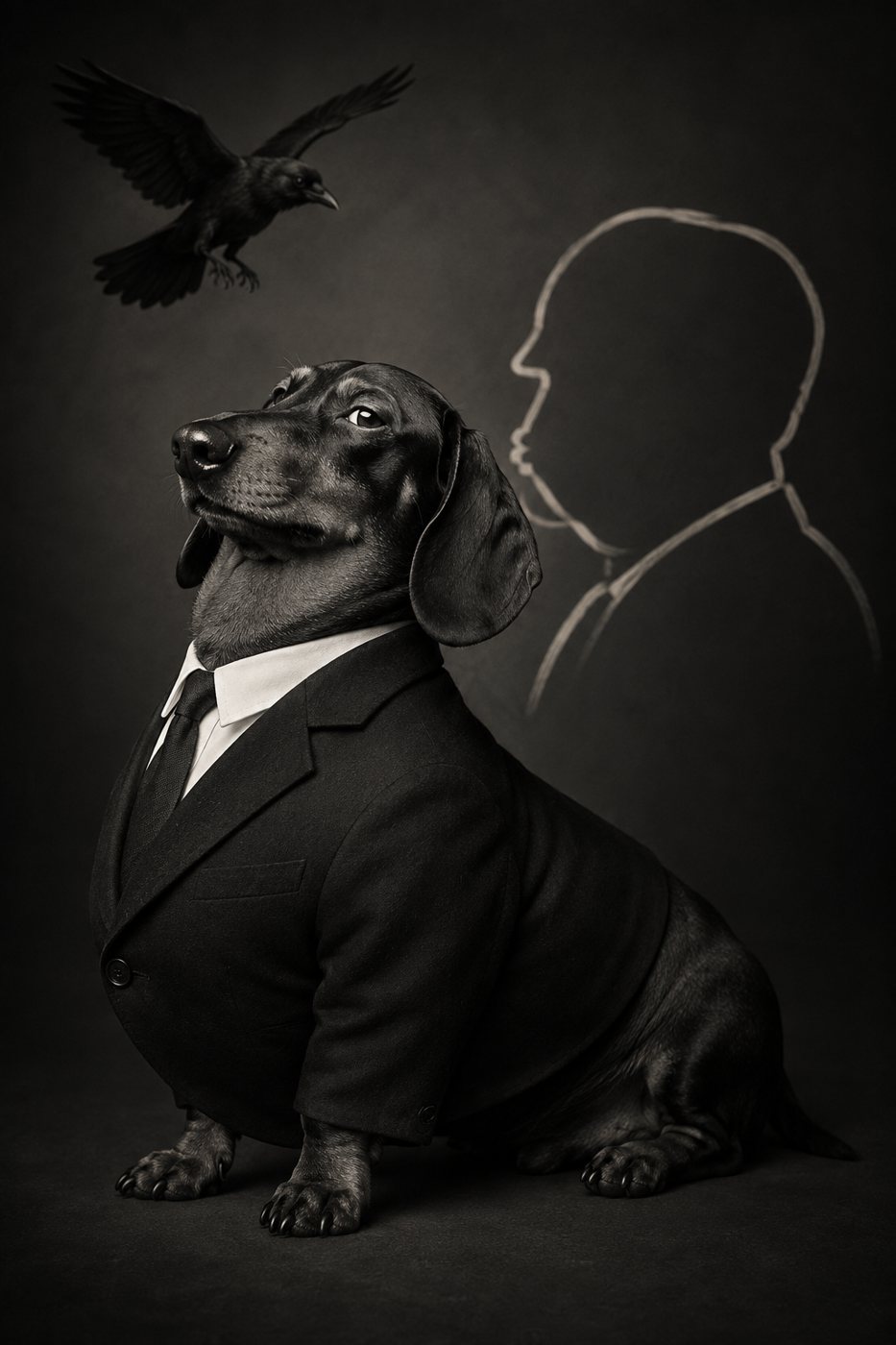
Alfred Hitchdog
ALFRED HITCHCOCK · 1899-1980
Alfred Hitchcock understood that suspense is not simply the arrival of danger. It is the terrible courtesy of knowing that danger is already in the room and being asked to sit politely beside it. Born in Leytonstone, London, in 1899, Hitchcock entered cinema during the silent period, first working in title design, art direction, screenwriting, and assistant direction. Those beginnings mattered. Long before sound could explain a character’s fear, Hitchcock learned to make a glance, a staircase, a doorway, or an inconveniently placed glass of milk carry the argument.
His British career produced increasingly confident thrillers, including The Lodger, Blackmail, The 39 Steps, and The Lady Vanishes. Blackmail, released in 1929, became one of the landmarks of early British sound cinema. By the time Hitchcock moved into Hollywood, his central interests were already established: innocent people accused of crimes, respectable surfaces hiding private obsessions, guilt moving faster than evidence, and ordinary architecture becoming morally unreliable. Rebecca brought him immediate American prestige, while Notorious, Strangers on a Train, Rear Window, Vertigo, North by Northwest, Psycho, and The Birds made his name almost synonymous with suspense.
Hitchcock’s greatness lies partly in precision. He did not merely film stories; he engineered the audience’s attention. In Rear Window, the viewer is made complicit in voyeurism. In Vertigo, romantic longing becomes an act of reconstruction and control. In Psycho, editing, sound, and expectation dismantle the security of the classical Hollywood narrative. He famously distinguished suspense from surprise by imagining a bomb beneath a table: surprise is the explosion; suspense is allowing the audience to see the bomb while the characters continue their conversation. It remains one of the clearest explanations of cinematic tension ever offered, and also a useful description of living with a dachshund who has disappeared beneath the dining table.
His carefully cultivated public persona amplified the work. The solemn profile, dry television introductions, brief film cameos, and grave delivery turned Hitchcock himself into a recognizable cultural image. Yet the humor was never separate from the darkness. His films are often very funny precisely because social manners continue while catastrophe approaches. The joke is not that danger is harmless. The joke is that humans remain absurdly formal in its presence.
In this portrait, Alfred Hitchdog stands beneath a circling bird and beside the famous outline of his human counterpart. The dachshund’s elevated chin captures the director’s mixture of authority, mischief, and mild disappointment with everyone else’s preparation. Hitchcock built entire films around the gap between what appears respectable and what is actually happening. A dachshund in a tailored suit understands that principle instinctively: dignity is maintained, motives remain private, and the suspicious rustling behind the curtain will be investigated at a time of his own choosing.
Landmarks: The 39 Steps, Notorious, Rear Window, Vertigo, North by Northwest, Psycho, The Birds
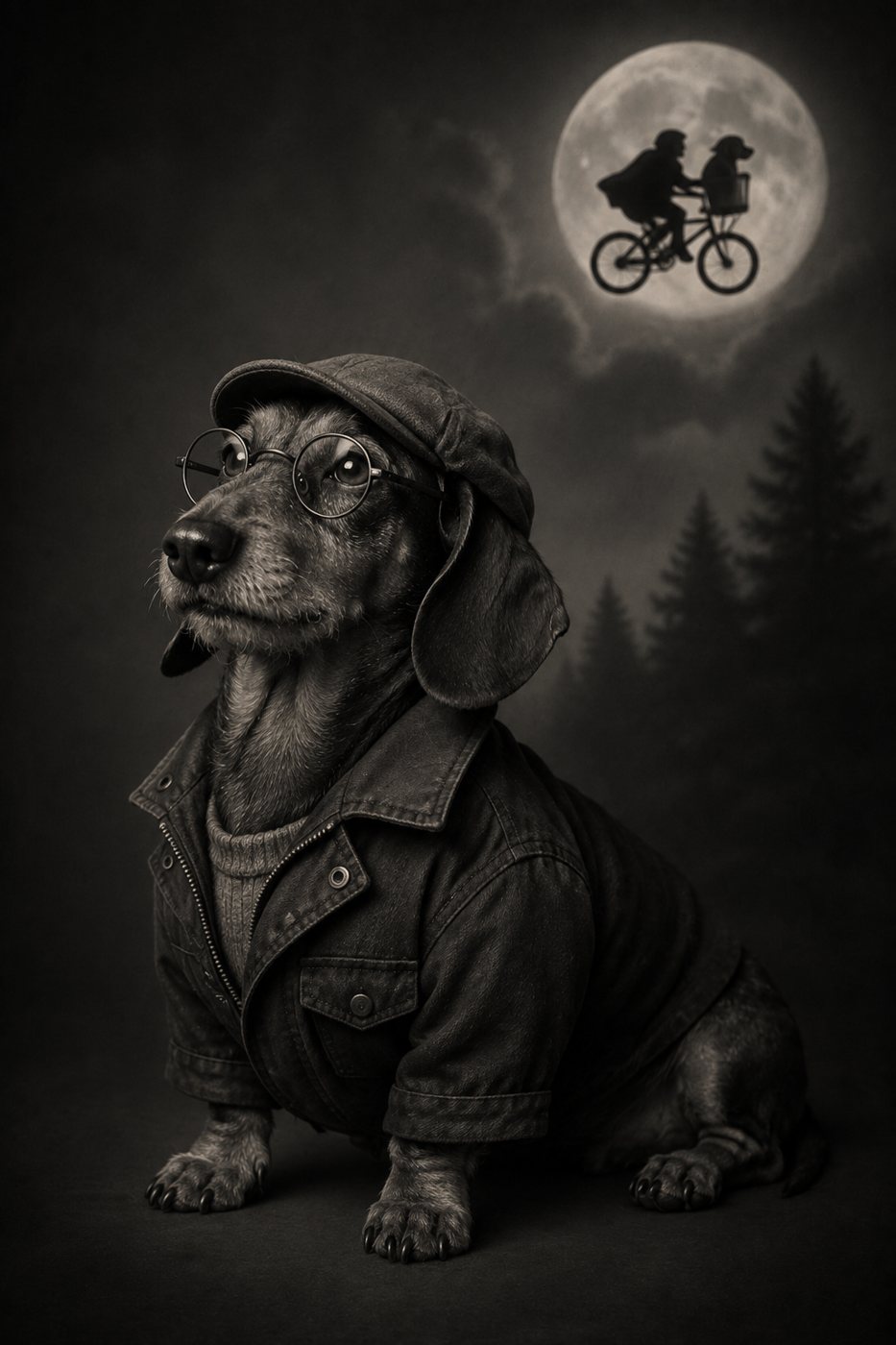
Steven Spielbark
STEVEN SPIELBERG · BORN 1946
Steven Spielberg has spent more than five decades turning astonishment into a cinematic grammar. Born in Cincinnati in 1946 and raised largely in Arizona and California, he began making short films as a child, using family members, neighborhood landscapes, and whatever effects could be assembled without a studio accounting department. His early professional work in television culminated in Duel, a lean 1971 thriller in which an ordinary motorist is pursued by a monstrous truck. The film already contained a Spielberg signature: an everyday person is suddenly placed before something enormous, unknowable, and moving directly toward him.
Jaws transformed that instinct into a global phenomenon. Its famously difficult production forced Spielberg to suggest the shark more often than he could show it, and the limitation sharpened the suspense. The film became a defining modern blockbuster, but Spielberg did not settle into one scale or genre. Close Encounters of the Third Kind and E.T. the Extra-Terrestrial found wonder in contact with the unknown. Raiders of the Lost Ark revived serial adventure with ruthless efficiency. Jurassic Park made digital creatures feel physically present, while Schindler’s List, Saving Private Ryan, Amistad, Munich, Lincoln, and The Post confronted history, memory, violence, and moral responsibility.
Spielberg’s popular touch is sometimes mistaken for simplicity. In fact, his films are highly controlled acts of emotional perspective. He often frames events through children, outsiders, or families under pressure. Light enters rooms with almost religious force. Faces become landscapes of recognition. A character looks upward, and the audience is invited to see the impossible through that gaze before the spectacle itself arrives. He understands that visual effects matter most when attached to human vulnerability. The dinosaur is impressive; the trembling glass of water is unforgettable.
His career also extends beyond directing. Through producing, studio-building, and support for other filmmakers, Spielberg helped shape modern American entertainment. After making Schindler’s List, he established the Shoah Foundation to record and preserve testimonies of Holocaust survivors and witnesses. That work demonstrates the serious foundation beneath the wonder: memory must be protected, stories must be transmitted, and technology is valuable when it helps human experience survive.
Steven Spielbark therefore appears not beside a spaceship or shark but beneath a moon crossed by a flying bicycle. It is the correct emblem. Spielberg’s cinema often begins with loneliness and ends with connection, though not always without damage. The dachshund director wears practical glasses and a working jacket, because miracles still require schedules, lenses, permits, and someone willing to ask whether the bicycle basket has been properly secured. His gift is to make audiences feel that cinema itself can briefly lift off the ground. His professional burden is that, once airborne, everyone expects him to land precisely on the emotional mark.
Landmarks: Jaws, Close Encounters, Raiders of the Lost Ark, E.T., Schindler’s List, Jurassic Park, Saving Private Ryan
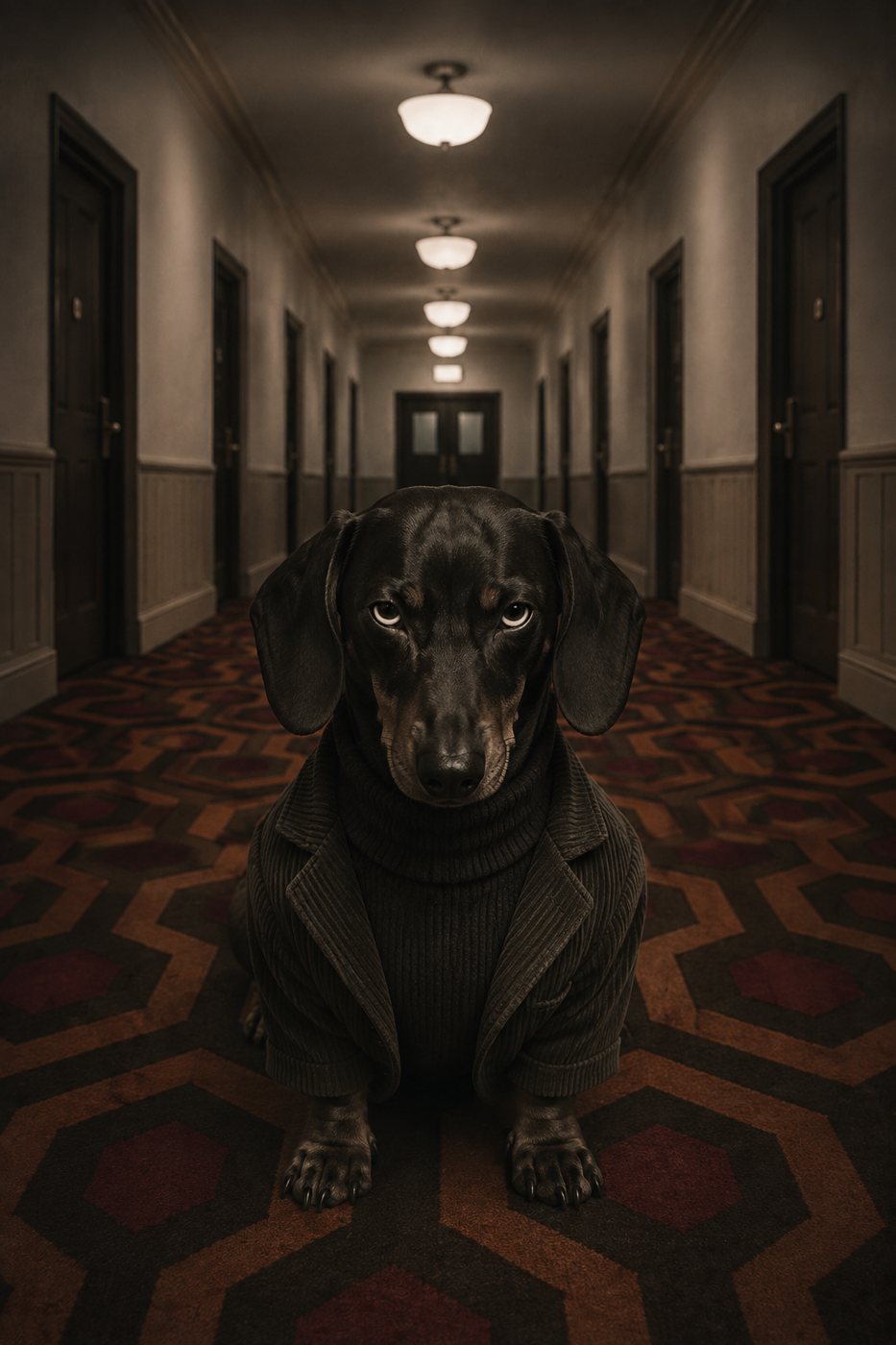
Stanley Kubrickle
STANLEY KUBRICK · 1928-1999
Stanley Kubrick made relatively few feature films, but each appears to have arrived from a private research institute devoted to the controlled destabilization of the audience. Born in the Bronx in 1928, Kubrick began as a photographer for Look magazine. Photojournalism trained him to compose quickly, observe behavior, and tell stories through sequences of images. Chess, another early passion, reinforced habits of calculation, patience, and strategic anticipation. Both disciplines remained visible in his filmmaking: every frame seems considered, and every character eventually discovers that the board is larger than expected.
After short documentaries and low-budget features, Kubrick gained attention with The Killing and Paths of Glory. Spartacus gave him experience with large-scale studio production, but he increasingly sought independence and control. Working mainly from Britain, he moved through genres without becoming contained by any of them. Lolita became a dark comedy of self-deception. Dr. Strangelove transformed nuclear annihilation into bureaucratic farce. 2001: A Space Odyssey treated science fiction as cosmic architecture. A Clockwork Orange examined violence, conditioning, and social hypocrisy. Barry Lyndon used specially adapted lenses and candlelit interiors to turn history into an exquisite museum of ambition. The Shining made domestic space geometrically hostile. Full Metal Jacket divided war into institutional manufacture and moral disintegration. Eyes Wide Shut closed his career with a nocturnal study of desire, jealousy, and social performance.
Kubrick’s reputation for perfectionism is deserved, though the mythology can obscure the purpose. His many takes, detailed research, technical experiments, and insistence on design were not simply displays of control. They were methods for finding a specific tone: behavior pushed beyond habit, environments that dominate the people inside them, and images sufficiently exact to remain unsettling decades later. His films often present systems - military, political, technological, sexual, or architectural - that claim rational order while producing madness.
The famous “Kubrick stare,” with the head lowered and eyes raised, condenses that tension into a face. It suggests calculation, threat, and the possibility that someone has already read the final page. The perfectly symmetrical corridor in this portrait belongs to the Overlook Hotel, but also to Kubrick’s broader visual world, where symmetry does not reassure. It traps.
Stanley Kubrickle sits at the corridor’s center with the composure of a director who has approved every lamp, measured every carpet motif, and remains unconvinced by the continuity report. A dachshund is an unusually appropriate guardian of Kubrickian space: low to the ground, highly observant, resistant to casual instruction, and capable of holding a stare far longer than social convention recommends. Somewhere beyond the vanishing point, a door has opened. Kubrickle already knows why. He is waiting for the rest of us to notice.
Landmarks: Paths of Glory, Dr. Strangelove, 2001, A Clockwork Orange, Barry Lyndon, The Shining, Full Metal Jacket
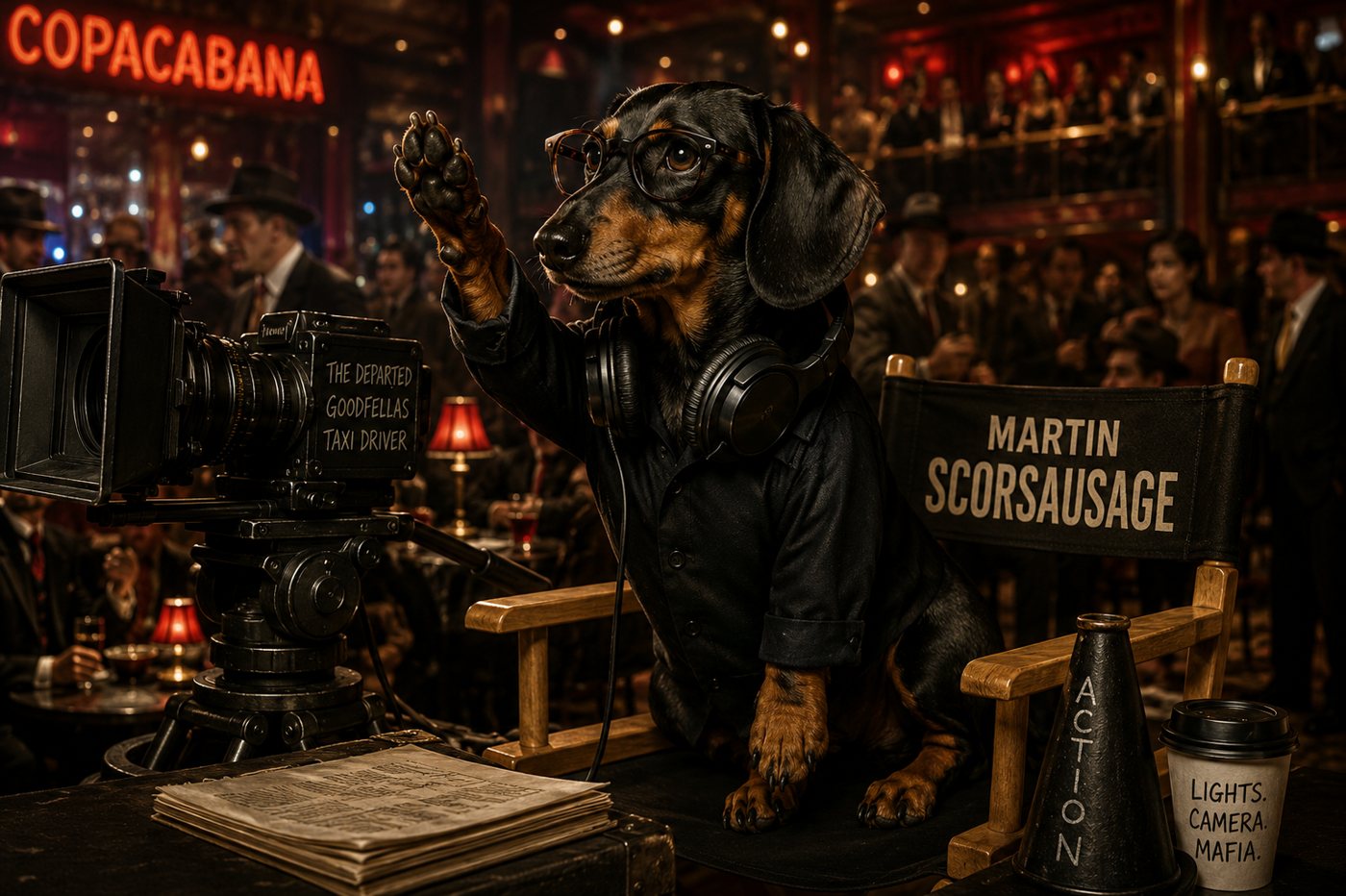
Martin Scorsausage
MARTIN SCORSESE · BORN 1942
Martin Scorsese’s cinema moves with the velocity of memory, temptation, music, and guilt. Born in Queens in 1942 and raised in Manhattan’s Little Italy, he grew up with severe asthma, which limited participation in street life and made churches and movie theaters central spaces of observation. That combination - Catholic ritual, neighborhood performance, violence, family loyalty, and cinema as an alternative universe - became one of the richest foundations in modern American film.
After studying and teaching at New York University, Scorsese developed his voice through short films and early features before Mean Streets announced a new kind of urban filmmaking. The film’s handheld energy, popular music, improvisational behavior, and moral unease flowed directly into Taxi Driver, Raging Bull, The King of Comedy, and Goodfellas. His collaborations with Robert De Niro and later Leonardo DiCaprio became among the most sustained director-actor partnerships in cinema, but Scorsese’s range is far wider than the gangster label suggests. The Last Temptation of Christ, The Age of Innocence, Kundun, Hugo, Silence, The Irishman, and Killers of the Flower Moon reveal a filmmaker repeatedly examining faith, power, complicity, and the stories societies tell to protect themselves.
Scorsese’s technique is exuberant but never merely decorative. The long tracking shot into the Copacabana in Goodfellas turns seduction into movement: doors open, rules bend, tables appear, and the audience understands the attraction of criminal privilege before the consequences arrive. Freeze frames, voice-over, sudden violence, accelerated editing, and carefully chosen music place viewers inside unstable moral systems. He can make corruption thrilling without pretending it is harmless. That balance is difficult, and he has spent a career refusing easy absolution.
His contribution to film culture extends beyond his own movies. Through The Film Foundation and the World Cinema Project, Scorsese has advocated for restoration, preservation, and access to films from many countries and traditions. His documentaries and public conversations reveal a historian’s generosity. He is not only an author of cinema but one of its most articulate custodians.
Martin Scorsausage directs from the center of a crowded nightclub, glasses alert, paw raised, camera ready. Around him, elegantly dressed dachshund gangsters wait for the shot and possibly for the check. The joke belongs naturally to Scorsese’s world: everyone is performing confidence, everyone knows the room’s hierarchy, and no one is certain who has been invited through the kitchen. The director’s task is to choreograph the movement without losing the moral cost. Scorsausage appears delighted by the complexity. He has located the camera, selected the record, and arranged for the audience to enjoy itself just enough to become implicated.
Landmarks: Mean Streets, Taxi Driver, Raging Bull, Goodfellas, The Age of Innocence, The Departed, Silence
Quentin Taranti-nose
QUENTIN TARANTINO · BORN 1963
Quentin Tarantino entered American cinema with the confidence of someone who had spent years studying movies in public, passionately and without asking permission from a syllabus. Born in Knoxville in 1963 and raised in the Los Angeles area, he worked at the Video Archives rental store in Manhattan Beach, where long conversations about genre, actors, directors, and forgotten exploitation films became an informal education. That background shaped a career built not on polite quotation but on collision: crime films with comedy, martial arts with melodrama, westerns with historical revenge, and extended dialogue with sudden physical consequence.
Reservoir Dogs established the essential method. A robbery largely occurs off-screen, while criminals argue, perform masculinity, reveal loyalties, and gradually destroy one another in a warehouse. Pulp Fiction expanded the approach through nonlinear structure, pop-cultural conversation, abrupt shifts in tone, and a belief that minor characters deserve major entrances. Jackie Brown showed a quieter emotional register and deep affection for performance. Kill Bill fused samurai cinema, kung fu, anime, westerns, and revenge tragedy. Inglourious Basterds and Django Unchained rewrote history through violent fantasy, while The Hateful Eight turned a room into a pressure chamber of suspicion. Once Upon a Time in Hollywood transformed late-1960s Los Angeles into an alternate memory of an industry changing beneath its stars.
Tarantino’s dialogue is often discussed as if it exists independently of direction. In fact, the conversations work because of framing, rhythm, casting, silence, and the threat that language may fail. His characters talk to establish power, delay action, test knowledge, and narrate themselves into significance. He also treats film history as a living archive. His advocacy for repertory exhibition, celluloid projection, and the New Beverly Cinema reflects a conviction that older movies should be experienced, not merely referenced.
The violence remains central and contested. Tarantino uses exaggeration, genre conventions, and theatricality, but the pleasure he takes in cinematic revenge has prompted serious debate. His work invites audiences to recognize both the artificial construction and the emotional charge of vengeance. He is a director of surfaces who knows that surfaces can still cut.
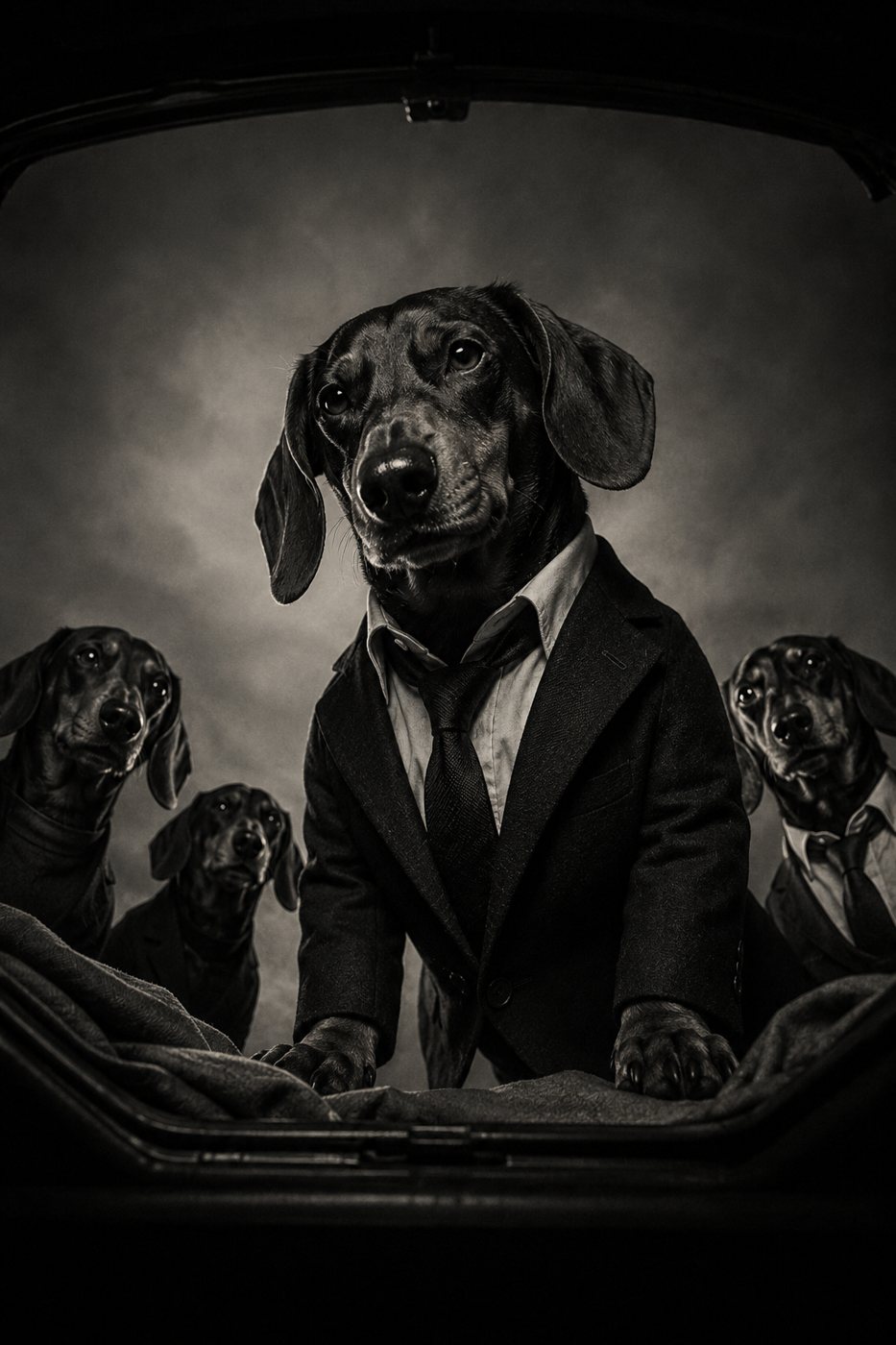
Quentin Taranti-nose is presented through the low-angle trunk shot, one of the director’s favorite compositional jokes. Several suited dachshunds peer downward with professional concern, suggesting that whatever is inside the trunk has not completed the necessary paperwork. The perspective makes the dogs monumental and the viewer extremely available. Tarantino’s cinema has always understood that camera placement can turn a conversation into a threat. Here, the central dachshund appears to be deciding whether the situation requires dialogue, a soundtrack cue, or both. No one should assume the scene will be brief.
Landmarks: Reservoir Dogs, Pulp Fiction, Jackie Brown, Kill Bill, Inglourious Basterds, Django Unchained
Francis Ford Coppawla
FRANCIS FORD COPPOLA · BORN 1939
Francis Ford Coppola’s career is one of American cinema’s great arguments between artistic ambition and industrial reality. Born in Detroit in 1939 and raised in a creative Italian American family, Coppola endured polio as a child and spent long periods isolated, experimenting with puppets, sound, and homemade performance. He studied theater at Hofstra and filmmaking at UCLA, worked in the resourceful orbit of Roger Corman, and wrote screenplays before directing the films that would place him at the center of the New Hollywood generation.
His screenplay for Patton earned an Academy Award, but The Godfather changed the scale of his reputation. Coppola transformed Mario Puzo’s crime saga into a study of family, power, capitalism, ritual, and moral corrosion. The Godfather Part II expanded the form across generations and became one of the rare sequels regarded as the equal, or superior, of its predecessor. In the same extraordinary period, Coppola directed The Conversation, an intimate surveillance thriller about professional expertise and private guilt. Apocalypse Now then pushed production, finance, weather, health, and sanity toward the edge while attempting to translate Joseph Conrad’s colonial nightmare into the Vietnam War.
These films established Coppola as both master and gambler. His company American Zoetrope was conceived as an alternative creative community, a place where filmmakers might gain greater control over development and production. The dream repeatedly collided with debt, studio politics, and the unpredictable economics of ambitious cinema. Yet Coppola continued across genres and scales, directing The Outsiders, Rumble Fish, Peggy Sue Got Married, Bram Stoker’s Dracula, The Rainmaker, and later highly personal independent projects. Megalopolis, released in 2024 after decades of development, returned him to the grandest version of the wager: self-financed, divisive, extravagant, and unmistakably his.
Coppola’s influence also lies in his willingness to make filmmaking itself visible as a risk. He has never treated independence as comfort. For him, independence means accepting the consequences of one’s own decisions, including the alarming invoices. His achievements emerged not from stable control but from a repeated willingness to build a larger table and then discover who would help pay for it.
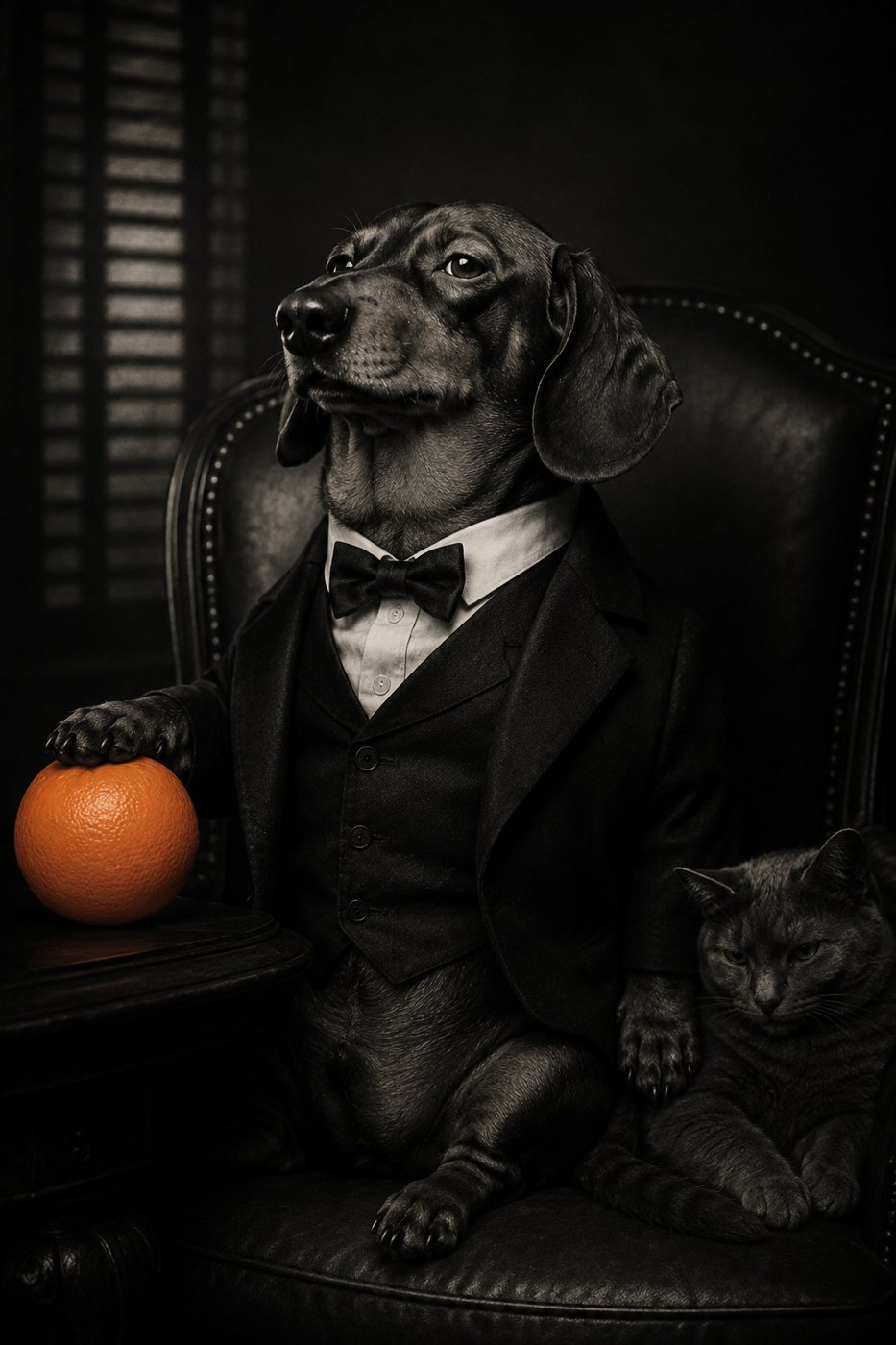
Francis Ford Coppawla sits in shadow beside an orange and a cat, immediately recognizable references to The Godfather’s visual world. The dachshund’s expression is calm because authority is most effective when it does not need to bark. One paw rests near the orange with the solemnity of an omen; the cat has already claimed the better portion of the chair. Coppola’s cinema understands that families are systems of affection, obligation, rivalry, and seating arrangements. The director may command the room, but the cat remains an independent producer.
Landmarks: The Godfather, The Conversation, The Godfather Part II, Apocalypse Now, Rumble Fish, Dracula

Wes Anderhound
WES ANDERSON · BORN 1969
Wes Anderson has created one of contemporary cinema’s most immediately identifiable visual languages. Born in Houston in 1969, he studied philosophy at the University of Texas at Austin, where he met Owen Wilson. Their collaboration produced the short and later feature version of Bottle Rocket, a modest crime comedy whose characters possessed enormous plans and limited operational competence. That combination - sincere feeling, elaborate preparation, and human inadequacy - became central to Anderson’s work.
Rushmore established his gift for presenting adolescent ambition with formal grandeur. The Royal Tenenbaums expanded the world into a literary family chronicle of gifted children, damaged adults, and carefully labeled rooms. The Life Aquatic with Steve Zissou, The Darjeeling Limited, Moonrise Kingdom, The Grand Budapest Hotel, The French Dispatch, Asteroid City, and The Phoenician Scheme developed increasingly intricate frames within frames. His stop-motion films Fantastic Mr. Fox and Isle of Dogs demonstrated that his approach was not simply a matter of photographing actors symmetrically. It was a complete method of world construction.
Anderson’s style is often reduced to centered compositions, pastel colors, lateral tracking shots, miniatures, chapter headings, and meticulously chosen typography. All are real, but they are not the whole achievement. Beneath the order lies grief. His characters build systems because life has already become disordered: parents fail, siblings compete, children disappear, friendships fracture, and elegant institutions decline. The visual precision creates distance, but the distance allows emotion to arrive without sentimentality. A perfectly arranged room can still contain someone who does not know how to apologize.
His films also depend on collaboration. Cinematographer Robert Yeoman, production designers, costume designers, composers, animators, and a recurring company of actors contribute to worlds that feel handmade even at substantial scale. Anderson’s Academy Award for the short film The Wonderful Story of Henry Sugar recognized a career that has moved fluidly between features, animation, theatrical artifice, and literary adaptation.
Wes Anderhound stands exactly at the center of a pink-and-mint hotel lobby. The luggage is balanced. The palms correspond. The arches agree with one another. Nothing has been left to the anarchic discretion of asymmetry. The dachshund concierge wears a fitted uniform and the expression of someone who has personally inspected every suitcase, although he would never discuss the contents. This is Anderson’s essential joke and tenderness: people, and dogs, arrange the visible world with obsessive care because the invisible world remains unmanageable. The hotel may be closing, the family may be collapsing, and the train may have departed, but the key fobs will remain in perfect numerical order.
Landmarks: Rushmore, The Royal Tenenbaums, Fantastic Mr. Fox, Moonrise Kingdom, The Grand Budapest Hotel
Tim Burrowton
TIM BURTON · BORN 1958
Tim Burton’s cinema belongs to outsiders who discover that the normal world is considerably stranger than the haunted one. Born in Burbank, California, in 1958, Burton grew up near the machinery of the entertainment industry while feeling detached from its sunny suburban image. Drawing, monster movies, animation, and the performances of Vincent Price offered an alternative vocabulary. At the California Institute of the Arts, Burton developed as an animator and visual artist before joining Disney, where his imagination was admired, encouraged, and not always considered suitable for the immediate assignment.
His early short Vincent, narrated by Price, introduced the essential Burton figure: a lonely child whose interior gothic universe is more vivid than his surroundings. The live-action short Frankenweenie and the success of Pee-wee’s Big Adventure led to Beetlejuice, Batman, and Edward Scissorhands. These films established his ability to combine studio-scale entertainment with a personal visual signature. Ed Wood celebrated artistic devotion without requiring conventional talent. The Nightmare Before Christmas, based on Burton’s story and designs and directed by Henry Selick, helped renew mainstream interest in stop-motion animation. Sleepy Hollow, Big Fish, Corpse Bride, Sweeney Todd, and the feature-length Frankenweenie continued his exploration of death, family, fantasy, and misunderstood creatures.
Burton’s worlds are built from crooked architecture, spirals, stripes, pale faces, elongated shadows, dead trees, and objects that seem to have developed personalities under insufficient supervision. Yet the emotional structure is often classical. His heroes seek acceptance, love, or a place where their difference is not treated as a technical defect. The grotesque becomes tender, while conventional respectability frequently reveals itself as predatory, hysterical, or merely beige.
As a lifelong draftsman, painter, and collector of visual ideas, Burton approaches films through design. Characters often seem to emerge from sketches that have acquired movement, costume, and unresolved childhood memories. His recurring collaborations with actors, composers, and craftspeople give the films a continuity that is less a brand than a private weather system.
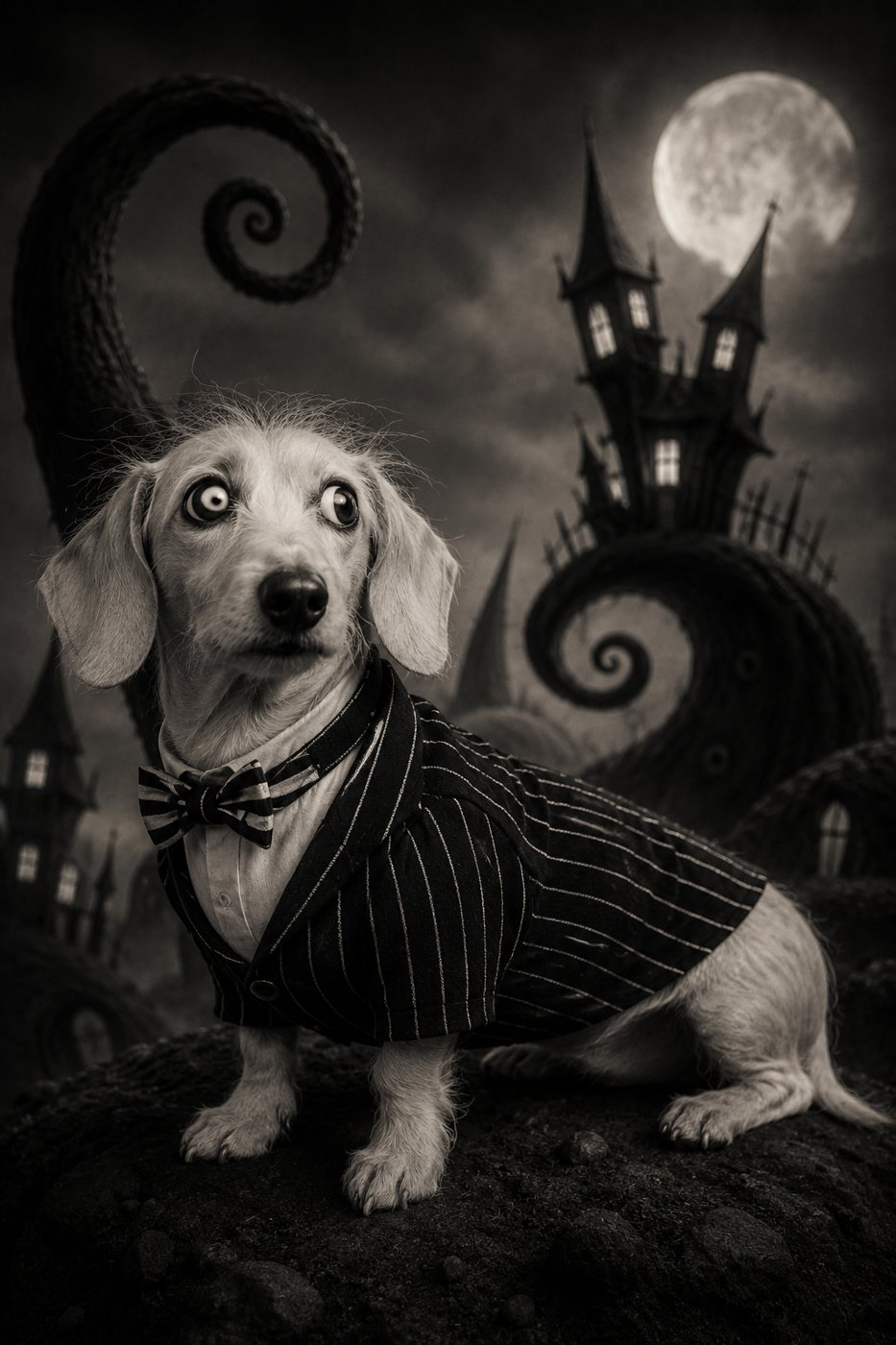
Tim Burrowton appears as a pale, wide-eyed dachshund beneath a full moon, surrounded by spiral hills and a house that has clearly declined several building inspections. The pinstriped suit is formal, but the hair has entered into a separate creative agreement. The dachshund looks startled, which is appropriate: Burton’s characters are frequently surprised to discover that the world has noticed them. Behind him, every branch curls toward a story. In front of him, the ground is uncertain. The image captures Burton’s durable proposition that strangeness is not the problem. The real danger is a society with no room for it.
Landmarks: Beetlejuice, Batman, Edward Scissorhands, Ed Wood, Sleepy Hollow, Big Fish, Corpse Bride
Christopher Nolang
CHRISTOPHER NOLAN · BORN 1970
Christopher Nolan has made complexity a form of popular spectacle. Born in London in 1970 and raised between Britain and the United States, he began experimenting with his father’s Super 8 camera as a child. At University College London, where he studied English literature and participated in the film society, Nolan gained practical experience with cameras, editing, projection, and the economics of making films with limited resources. His first feature, Following, was shot in black and white on weekends with friends, careful rehearsal, and a budget that encouraged everyone to stand exactly where planned.
Memento brought international attention through a structure that places the audience inside the protagonist’s damaged experience of time. Insomnia demonstrated his ability to work within a studio thriller, while Batman Begins and The Dark Knight trilogy reimagined superhero cinema through crime drama, moral conflict, and large-format realism. The Prestige turned rivalry into narrative machinery. Inception built a heist film across layers of dreaming. Interstellar joined intimate family separation to cosmic scale. Dunkirk organized survival through intersecting durations. Tenet made temporal inversion both plot and physical action. Oppenheimer combined biography, political history, subjective memory, and IMAX spectacle, earning Nolan Academy Awards for directing and producing Best Picture.
Time is Nolan’s most visible subject, but his deeper concern is consequence. His characters construct systems, inventions, identities, and missions that exceed their control. Information is fragmented, and viewers must participate in assembly. Yet the films are not puzzles for their own sake. Nolan uses structure to create feeling: memory becomes unreliable because grief is overwhelming; chronology breaks because experience does not arrive in orderly paragraphs.
He is also a forceful advocate for theatrical exhibition, photochemical film, practical effects, and large-format cinematography. Miniatures, real locations, mechanical rigs, and in-camera techniques coexist with digital work. His productions suggest that audiences will accept intellectual difficulty if the image has sufficient scale and the sound mix is prepared to rearrange the furniture.
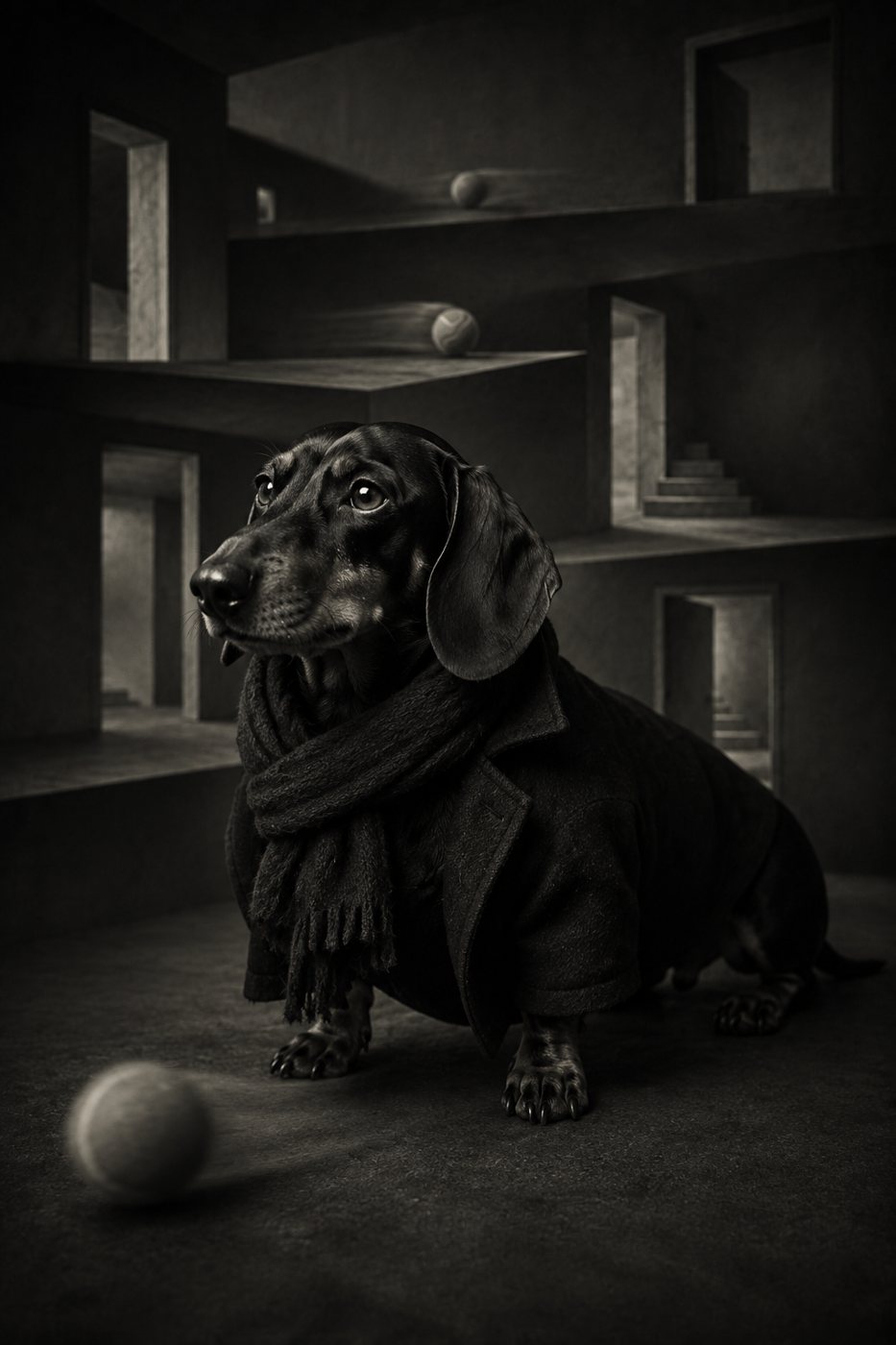
Christopher Nolang stands inside a layered architectural maze while tennis balls roll across several planes of time. One appears to move backward, which the dachshund accepts without surprise; retrieval has always been a nonlinear discipline. The scarf, coat, and thoughtful gaze imply that he has already diagrammed the sequence. Somewhere, an editor is checking whether the first bounce occurs before or after the emotional revelation. Nolan’s cinema asks viewers to enter the maze rather than look down upon it. Nolang offers the same invitation, though possession of the ball at the end of the sequence remains contractually reserved for the director.
Landmarks: Memento, The Dark Knight, Inception, Interstellar, Dunkirk, Tenet, Oppenheimer
Akira Kurosausage
AKIRA KUROSAWA · 1910-1998
Akira Kurosawa united movement, weather, moral inquiry, and visual clarity with a force that changed world cinema. Born in Tokyo in 1910, he initially trained as a painter before entering the film industry as an assistant director in 1936. The discipline of painting remained central to his filmmaking; he later created extensive storyboards whose color and composition could stand as artworks in their own right. His years as an assistant taught him the full mechanics of production, from script and performance to editing, a role he continued to treat as fundamental.
Kurosawa made his directing debut with Sanshiro Sugata in 1943. Postwar films such as Drunken Angel, Stray Dog, and No Regrets for Our Youth examined social dislocation and moral responsibility. Rashomon won the Golden Lion at Venice and introduced many international audiences to Japanese cinema. Its conflicting testimonies became so influential that the film’s title entered general language as a description of incompatible accounts. Ikiru followed a bureaucrat confronting mortality. Seven Samurai transformed collective action, class conflict, and tactical movement into an epic whose structure has been endlessly adapted. Throne of Blood translated Macbeth into a landscape of fog, prophecy, and feudal terror. The Hidden Fortress, Yojimbo, Sanjuro, High and Low, Red Beard, Dersu Uzala, Kagemusha, Ran, and Dreams continued a career of extraordinary range.
Kurosawa’s images are rarely static even when the camera holds. Wind moves grass and fabric. Rain becomes an actor. Crowds form vectors. Characters enter and exit in carefully organized groups. Multiple cameras allowed action to unfold with spontaneity while preserving editorial flexibility. His cutting could be swift and muscular, yet his humanism remained patient. He returned repeatedly to the question of how a person acts with dignity inside corrupted institutions or violent systems.
His influence crosses genres and national traditions. Westerns drew from his samurai films, while filmmakers from George Lucas to Martin Scorsese acknowledged his impact. Kurosawa absorbed Western literature and cinema without losing the specificity of Japanese history, performance, and landscape. The result was not imitation but exchange at the highest level.
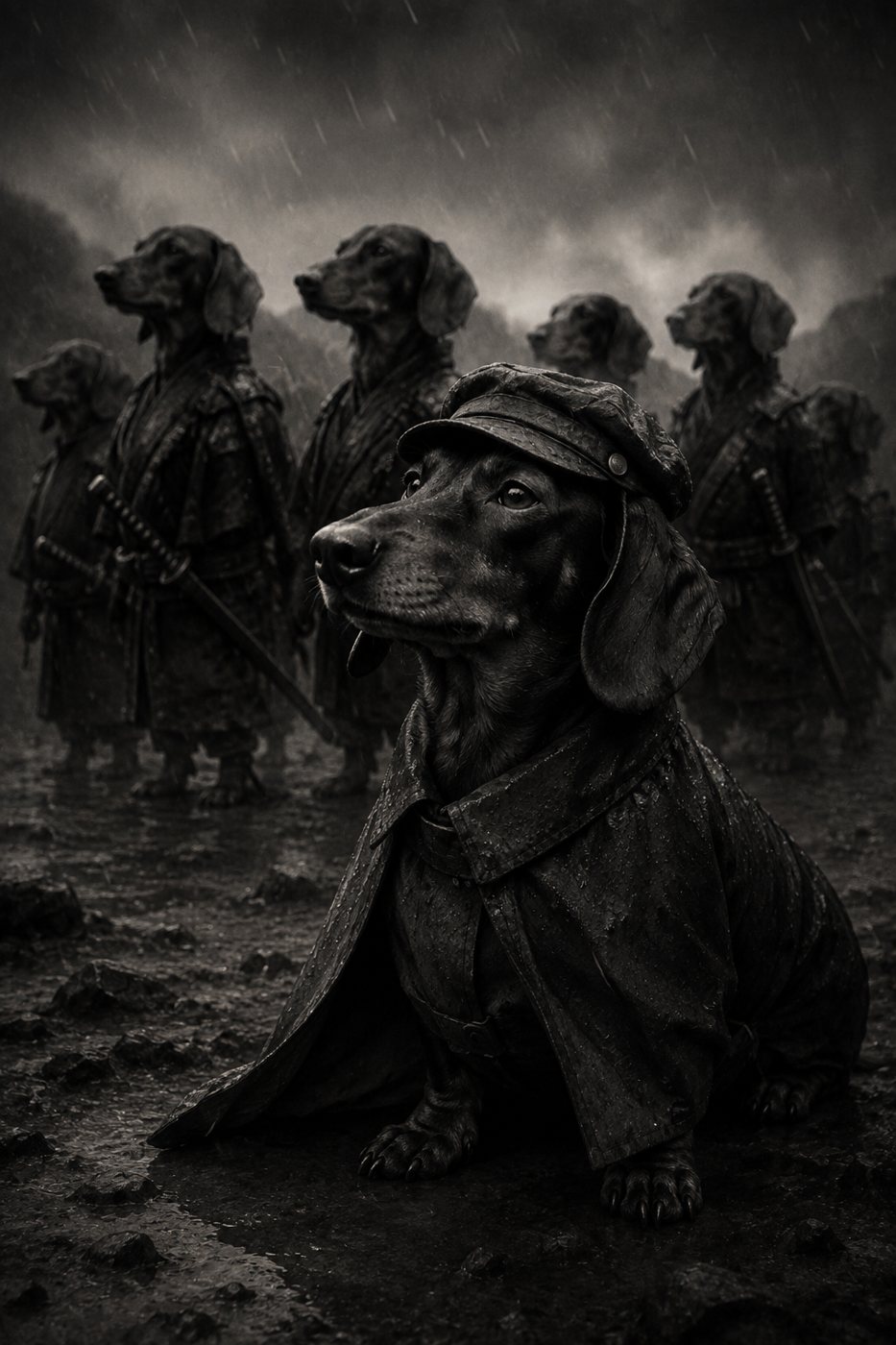
Akira Kurosausage stands in heavy rain before seven samurai dachshunds. The director’s cap is soaked, the ground is mud, and no one has suggested postponing the scene. This is correct. Kurosawa understood that weather reveals character and improves composition, although it complicates lunch. The central dachshund looks beyond the frame with calm authority, while the formation behind him waits for action. Each dog has a role, each movement has weight, and every drop of rain appears to have received direction.
Landmarks: Rashomon, Ikiru, Seven Samurai, Throne of Blood, Yojimbo, High and Low, Ran
Federico Fellini-Weenie
FEDERICO FELLINI · 1920-1993
Federico Fellini turned memory into carnival and autobiography into public mythology. Born in Rimini in 1920, he moved to Rome as a young man and worked as a cartoonist, journalist, gag writer, and screenwriter. His collaboration on Roberto Rossellini’s Rome, Open City placed him near the emergence of Italian neorealism, but Fellini gradually moved away from documentary surfaces toward a cinema in which streets, dreams, performers, religious processions, childhood fears, and private fantasies could share the same crowded frame.
Early films such as I Vitelloni retained a strong connection to provincial life and social observation. La Strada, with its wandering performers and emotional severity, brought international acclaim. Nights of Cabiria found resilience in a woman repeatedly betrayed by hope. La Dolce Vita transformed modern Rome into a procession of celebrity, emptiness, spectacle, and spiritual hunger. The image of Anita Ekberg in the Trevi Fountain became iconic, but the film’s true subject is a society endlessly producing images because it no longer knows what to believe.
With 8 1/2, Fellini made creative paralysis itself into a masterpiece. A director unable to complete his film becomes surrounded by memories, lovers, collaborators, fantasies, and expectations. The result is both confession and performance, one of cinema’s great demonstrations that a work about not knowing what to make can become the thing successfully made. Juliet of the Spirits, Satyricon, Roma, Amarcord, and Casanova expanded his visual world through increasingly baroque design. Fellini’s films received four Academy Awards in the foreign-language category, and he later received an honorary Oscar for his career.
The adjective “Felliniesque” now describes a mixture of exuberance, grotesquerie, dream logic, theatrical display, and affectionate exaggeration. That broad cultural recognition can obscure the precision beneath the apparent chaos. Fellini arranged faces, bodies, costumes, music, architecture, and movement with a cartoonist’s eye. His spectacles are emotionally organized, even when reality has politely withdrawn.
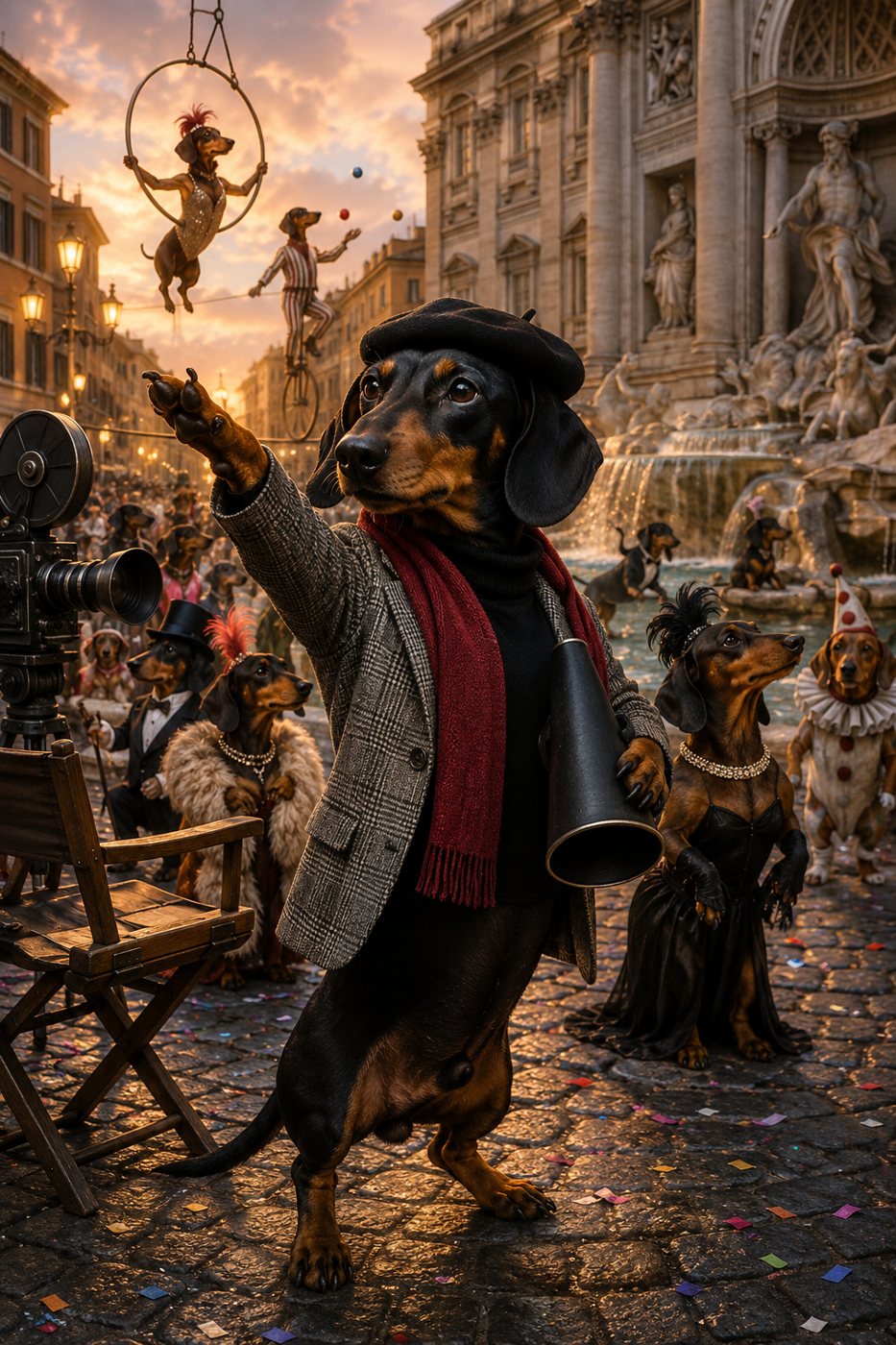
Federico Fellini-Weenie directs a Roman street overflowing with fountains, glamorous dogs, aerial performers, jugglers, confetti, and several characters who appear to have arrived from different dreams. He wears a beret and holds a megaphone because someone must take responsibility for the parade, though not necessarily for its meaning. The central dachshund gestures toward the next movement with complete confidence. Fellini understood that life rarely offers a clean composition, but cinema can transform the crowd into rhythm. The fountain flows, the circus continues, and every dachshund has been assured that the close-up is imminent.
Landmarks: La Strada, Nights of Cabiria, La Dolce Vita, 8 1/2, Juliet of the Spirits, Amarcord

David Leash
DAVID LYNCH · 1946-2025
David Lynch found nightmares inside well-kept rooms and beauty inside damaged machines. Born in Missoula, Montana, in 1946, he grew up in several American towns before studying painting. At the Pennsylvania Academy of the Fine Arts, Lynch began experimenting with moving images because he wanted one of his paintings to move and make sound. That simple desire led to short films and then Eraserhead, a feature created over several years with limited resources, intense commitment, and a soundscape that seemed to come from an industrial dream no city planner had approved.
The Elephant Man brought Lynch into larger-scale production without erasing his sensibility. Dune proved a painful encounter with studio control, but Blue Velvet returned him to a more personal territory: manicured suburbia, romantic innocence, sexual violence, and hidden systems of power. Twin Peaks, created with Mark Frost, carried that world into television and permanently altered expectations of what serialized storytelling could contain. Wild at Heart won the Palme d’Or. Lost Highway, Mulholland Drive, and Inland Empire pushed identity and narrative toward dream logic, while The Straight Story demonstrated that Lynch’s strangeness was never dependent on overt surrealism. His return to Twin Peaks in 2017 became one of the most radical late works by a major American filmmaker.
“Lynchian” has entered the language, but it means more than something odd. A Lynchian moment begins with familiarity, introduces a small disturbance, and allows sound, duration, performance, or an object to reveal that the surface reality has never been secure. His work gives unusual weight to hums, electrical currents, curtains, hallways, songs, and pauses. He could make terror funny and comedy frightening without announcing the transition.
Lynch remained a painter, musician, designer, writer, and advocate of transcendental meditation. His creative practice was grounded in attention and in the belief that ideas arrive when the mind is given room to receive them. He died in 2025, leaving a body of work that continues to influence film, television, music, visual art, and the emotional interpretation of ceiling fans.
David Leash sits in a perfectly respectable suburban living room before a biscuit containing an eye. Nothing else appears wrong, which is precisely why everything is wrong. The dachshund is beautifully groomed and calmly dressed, refusing to explain the object. Lynch’s cinema respects mystery by not reducing it to information. The biscuit may be watching the dog, the dog may be dreaming the room, or the lamp may know more than both. A lesser director would provide an answer. David Leash allows the coffee to cool and waits for the low electrical hum to become audible.
Landmarks: Eraserhead, The Elephant Man, Blue Velvet, Twin Peaks, Wild at Heart, Mulholland Drive
Pedro Almodogvar
PEDRO ALMODOVAR · BORN 1949
Pedro Almodovar brought the freedoms, contradictions, and emotional excess of post-Franco Spain into a cinema of color, desire, women, performance, and reinvention. Born in Calzada de Calatrava in 1949, he moved to Madrid as a teenager with the intention of making films. Formal film-school study was unavailable under the dictatorship, so he built an education through work, theater, Super 8 filmmaking, writing, music, underground culture, and the collective energy that would become known as La Movida Madrilena.
His early features, including Pepi, Luci, Bom and Labyrinth of Passion, embraced irreverence and instability. Women on the Verge of a Nervous Breakdown brought international recognition through a meticulously controlled farce of abandonment, performance, and emotional emergency. Almodovar’s later films deepened without becoming visually timid. All About My Mother examined grief, motherhood, acting, and chosen family. Talk to Her explored intimacy, care, and moral unease. Bad Education confronted memory and abuse. Volver joined family secrets to the supernatural with warmth and wit. Broken Embraces, The Skin I Live In, Julieta, Pain and Glory, Parallel Mothers, and The Room Next Door continued his investigation of identity, creativity, illness, loss, and the stories people construct to survive.
Almodovar’s saturated reds, blues, floral patterns, glossy interiors, costumes, and carefully placed objects are not decorative excess applied after the drama. They are the drama’s emotional architecture. Color tells us what characters cannot yet admit. Melodrama, in his hands, is not an embarrassment to be corrected by irony. It is a serious form for lives in which love, shame, memory, desire, and family arrive at full volume.
With his brother Agustin, Almodovar created the production company El Deseo, supporting his own work and that of other filmmakers. His films have helped transform Spanish cinema’s international profile while remaining culturally specific and personally recognizable. He has won major honors at Cannes, Venice, and the Academy Awards, but his most important achievement is the continuity of a world in which marginalized characters are not treated as social footnotes. They occupy the center of the frame.
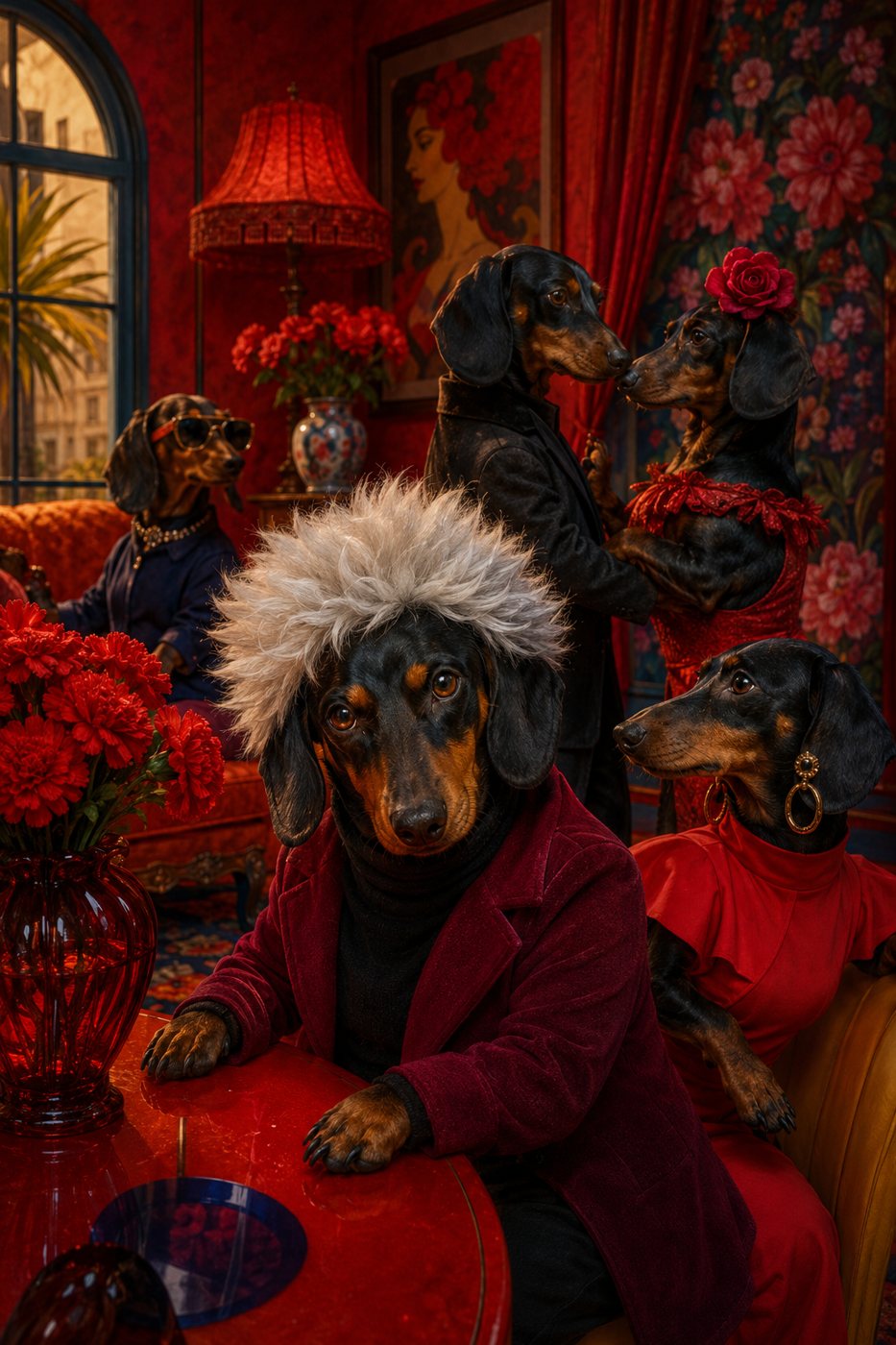
Pedro Almodogvar sits in a crimson room crowded with flowers, elegant dachshunds, dramatic glances, and at least three relationships requiring immediate clarification. He wears a magnificent pale wig because emotional truth does not prohibit excellent styling. Behind him, one couple is reconciling or beginning a new complication; another dog observes through sunglasses with the calm of someone holding essential information. Almodovar’s cinema understands that family is rarely simple and desire never respects the furniture plan. Fortunately, the red walls are prepared.
Landmarks: Women on the Verge, All About My Mother, Talk to Her, Volver, Pain and Glory, Parallel Mothers
Spike Leash
SPIKE LEE · BORN 1957
Spike Lee has made the American city a stage for argument, memory, music, style, anger, humor, and political urgency. Born in Atlanta in 1957 and raised in Brooklyn, Lee studied at Morehouse College and earned an MFA from New York University’s Tisch School of the Arts. His student film Joe’s Bed-Stuy Barbershop: We Cut Heads received a Student Academy Award, signaling the arrival of a filmmaker determined to connect formal energy with subjects that mainstream American cinema routinely ignored or simplified.
She’s Gotta Have It announced an independent voice with wit, sexuality, and visual invention. School Daze addressed colorism, class, and identity within Black institutions. Do the Right Thing transformed one hot day in Bedford-Stuyvesant into an escalating study of race, community, policing, property, and responsibility. Its saturated colors, direct addresses, music, and unresolved ending remain central to American film history. Malcolm X joined biography to political epic, while Crooklyn turned family memory into neighborhood portraiture. Clockers, 25th Hour, Inside Man, Chi-Raq, BlacKkKlansman, Da 5 Bloods, and Highest 2 Lowest demonstrate Lee’s range across crime, satire, war, musical form, and genre filmmaking.
Lee’s documentaries are equally important. 4 Little Girls examined the 1963 Birmingham church bombing. When the Levees Broke and If God Is Willing and da Creek Don’t Rise documented Hurricane Katrina and its aftermath with historical depth and attention to institutional failure. His company, 40 Acres and a Mule Filmworks, became both a production base and a declaration of cultural independence.
Formally, Lee’s cinema is unmistakably active. Characters address the camera. Colors intensify argument. Music functions as history and counterpoint. The signature double-dolly shot allows a character to appear as if moving through space without walking, creating an expression of shock, inevitability, or heightened consciousness. Lee also teaches at NYU, connecting production to the education of future filmmakers.
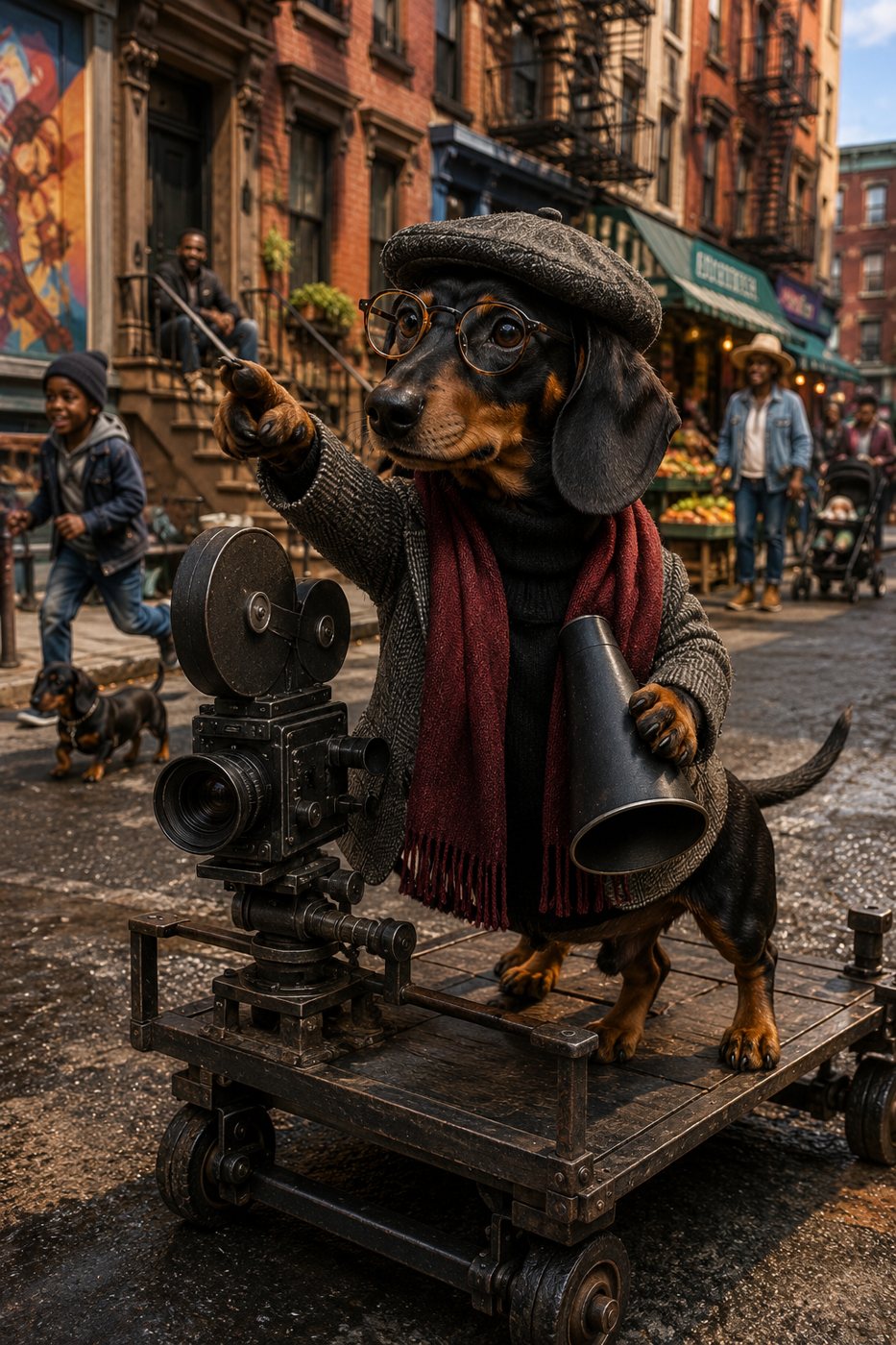
Spike Leash directs from a miniature camera dolly on a Brooklyn street, glasses focused and paw extended toward the next mark. The block is not background decoration; it is a living social field of stoops, businesses, murals, pedestrians, memory, and contested ownership. The dachshund director holds a megaphone because the scene has something to say and because New York has never rewarded excessive vocal restraint. Lee’s work insists that style and politics are not opponents. The frame itself takes a position. Spike Leash has positioned the camera, engaged the neighborhood, and is now waiting for everyone to do the right take.
Landmarks: She’s Gotta Have It, Do the Right Thing, Malcolm X, Crooklyn, 25th Hour, BlacKkKlansman
Ridley Scottie
RIDLEY SCOTT · BORN 1937
Ridley Scott is a builder of worlds whose surfaces feel used before the story begins. Born in South Shields, England, in 1937, he studied art and design before joining the BBC as a trainee designer and later directing television. Work in advertising sharpened his ability to establish atmosphere, narrative, and visual identity with great speed. By the time he directed his first feature, The Duellists, Scott possessed a painter’s eye, a designer’s discipline, and the practical understanding that fog is both an aesthetic instrument and a production resource.
Alien transformed science fiction by making space industrial, wet, dark, and physically dangerous. The spacecraft did not look like a showroom; it looked inhabited by workers with contracts, complaints, and insufficient information. Blade Runner created a future Los Angeles of rain, neon, advertising, memory, and moral ambiguity, influencing decades of production design. Thelma & Louise joined road movie, feminist rebellion, and tragic momentum. Gladiator revived the historical epic for a new generation. Black Hawk Down, Kingdom of Heaven, American Gangster, Prometheus, The Martian, The Last Duel, Napoleon, and Gladiator II reveal a director comfortable with war, history, science fiction, crime, and survival.
Scott’s films differ widely in tone, yet their environments are consistently persuasive. He storyboards extensively, thinks through images, and works at a pace that would exhaust several committees. Architecture, weather, costume, machinery, and landscape establish power before dialogue explains it. His characters frequently confront systems larger than themselves: empires, corporations, armies, hostile planets, or biological organisms with questionable respect for personal space.
The critical reputation of individual Scott films has often changed over time. Blade Runner, initially divisive, became a defining work. Kingdom of Heaven gained substantial reassessment through its director’s cut. This pattern reflects the density of his visual storytelling and the complexities of studio versions, audience expectation, and historical distance.
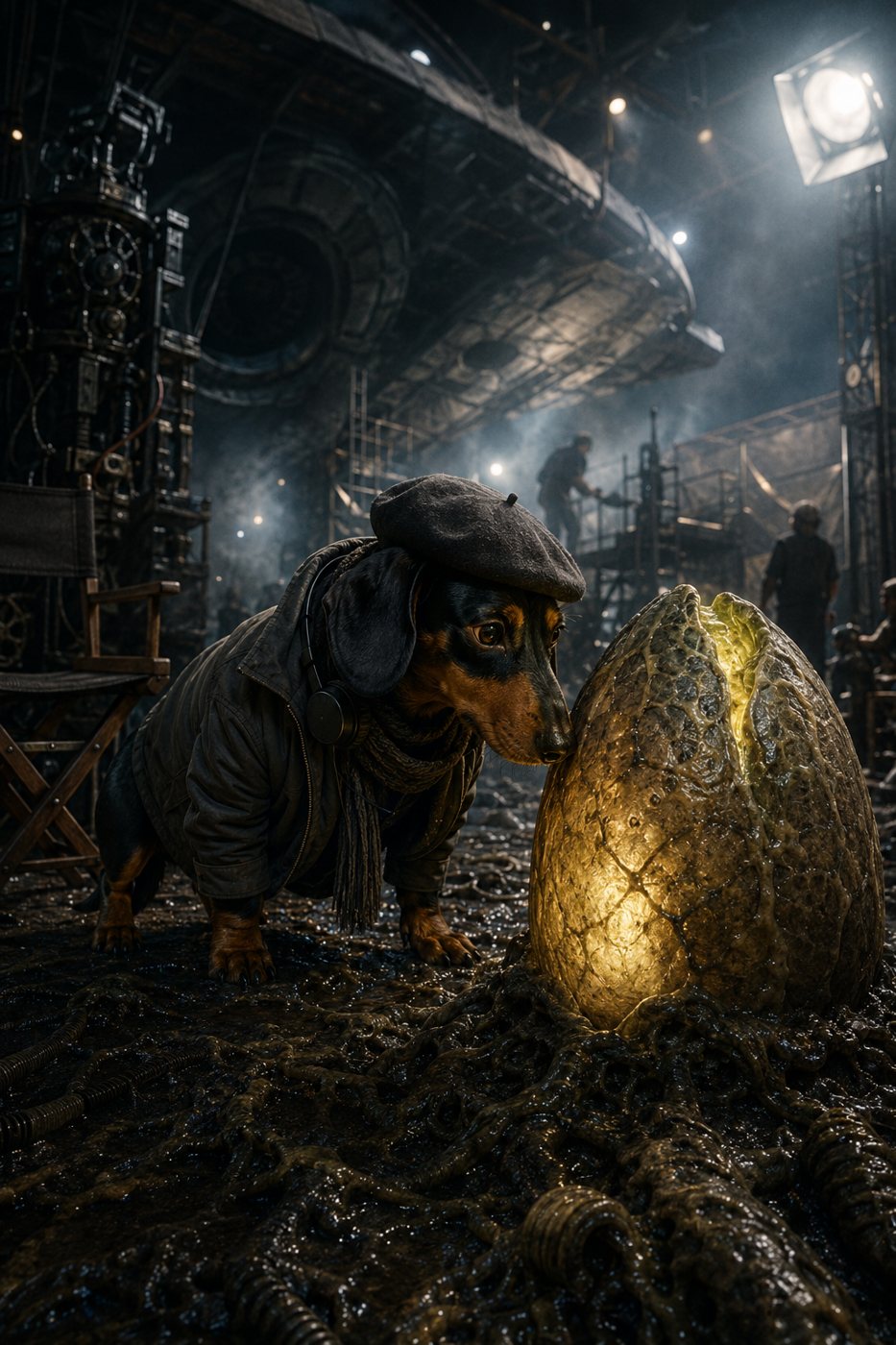
Ridley Scottie stands on a vast science-fiction set before a glowing alien egg that he has specifically been instructed not to sniff. The instruction has failed because it misunderstands both the director and the dachshund. Scott’s cinema advances by investigating the dangerous object, entering the forbidden corridor, and asking production design to make the consequences magnificent. The dog leans forward with professional concentration while the egg illuminates the industrial slime. Somewhere off-frame, a safety officer is completing a form. The shot, however, is excellent.
Landmarks: Alien, Blade Runner, Thelma & Louise, Gladiator, Black Hawk Down, The Martian, The Last Duel
James Camerhound
JAMES CAMERON · BORN 1954
James Cameron approaches filmmaking as engineering conducted under emotional pressure. Born in Kapuskasing, Ontario, in 1954, he moved to California as a teenager and pursued a largely self-directed education in design, photography, effects, and cinema. Early work in the resourceful production environment surrounding Roger Corman taught him how sets, miniatures, effects, and schedules fit together. The Terminator, made with limited resources and considerable invention, established a career in which technology would repeatedly serve stories of survival, transformation, and human determination.
Aliens expanded a horror film into a military action epic without losing the emotional center of Ellen Ripley. The Abyss combined underwater production, science fiction, and pioneering digital effects under famously demanding conditions. Terminator 2: Judgment Day advanced computer-generated imagery while remaining anchored in a protector-child relationship. True Lies brought large-scale action into domestic comedy. Titanic fused historical reconstruction, romance, engineering, disaster, and then-unprecedented production scale, earning eleven Academy Awards and making Cameron one of the few directors whose professional anxieties can be measured in nautical miles.
Avatar and Avatar: The Way of Water extended performance capture, stereoscopic filmmaking, virtual production, and digital world-building. Cameron’s technological ambitions are not separate from his environmental and emotional themes. His stories often oppose extraction to connection, machinery to biology, and domination to stewardship. Even when the films are immense, the central structures are direct: protect the child, save the person, survive the sinking, defend the home.
Cameron’s work as a deep-sea explorer is not promotional decoration. He participated in the development of specialized submersibles and completed a solo descent to the Challenger Deep in 2012. The same mindset links his filmmaking and exploration: define the impossible requirement, assemble the team, develop the equipment, and continue after reasonable people have suggested moderation.
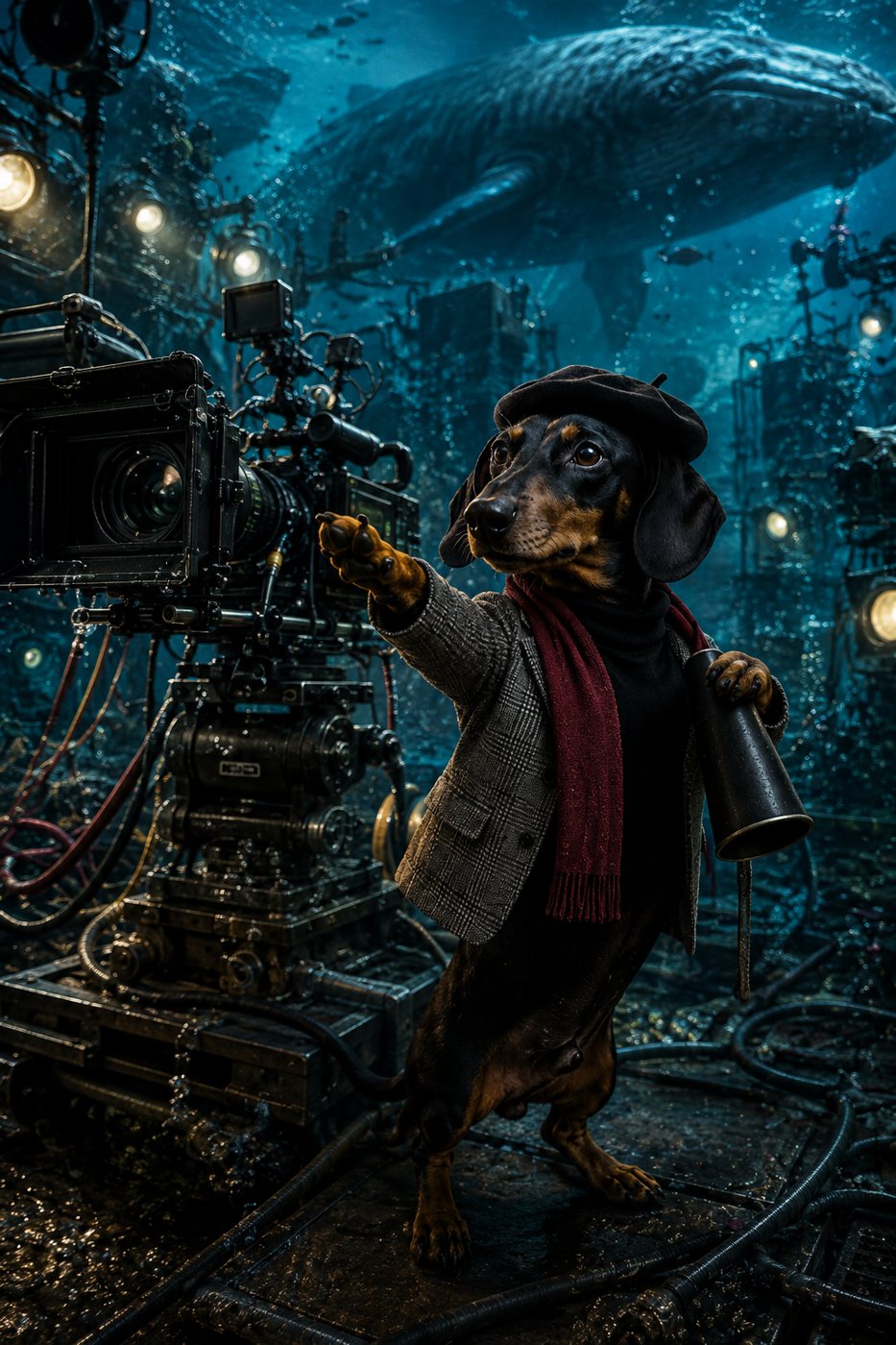
James Camerhound directs underwater beside a camera rig that appears capable of photographing a continent. Cables, monitors, lights, bubbles, and a passing whale confirm that the approved budget has become an archaeological concept. The dachshund remains calm, paw raised, because the shot can still be improved. Cameron’s productions often begin where ordinary logistics end. In dachshund terms, this is familiar territory: the objective is clear, the route is obstructed, and no amount of furniture will prevent forward movement. The only question is whether the camera housing has been tested at depth.
Landmarks: The Terminator, Aliens, The Abyss, Terminator 2, Titanic, Avatar, Avatar: The Way of Water
Guillermo del Toroso
GUILLERMO DEL TORO · BORN 1964
Guillermo del Toro treats monsters not as interruptions of humanity but as alternative ways of understanding it. Born in Guadalajara in 1964, he developed an early fascination with horror, fairy tales, makeup, insects, religious imagery, and the physical craft of creatures. He trained in special effects, founded the company Necropia, made short films, and worked across Mexican film and television before directing Cronos. That debut joined vampirism, aging, machinery, and tenderness in a form that already contained the emotional architecture of his later work.
Mimic brought him into Hollywood under difficult studio conditions. The Devil’s Backbone returned to Spanish-language filmmaking and used a ghost story to examine the violence of the Spanish Civil War. Hellboy and Hellboy II combined comic-book action with affection for misfit beings. Pan’s Labyrinth intertwined fascist brutality with a dangerous fairy-tale realm, refusing to make fantasy an escape from history. Pacific Rim presented giant monsters and machines with the enthusiasm of a child and the design discipline of a master craftsman. Crimson Peak revived gothic romance. The Shape of Water made love possible across species and won Academy Awards for Best Picture and Best Director. Nightmare Alley, Pinocchio, and Frankenstein continued his exploration of creation, fathers, mortality, obedience, and the moral superiority of beings labeled monstrous.
Del Toro’s creatures are intensely designed but rarely reducible to effects. Texture, silhouette, movement, and practical construction give them physical presence, while their emotional function gives them dignity. He has described monsters as powerful symbols, and his films repeatedly ask why society fears visible difference while tolerating institutional cruelty. The true monster is often the person with authority, polished shoes, and a clean office.
His notebooks, collections, production designs, and legendary houses of books and objects reveal a creative process based on accumulation and careful observation. He supports other filmmakers, writes and produces widely, and speaks about cinema with the generosity of someone who regards influence as a shared inheritance rather than private property.
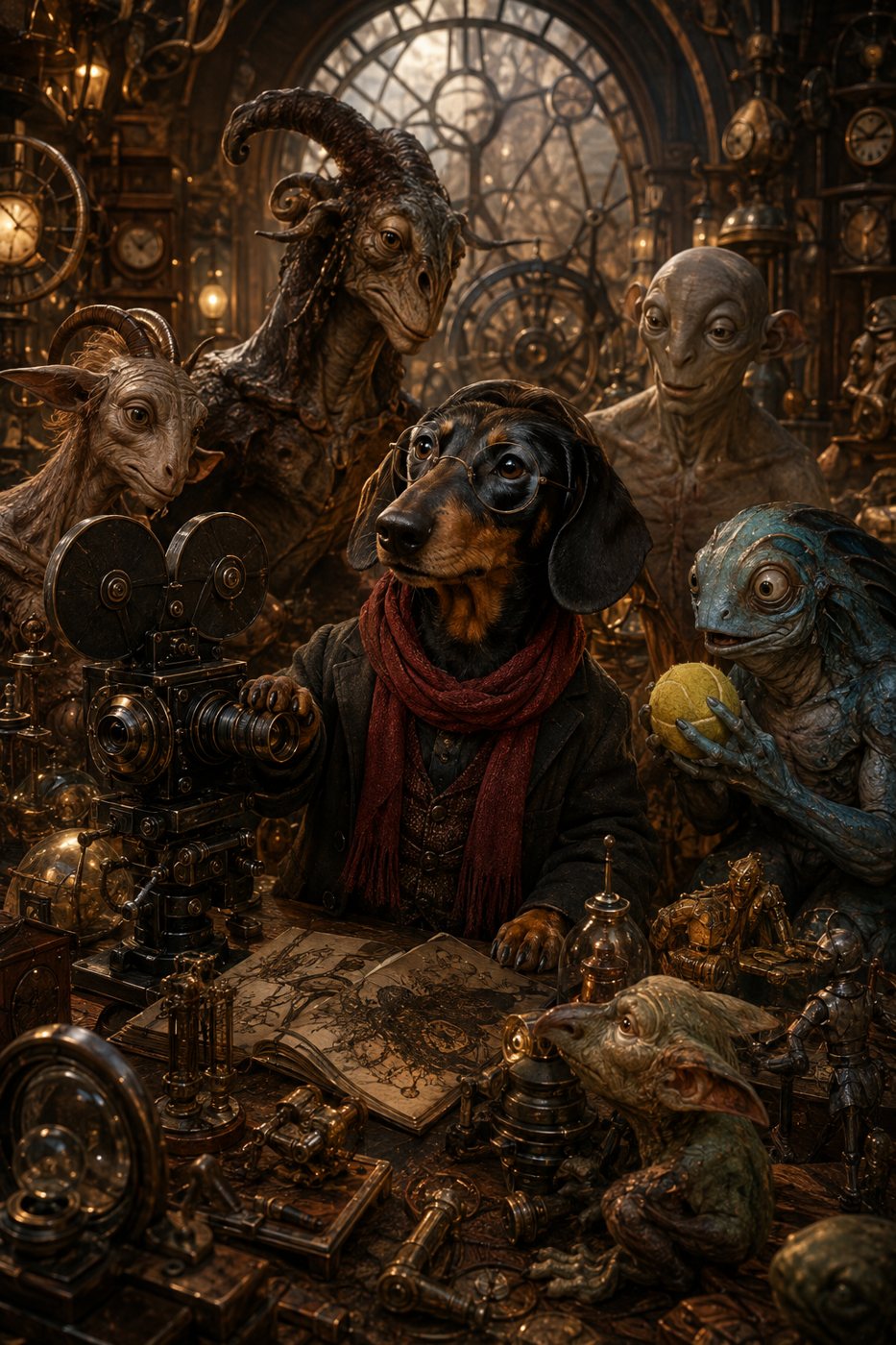
Guillermo del Toroso stands at the center of a clockwork workshop surrounded by horned creatures, amphibious beings, old cameras, sketches, gears, and a tennis ball held with ceremonial seriousness. The dachshund director looks gentle because the monsters are not the problem. They are collaborators. The amphibious creature has understood the essential production note: when uncertain, secure the ball. Del Toro’s cinema gives the strange a home, the wounded a mythology, and the beautifully imperfect a close-up.
Landmarks: Cronos, The Devil’s Backbone, Pan’s Labyrinth, Hellboy II, The Shape of Water, Pinocchio
Sofia Coppawla
SOFIA COPPOLA · BORN 1971
Sofia Coppola has built a cinema of atmosphere, isolation, privilege, youth, femininity, and the quiet negotiations of identity. Born in New York City in 1971 into a filmmaking family, she grew up around sets, artists, travel, and the practical intimacy of production. Her early public visibility as an actor sometimes overshadowed her interests in design, photography, fashion, and writing. When she moved behind the camera, the result was not an extension of her father’s style but a distinct authorship based on observation, restraint, and emotional space.
The Virgin Suicides adapted Jeffrey Eugenides’s novel through the remembered fascination of boys who never fully understand the sisters they observe. Lost in Translation placed two displaced Americans in a Tokyo hotel and found intimacy in exhaustion, cultural distance, and temporary companionship. The film earned Coppola the Academy Award for original screenplay and made her the first American woman nominated for Best Director. Marie Antoinette approached history through youth culture, music, clothing, consumption, and confinement rather than conventional ceremonial biography.
Somewhere, which won the Golden Lion at Venice, examined celebrity emptiness and a father-daughter relationship through repetition and stillness. The Bling Ring treated aspiration and theft as products of image culture. The Beguiled brought controlled tension to an isolated household during the American Civil War and earned Coppola the Best Director prize at Cannes. On the Rocks returned to New York with a lighter study of marriage and paternal charm, while Priscilla reconsidered an iconic relationship from the perspective of the young woman living inside it.
Coppola’s films often focus on people who possess access, beauty, or luxury but lack agency, language, or connection. Hotels, bedrooms, palaces, swimming pools, dressing rooms, and cars become emotional containers. Music, costume, duration, and production design communicate what dialogue leaves untouched. Her work is sometimes described as slight because it refuses conventional dramatic volume. The restraint is the point. Ennui can be historically revealing when it shows the structure of a life from which escape is difficult.
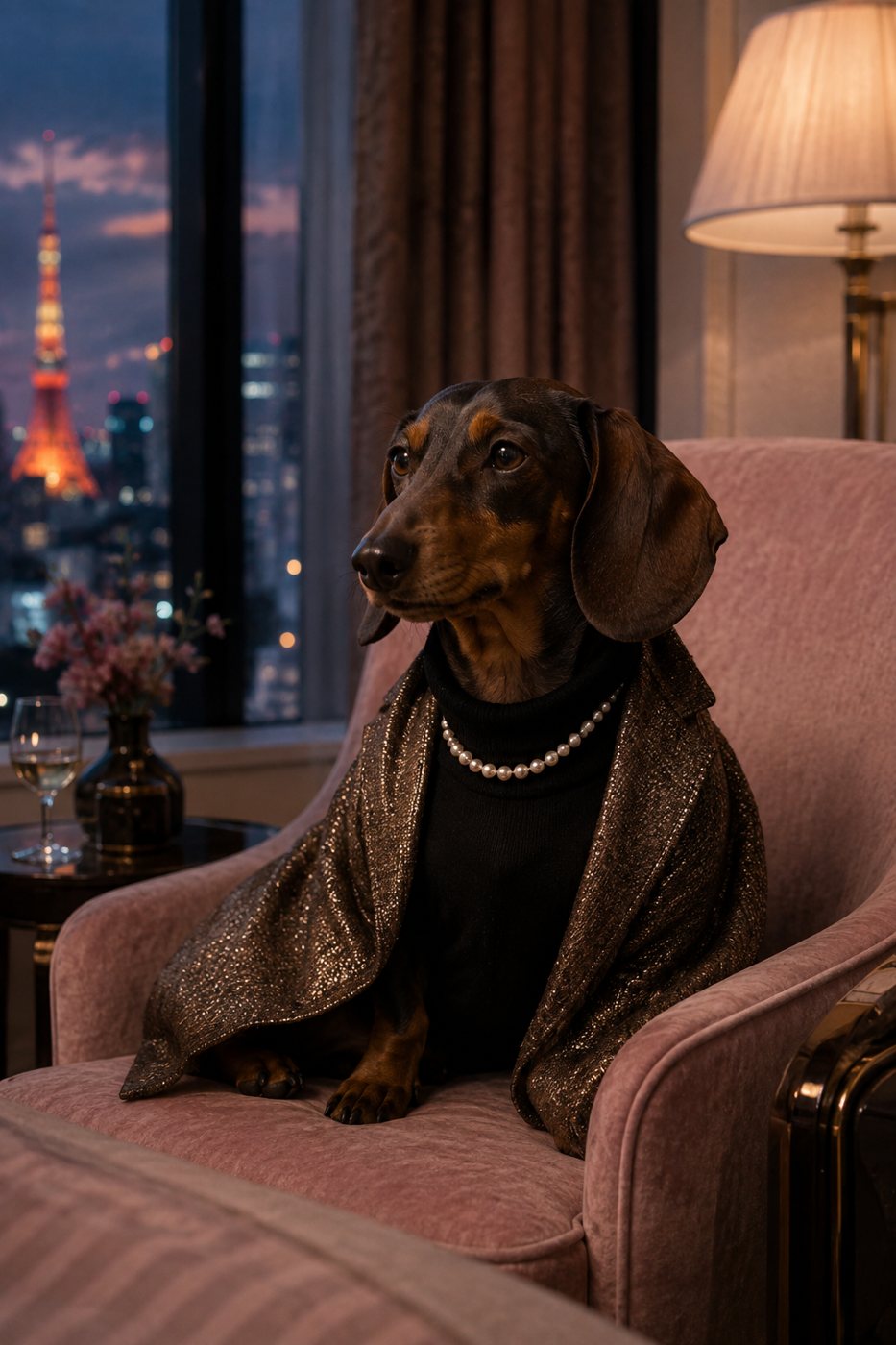
Sofia Coppawla sits in a plush Tokyo hotel chair, wrapped in soft metallic fabric and pearls, with the city glowing beyond the window. Nothing dramatic is happening, and the image is full of drama. The dachshund’s gaze suggests an awareness that the room is beautiful, the view is expensive, and neither fact resolves the evening. Coppola’s cinema trusts such moments. A dog may have every cushion available and still wonder whether it belongs in the room. The lamp remains warm. The city remains distant. The feeling is precise.
Landmarks: The Virgin Suicides, Lost in Translation, Marie Antoinette, Somewhere, The Beguiled, Priscilla
George Lucasage
GEORGE LUCAS · BORN 1944
George Lucas changed not only the stories Hollywood told but the infrastructure used to tell them. Born in Modesto, California, in 1944, he was initially fascinated by cars and racing. A serious automobile accident redirected his life, and he entered community college before studying film at the University of Southern California. There he became part of a generation treating cinema as both art and technology. His student work and the feature THX 1138 revealed an interest in systems, control, sound, speed, and individuals attempting to escape environments built to contain them.
American Graffiti transformed memories of cruising, music, adolescence, and small-town California into a formally innovative ensemble film. Its success allowed Lucas to pursue Star Wars, a project that combined serial adventures, mythology, westerns, samurai films, aviation imagery, and effects challenges that existing studios were not prepared to solve. The film’s 1977 release reshaped global popular culture. Lucas did not direct the next two entries in the original trilogy, but as creator, producer, and head of the expanding Lucasfilm organization, he remained central to the universe’s development.
To realize Star Wars, Lucas founded Industrial Light & Magic, which became one of the most important visual-effects companies in cinema. Skywalker Sound advanced audio production. The development of editing, digital imaging, computer graphics, and production technologies across the Lucas companies influenced filmmaking far beyond a single franchise. With Steven Spielberg, Lucas also created the Indiana Jones series, fusing archaeological adventure with the speed and clarity of classic serial storytelling.
Lucas later returned to directing with the Star Wars prequel trilogy, embracing digital production and exhibition at a scale that accelerated the industry’s transition. The films prompted intense debate, but their technical ambition and long-term influence are undeniable. Lucas eventually sold Lucasfilm and directed substantial resources toward education and the Lucas Museum of Narrative Art.
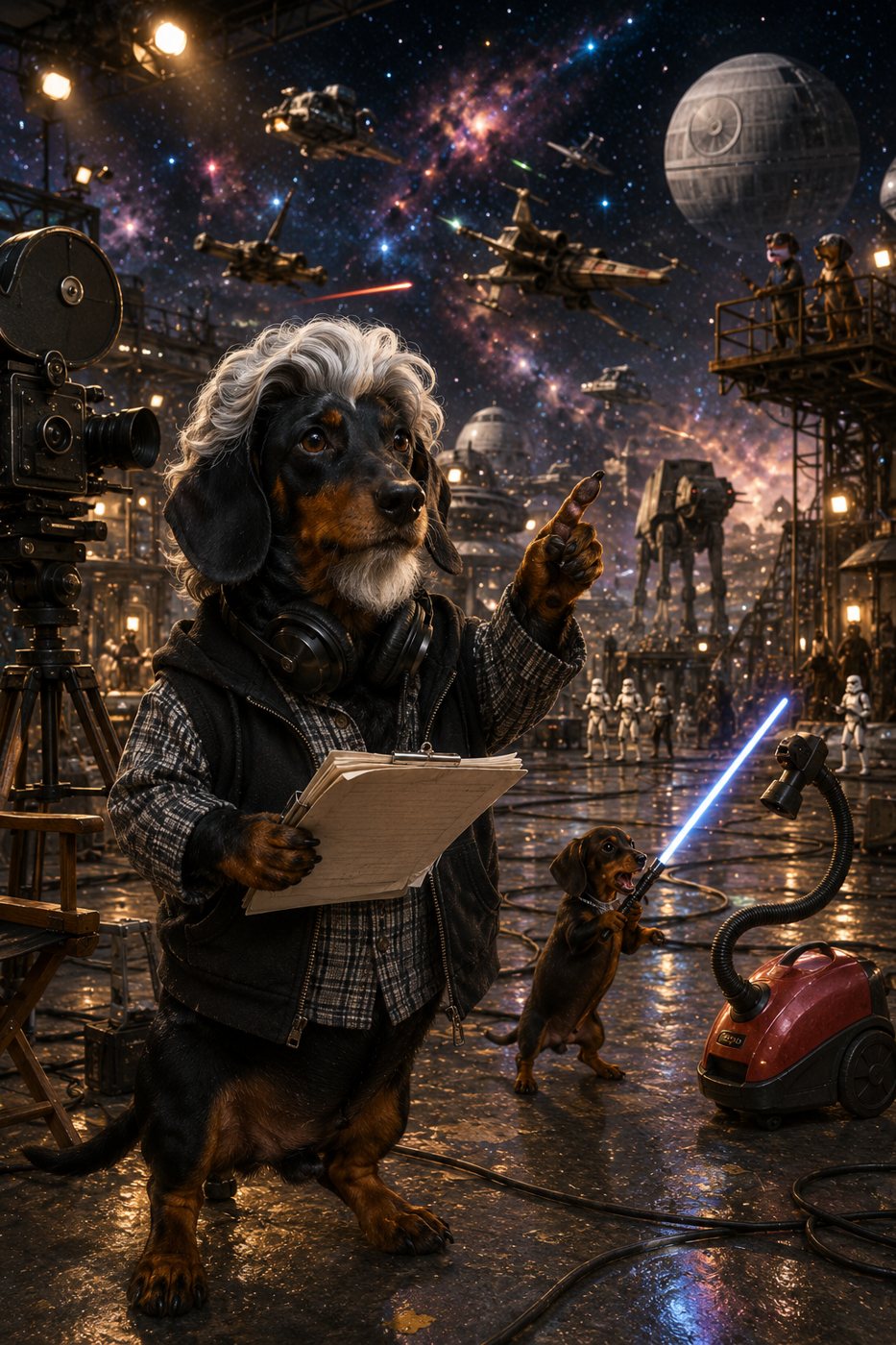
George Lucasage directs a galactic set while a smaller dachshund duels a vacuum cleaner with a glowing stick. This may be the clearest possible summary of imaginative production: the universe is enormous, the mythology is ancient, the budget is consequential, and the immediate conflict involves household equipment. The bearded director holds pages and points toward the action, surrounded by spacecraft, lights, walkers, cables, and crew. Lucas understood that audiences will follow a simple emotional line through extraordinary complexity. The young hero faces the machine. The music rises. The vacuum has underestimated the Force, and also the dachshund’s historical objection to suction noise.
Landmarks: THX 1138, American Graffiti, Star Wars; creator of Indiana Jones; founder of Lucasfilm and ILM
Orson Wellesh
ORSON WELLES · 1915-1985
Orson Welles entered American culture as a prodigy and spent much of the rest of his career attempting to recover the freedom granted to him at the beginning. Born in Kenosha, Wisconsin, in 1915, he developed early as an actor, director, writer, magician, visual artist, and radio performer. In his early twenties, he staged ambitious productions for the Federal Theatre Project, co-founded the Mercury Theatre, and became nationally famous through radio. The 1938 broadcast of The War of the Worlds demonstrated the power of modern media, though the mythology of nationwide panic later grew larger than the documented event.
RKO offered Welles an extraordinary contract, and at twenty-five he directed Citizen Kane. Working with cinematographer Gregg Toland and a remarkable team, Welles used deep-focus photography, low angles, ceilings, layered sound, nonlinear narration, and expressive design to examine wealth, media power, memory, and emotional loss. The film’s reputation grew across decades until it became a central reference point in film history. Its success as art did not guarantee Welles institutional security.
The Magnificent Ambersons was taken from him and drastically re-edited while he was working in Brazil. That experience became the pattern of a career marked by conflict over control, incomplete financing, dispersed production, and unfinished or altered projects. Yet Welles continued to create extraordinary films: The Lady from Shanghai, Othello, Touch of Evil, The Trial, Chimes at Midnight, and F for Fake. He financed work through acting, voice performance, television appearances, and commercial assignments, moving between countries and assembling films over long periods.
Welles’s style joined theater, radio, painting, literature, and cinema. His voice could dominate a room before he entered it. His camera made ceilings oppressive and faces architectural. He understood performance as both revelation and deception. F for Fake, one of his late masterpieces, turned forgery, authorship, editing, and storytelling into a playful essay that anticipated later forms of cinematic self-reflection.
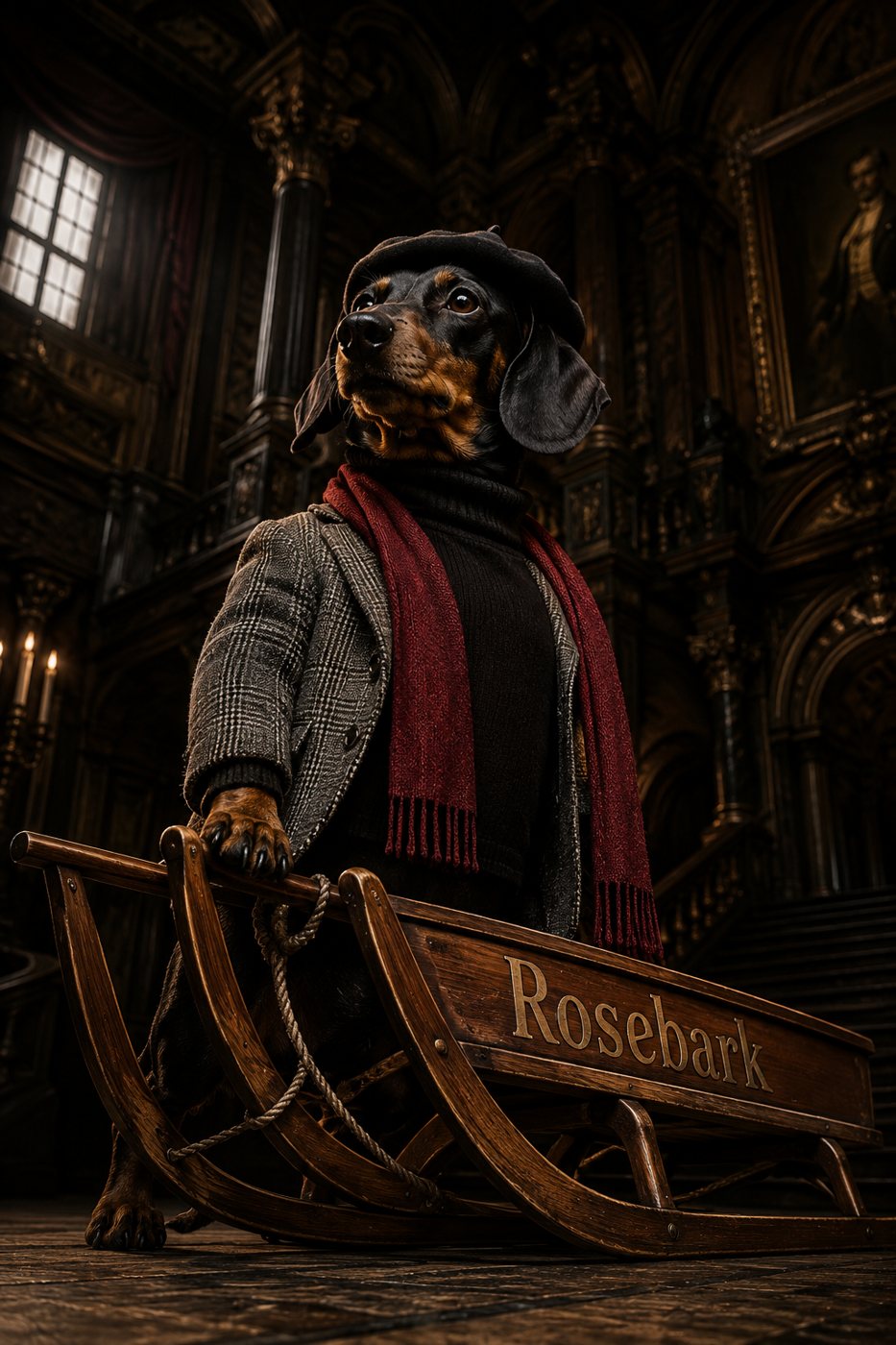
Orson Wellesh is photographed from an extreme low angle in a mansion of carved shadows, guarding a sled marked Rosebark. The reference is affectionate but exact: a simple childhood object becomes the organizing absence in a life of power. The dachshund stands with theatrical authority, one paw on the sled, as though both property and interpretation require his approval. Welles knew that scale is a matter of perspective. Place the camera low enough and a small figure becomes monumental. Give that figure a deep voice, a grand staircase, and incomplete financing, and cinema history begins.
Landmarks: Citizen Kane, The Magnificent Ambersons, The Lady from Shanghai, Othello, Touch of Evil, F for Fake
RESEARCH AND FURTHER READING
These essays are interpretive biographical portraits rather than academic catalogues. Dates, career milestones, awards, and film histories were checked against the following institutional and established sources. The appendix records the principal reference families used across the book; individual essays synthesize multiple sources.
Alfred Hitchcock BFI Screenonline, "Hitchcock, Alfred (1899-1980) Biography"; BFI Sight and Sound, "Alfred Hitchcock: My Own Methods." |
Federico Fellini Academy and Cannes records; Italian and international film histories; major retrospectives. |
|---|---|
Steven Spielberg Amblin, official Steven Spielberg biography; Academy Museum of Motion Pictures materials; USC Shoah Foundation institutional history. |
David Lynch Academy and Cannes records; major obituaries and critical histories published in 2025. |
Stanley Kubrick BFI Screenonline, "Kubrick, Stanley (1928-1999) Biography"; BFI Sight and Sound, "Stanley Kubrick, Cinephile." |
Pedro Almodovar Festival de Cannes biography and film records; Venice and Academy records; El Deseo materials. |
Martin Scorsese The Film Foundation and World Cinema Project institutional materials; NYU and major biographical film references. |
Spike Lee NYU Tisch official biography; Academy records; 40 Acres and a Mule filmography and institutional materials. |
Quentin Tarantino Cannes and Academy film records; major biographical and film-history references; New Beverly Cinema institutional materials. |
Ridley Scott BAFTA and Academy records; Royal College of Art and major career profiles. |
Francis Ford Coppola Academy and Cannes records; American Zoetrope materials; major biographical film references. |
James Cameron Academy of Achievement biography; Academy records; deep-sea exploration and production histories. |
Wes Anderson Academy and BAFTA records; major film-history profiles and production studies. |
Guillermo del Toro Academy records; official and major biographical references; production and effects histories. |
Tim Burton Tim Burton official biography and exhibition materials; Museum of Modern Art exhibition records. |
Sofia Coppola Academy, Cannes, and Venice records; major career profiles and production histories. |
Christopher Nolan Academy records; British and American biographical references; interviews on large-format and practical filmmaking. |
George Lucas Lucasfilm institutional history; Academy records; Industrial Light & Magic and USC film histories. |
Akira Kurosawa Academy records; Japanese and international film histories; major retrospectives and biographical references. |
Orson Welles Indiana University Orson Welles on the Air archive; Academy records; major Welles film histories. |
Editorial cutoff: August 4, 2026