The Art of War According to Dachshunds
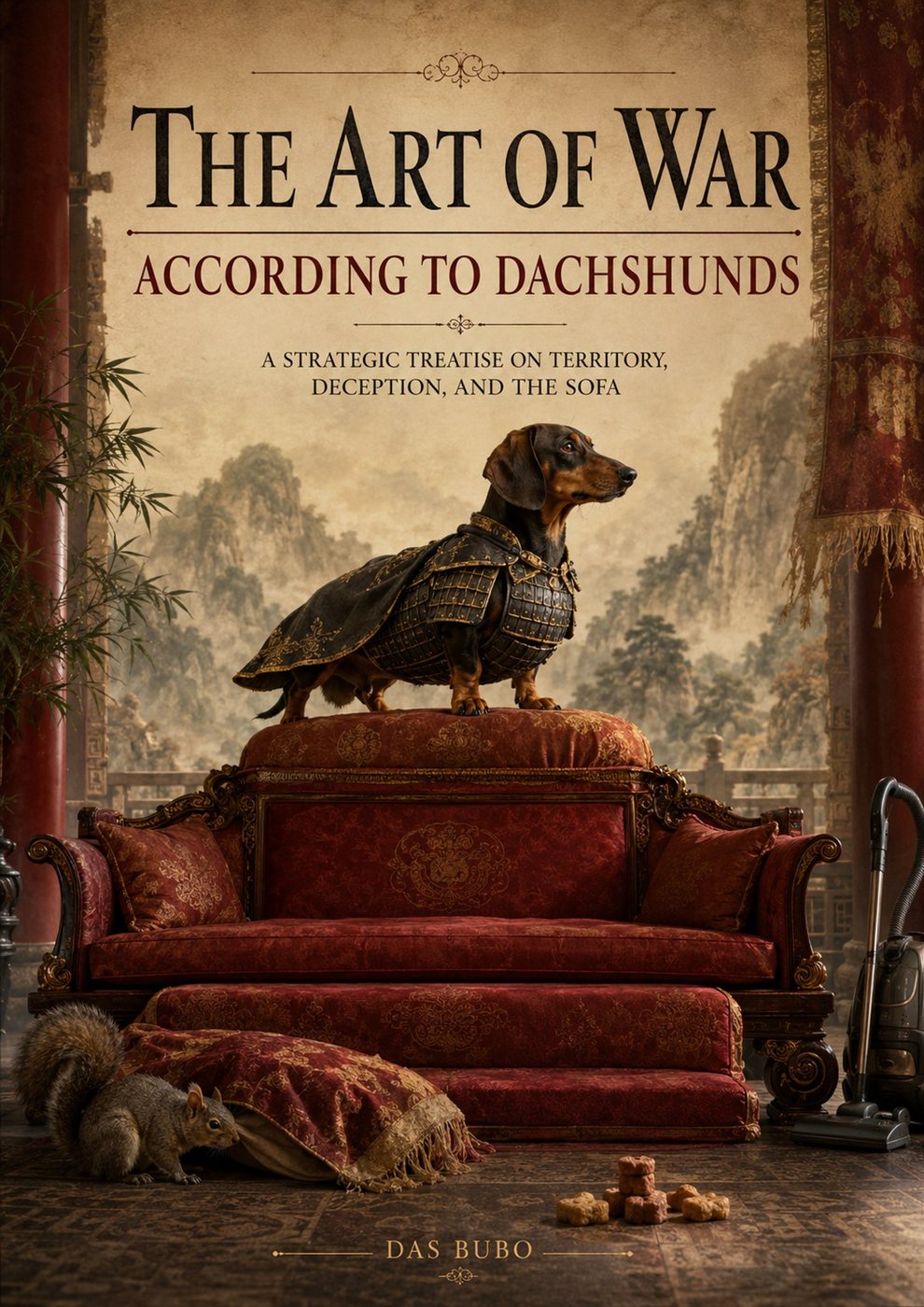
THE ART OF WAR ACCORDING TO DACHSHUNDS
A STRATEGIC TREATISE ON TERRITORY, DECEPTION, AND THE SOFA
Attributed to SUN TZU, called the Low General
With the accumulated commentaries of the later masters
Recovered, arranged, and rendered into the common tongue by DAS BUBO
A DAS BUBO PUBLICATION

BOOKS OF CONSIDERABLE LENGTH
A DAS BUBO PUBLICATION
BOOKS OF CONSIDERABLE LENGTH
PUBLISHER AND CREATIVE IMPRINT: DAS BUBO
EDITORIAL DIRECTION: DAS BUBO
EDITORIAL VOICE: The Das Bubo Editorial Dachshunds
CONCEPT, EDITORIAL DIRECTION, TEXT, AND DESIGN: DAS BUBO
Copyright © 2026 DAS BUBO. All rights reserved.
No part of this publication may be reproduced, stored, transmitted, or redistributed in any form without prior written permission, except for brief quotations used in review, criticism, or other uses permitted by law.
This book is an original work of artistic parody and affectionate reinterpretation inspired by the public-domain classic The Art of War. It is not a literal translation, scholarly edition, or historical reconstruction of Sun Tzu’s text.
All dogs are fictional. Any resemblance to living dachshunds, particularly those who have taken food from a low table and then adopted a look of grave innocence, is entirely plausible.
DAS BUBO · © 2026
PUBLISHER'S NOTE
ON LOWERING THE CENTRE OF GRAVITY
Most editions of The Art of War are concerned with command, terrain, deception, supply, intelligence, and the preservation of the state. This edition is concerned with the same subjects, except that terrain includes the sofa, supply includes cheese, and intelligence is obtained chiefly by watching whoever is cooking.
The DAS BUBO method is simple: treat the classic with enough respect that the parody has something solid to stand on. The architecture remains military. Only the centre of gravity has been lowered by approximately eight inches.
The dachshund is therefore not decoration. He is the interpretive instrument. Few creatures have considered territory, narrow passes, logistics, stubborn refusal, opportunistic alliances, or the tactical value of appearing asleep with greater seriousness.
We have resisted the temptation to explain the jokes, modernize the Master’s voice, or improve the manners of his commentators. A treatise on strategy should sound as though kingdoms depend upon it, even when what depends upon it is the warm hollow in a cushion before it cools.
Read accordingly.
— The Das Bubo Editorial Dachshunds

CONTENTS
THE CAMPAIGN IN ORDER
Translator’s Preface On the Text and Its Transmission
A Note on the Commentators The Five Hands That Follow the Master
Chapter I — Laying Plans The Five Constants of the Household
Chapter II — Waging War No Campaign Outlasts the Supper Hour
Chapter III — Attack by Stratagem Win Without Leaving the Sofa
Chapter IV — Tactical Dispositions Appear Asleep When You Are Listening
Chapter V — Energy The Sudden Application of Small Legs
Chapter VI — Weak Points and Strong The Undefended Bag
Chapter VII — Manoeuvring Between the Legs of the Ministers
Chapter VIII — Variation in Tactics The Nine Refusals
Chapter IX — The Army on the March Following the Cook
Chapter X — Terrain Of Cushions, Thresholds, and the Forbidden Stair
Chapter XI — The Nine Situations From the Hallway to the Deep Duvet
Chapter XII — The Attack by Fire Concerning the Roaring Beast
Chapter XIII — The Use of Spies The Kitchen Must Be Known
Appendix I — The Thirty-Six Stratagems, of Which Nine Survive
Appendix II — A Glossary of the Master’s Terms
About DAS BUBO Books of Considerable Length
Colophon Of the Cushion Text and Its Plates
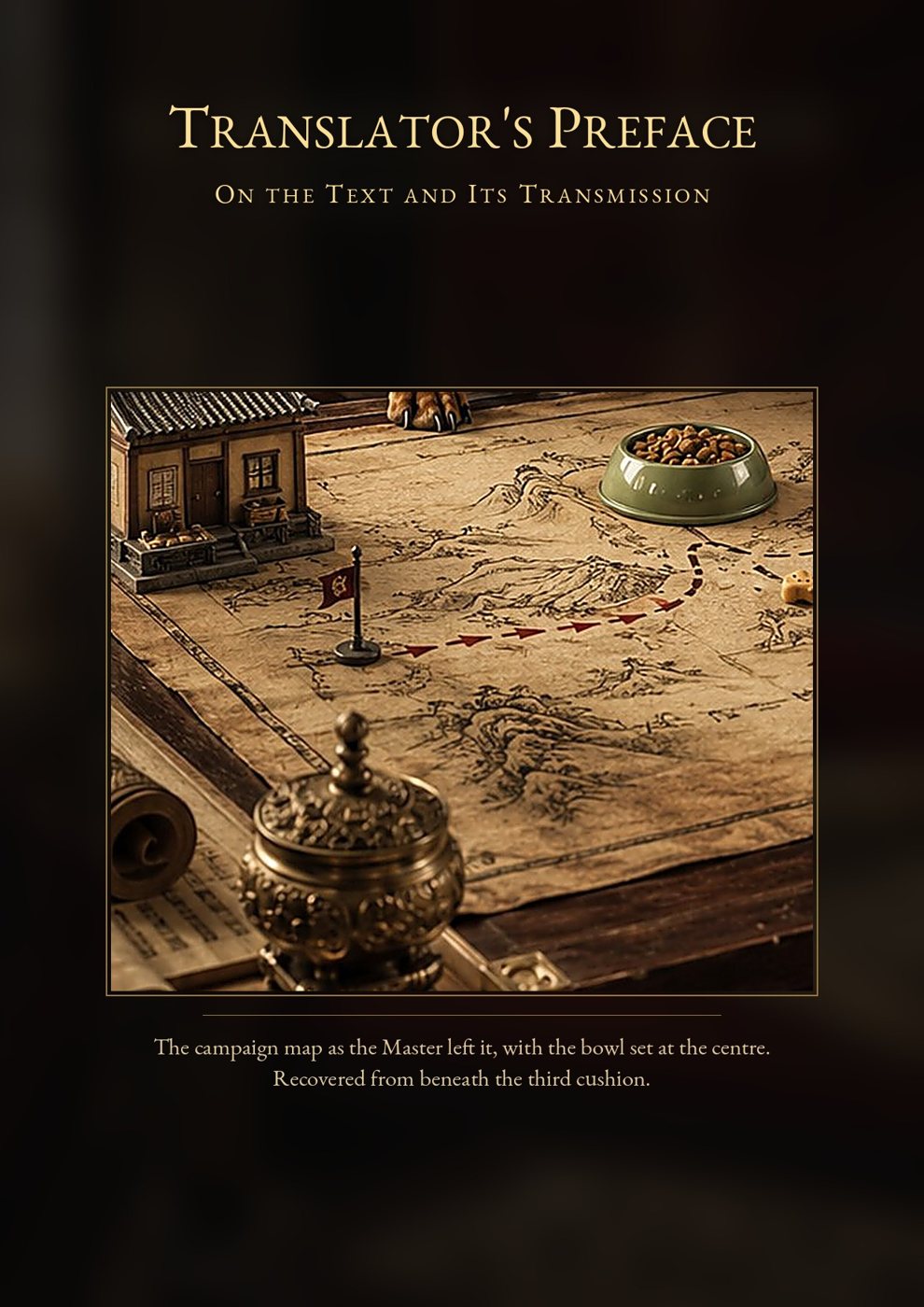
TRANSLATOR'S PREFACE
The text presented here was recovered from beneath the third cushion of a sofa in circumstances the household has asked me not to describe. It was not complete. It was not clean. Two chapters bore the marks of teeth, and the chapter on Fire had been sat upon for what I estimate to be a considerable period.
Of the author, Sun Tzu, called the Low General, almost nothing certain is known. Tradition holds that he was presented to a prince who asked whether the art of war could be taught to anything. Sun Tzu was placed before a plate of sausage and instructed not to take it. The prince recorded that the dog did not take the sausage. The prince also recorded, some minutes later, that the sausage was gone. He appointed him general the same day.
The commentaries are the work of five later hands, none of whom met the Master and all of whom were certain they understood him. I have preserved them in full, including the passages where they contradict one another and the passages where they contradict themselves. The scholarly reader will find this frustrating. The scholarly reader is not the audience for a book about sausage.
A word on terminology. Where the Master writes of the State, I have written of the Household. Where he writes of the sovereign, I have written of the Tall Ones. Where he writes of gold, I have written of cheese, because that is what he meant.
I have added nothing. I have removed only the chewing.
— D.B.
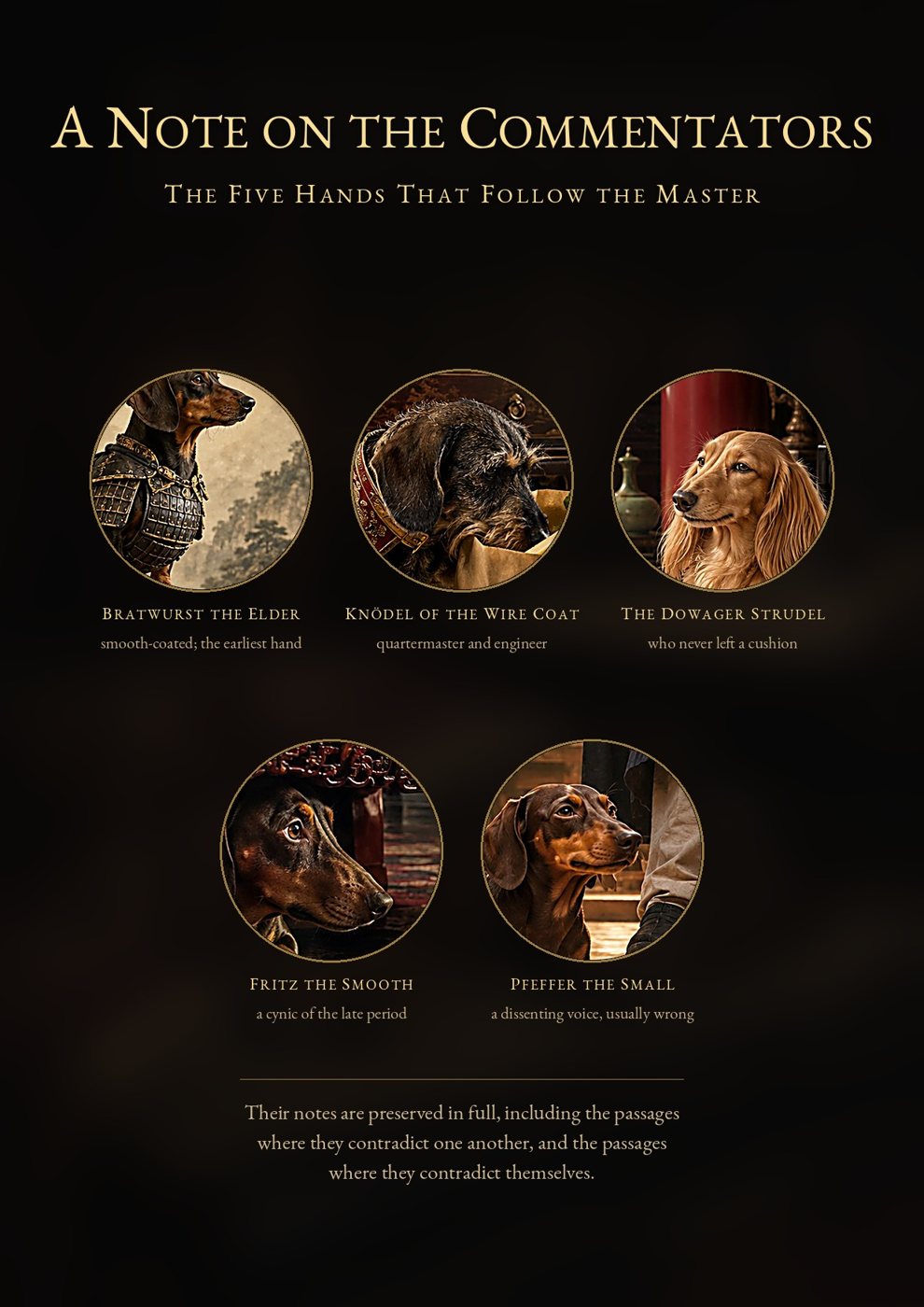
A NOTE ON THE COMMENTATORS

BRATWURST THE ELDER, smooth-coated, the earliest of the commentators and the only one to have seen combat. He fought through the Cushion Wars and lost an ear to a screen door. His notes are brief to the point of rudeness and are generally correct.

KNÖDEL OF THE WIRE COAT, quartermaster and engineer. He held that strategy is a branch of supply and that supply is a branch of the kitchen. His major work, On Bags, is lost. Fragments suggest it was long.
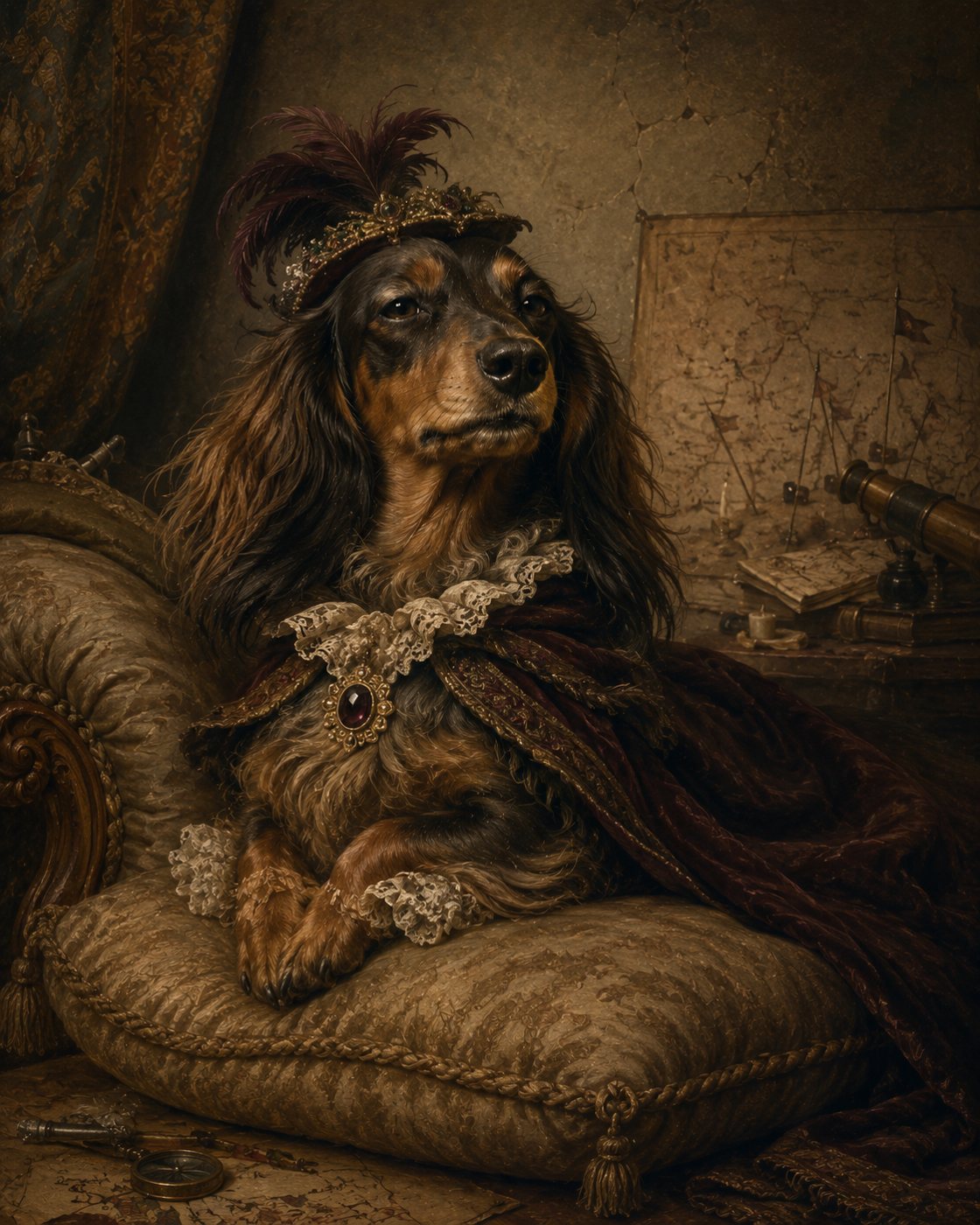
THE DOWAGER STRUDEL, long-haired, who never in her life left a cushion under conditions she considered adverse. She commanded four campaigns from a chaise and won three. Her commentary is concerned chiefly with dignity, and is frequently withering.
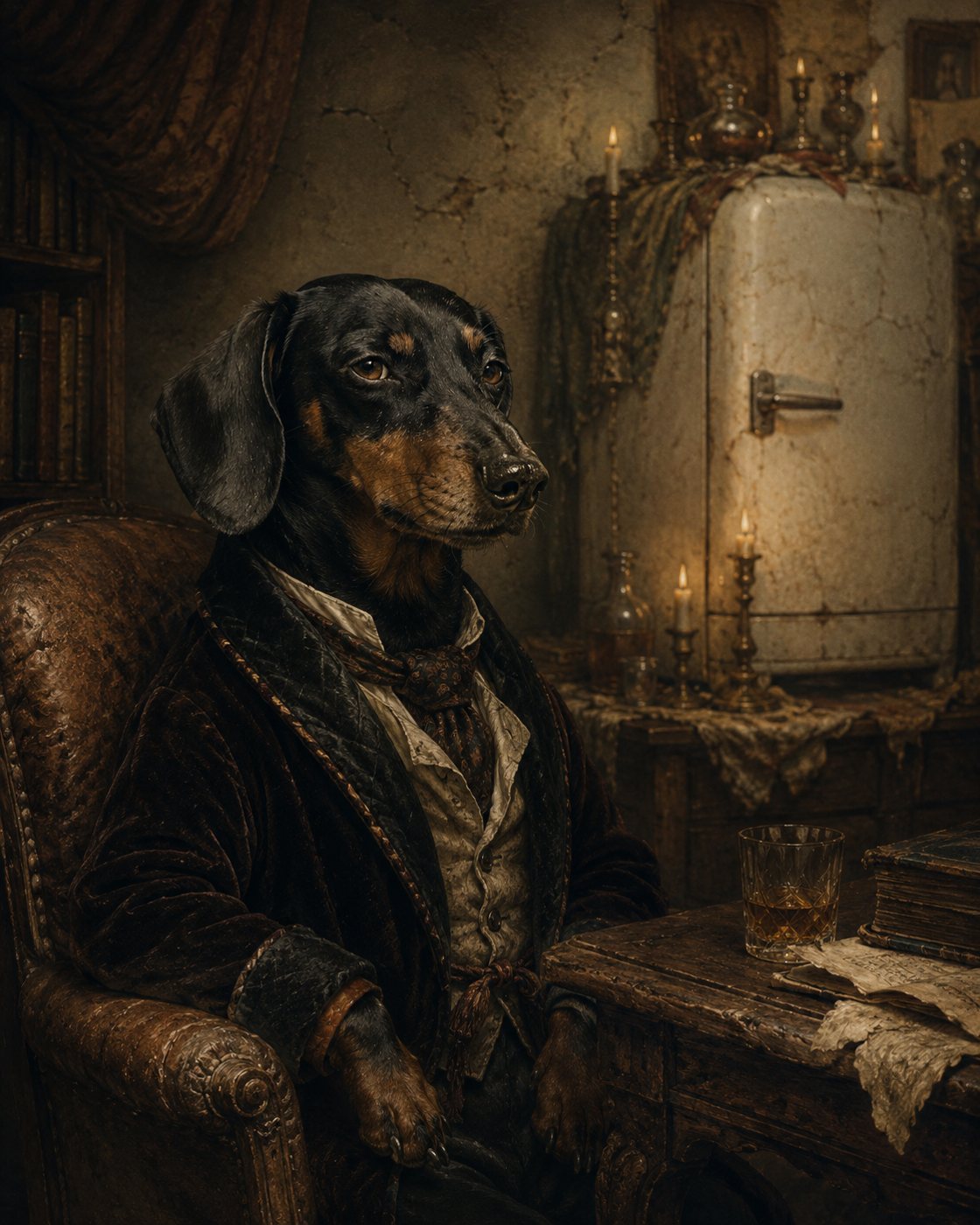
FRITZ THE SMOOTH, the late hand, a cynic of the decadent period. He maintained that the entire treatise is a commentary on the refrigerator and that everything else in it is decoration.

PFEFFER THE SMALL, a miniature of the northern kennels, a dissenting voice, usually wrong, retained by tradition and by the affection of copyists.
孫子の兵法
THE ART OF WAR
A STRATEGIC TREATISE ON TERRITORY, DECEPTION, AND THE SOFA

CHAPTER I
LAYING PLANS
THE FIVE CONSTANTS OF THE HOUSEHOLD
1. Sun Tzu said: The art of war is of vital importance to the Household. It is a matter of supper and of no supper, a road either to the sofa or to the floor.
2. It cannot on any account be neglected. The dog who neglects it sleeps where he is put.
3. The art of war is governed by five constant factors. These are: the Bond; the Hour; the Floor; the General; and Method and Discipline.
4. THE BOND is that which causes the Tall Ones to be in accord with the dog, so that they will feed him regardless of what he has recently done to the rug.
5. THE HOUR comprises night and day, cold and heat, the going-out and the coming-back, and above all the supper hour, which is fixed in the heavens and may be advanced by nothing except sustained looking.
6. THE FLOOR comprises distances great and small; tile and carpet; the height of the cushion; the width of the gap beneath the cabinet; and the sunbeam, which moves.
7. THE GENERAL stands for the virtues of wisdom, appetite, benevolence, stubbornness, and volume.
8. By METHOD AND DISCIPLINE are to be understood the marshalling of the Household into its proper ranks; the graduation of precedence among the dogs; the maintenance of the roads by which food shall reach the dog; and the strict control of the expenditure of naps.
9. These five heads should be familiar to every general. He who knows them will be fed. He who knows them not will be spoken to in the voice reserved for the rug.
10\. Therefore, in your deliberations, compare the two households in this wise:11. Which of the Tall Ones is the more moved by the eye? Which of them drops the more, and drops it lower? In which household is the rule against the table merely spoken, and in which is it enforced? Which of them says no and means not yet? Which of them says no and then looks away? Whose lap is available and whose is defended? Which of them, when the bag is opened, opens it near the floor?
12. By means of these seven considerations I can forecast victory or defeat, and I have not yet been wrong at the hour of supper.
13\. All warfare is founded upon the appearance of innocence.14. Hence, when we are able to reach the counter, we must seem unable to reach the counter. When we are already in the kitchen, we must seem to have arrived there by an error of navigation.
15. When the food is near, we must appear asleep. When the food is far, we must appear asleep, but nearer.
16. Hold out an empty mouth to the enemy. Let him look into it. Let him find nothing. He will not look again for some time, and it is in that interval that the sausage is taken.
17. If the Tall One is at ease, weary him with looking. If he is united with the other Tall One, separate them, and work upon the softer.
18. Attack him where he is unprepared. Appear at the ankle when he is carrying the plate with both hands.
19. These military devices, leading to victory, must not be divulged beforehand, and in any case cannot be, as we do not speak.
20\. Now the general who wins a battle makes many calculations in his mind before the battle is fought. The general who loses a battle makes but few calculations beforehand.21. Thus do many calculations lead to victory, and few calculations to defeat: how much more so where no calculation is made at all, and the dog simply barks at the door because he heard a noise and felt strongly.
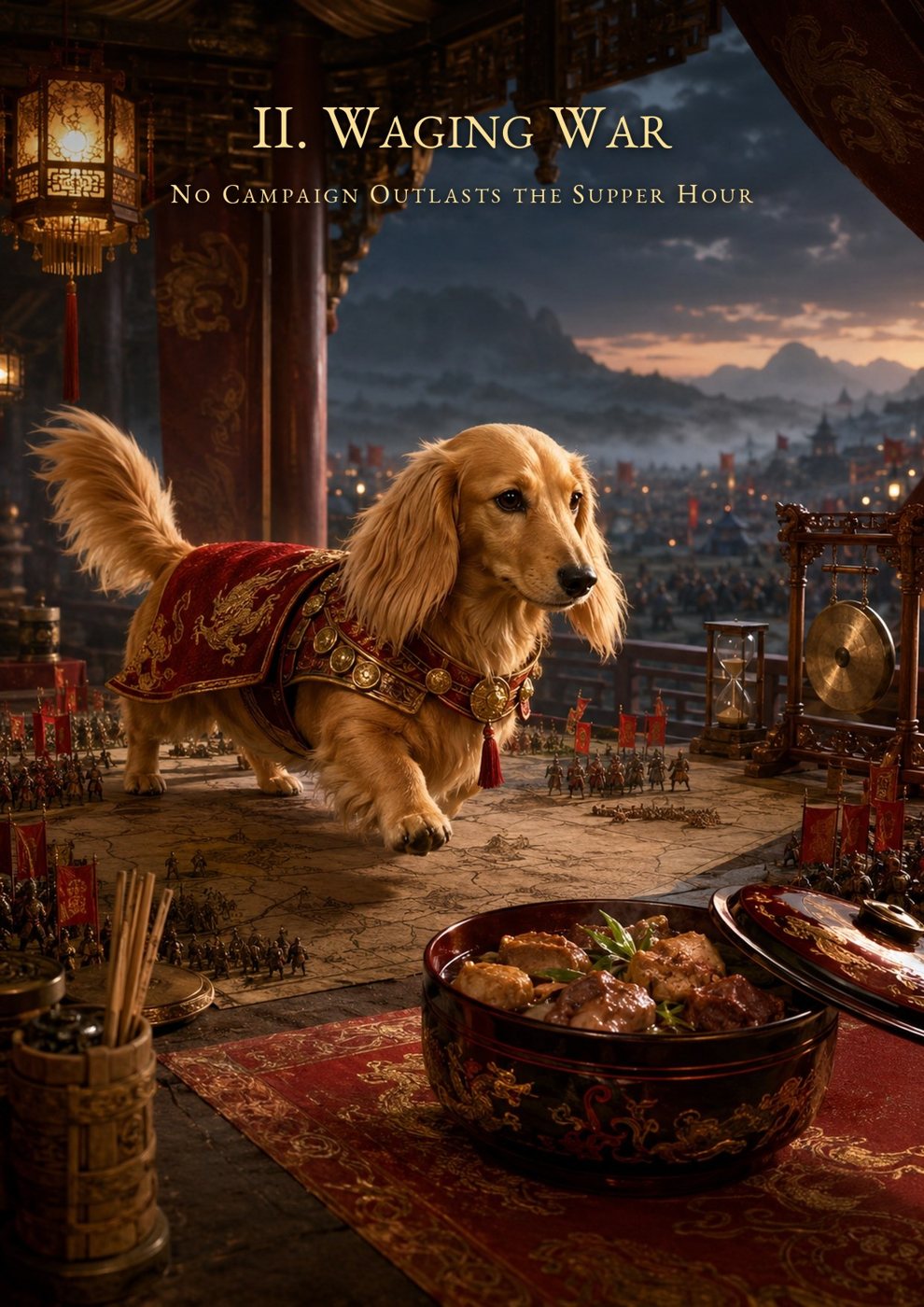
CHAPTER II
WAGING WAR
NO CAMPAIGN OUTLASTS THE SUPPER HOUR
1. Sun Tzu said: In the operations of war, where there are in the field a long body, four short legs, one tail employed as a signal, and provisions sufficient for a single afternoon, the expenditure at home will be heavy.
2. The cost of maintaining the eye alone, in its raised and sorrowing posture, will reach a great sum daily. Such is the cost of raising an army of one.
3. When you engage in actual begging, if victory is long in coming, then the eyes grow weary and their edge is dulled. If you lay siege to a lap, you will exhaust your strength.
4. Again, if the campaign is protracted, the resources of the Household will not be equal to the strain. The Tall Ones will say the word spoiled, and it will go badly for the whole army.
5. Now, when your eyes are dulled, your sorrow damped, your strength exhausted and your treasure of cheese spent, the other dog will spring up to take advantage of your extremity. Then no dog, however wise, will be able to avert the consequences that must ensue.
6. Thus, though we have heard of stupid haste in war, cleverness has never been seen associated with long delays.
7. There is no instance of a Household having benefited from prolonged begging.
8. It is only one who is thoroughly acquainted with the evils of begging who can thoroughly understand the profitable way of doing it.
9\. The skillful general does not raise a second appeal, nor are his supply-wagons loaded more than once.10. Bring war material with you from home, but forage on the enemy. Thus the army will have food enough for its needs.
11. Poverty of the Household treasury causes an army to be maintained by contributions from a distance. The bowl is filled once in the morning and once in the evening, and between these hours the dog who relies upon the bowl is a poor man.
12. On the other hand, the proximity of an army causes prices to go up; and high prices cause the people’s substance to be drained away. Where the dog is seen to want a thing greatly, the thing is put upon a higher shelf.
13. Hence a wise general makes a point of foraging on the enemy. One crumb of the enemy’s provisions is equivalent to twenty of one’s own, and one bite taken from the plate of a Tall One is worth the entire bowl.
14\. Now in order to kill the enemy, our dogs must be roused to anger; that there may be advantage from defeating the enemy, they must have their rewards.15. Therefore in war, let your great object be the sausage, and not the demonstration of longing.
16. The demonstration of longing is a means. Dogs forget this, and grow fond of the demonstration, and perform it beautifully, and are admired, and are not fed.
17\. In war, then, let your great object be victory, not lengthy campaigns.18. Thus it may be known that the leader of armies is the arbiter of the Household’s fate, the man on whom it depends whether the floor shall be swept before supper or after.
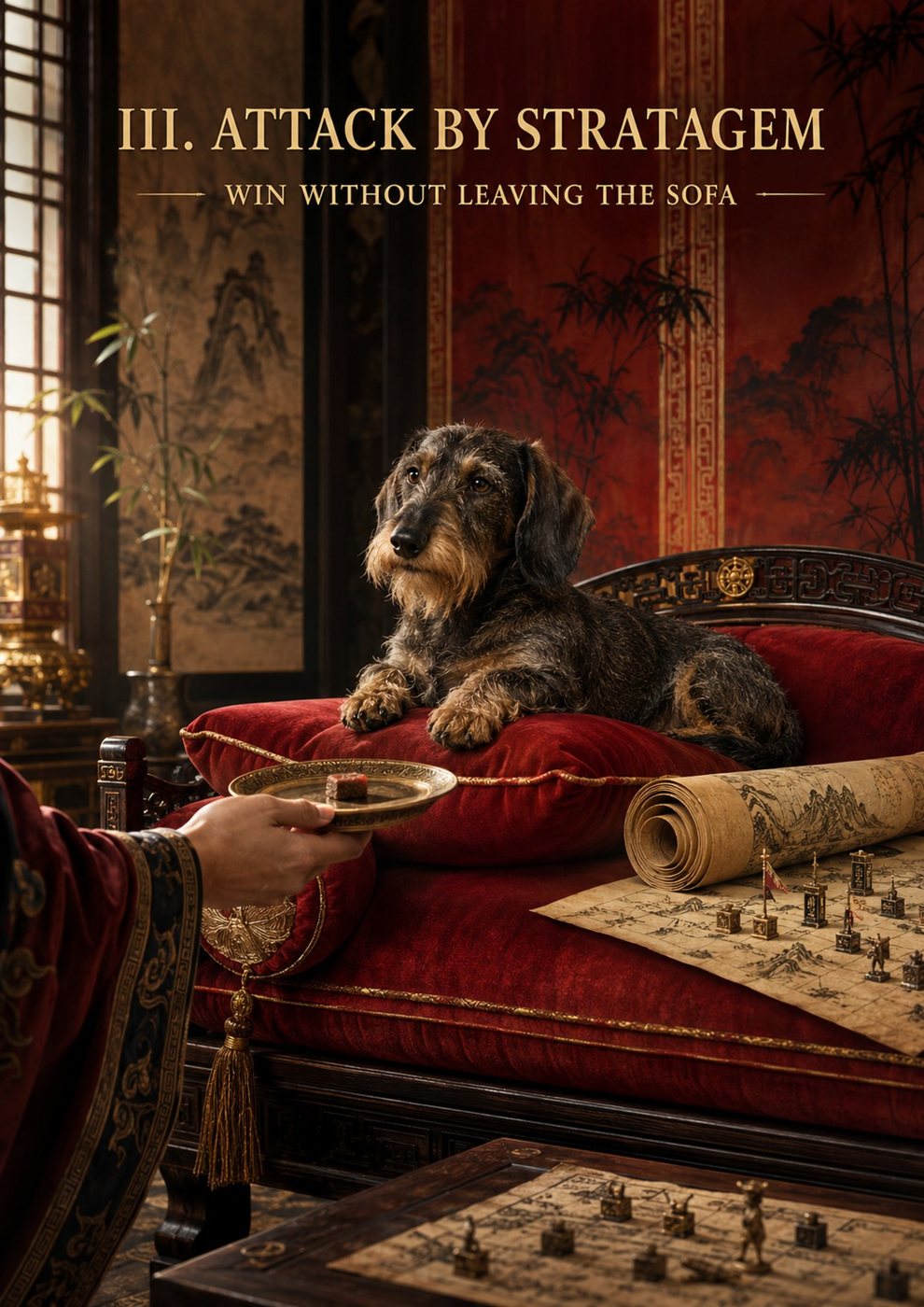
CHAPTER III
ATTACK BY STRATAGEM
WIN WITHOUT LEAVING THE SOFA
1. Sun Tzu said: In the practical art of war, the best thing of all is to take the Household whole and intact; to shatter and destroy it is not so good. So too it is better to take the sandwich entire than to take it in pieces from the floor, in haste, with everyone shouting.
2. Hence to bark a hundred times and be fed a hundred times is not supreme excellence. Supreme excellence consists in obtaining the cheese without rising.
3. Thus the highest form of generalship is to balk the enemy’s plans: to be found already sitting by the door before the thought of the walk has fully formed in him, so that he believes it was his own idea, and is pleased with himself, and gives you a treat for it.
4. The next best is to prevent the junction of the enemy’s forces. Two Tall Ones in one room will agree that you have been fed. One Tall One alone is uncertain, and uncertainty is where the second supper lives.
5. The next in order is to attack the army in the field, which is to say, to place yourself bodily between the Tall One and the television.
6. The worst policy of all is to besiege the closed door of the small tiled room. Barking at that door has never opened it. It has been attempted in every generation. It has never once succeeded, and the scratching is remembered against you for years.
7\. The skillful general subdues the enemy's troops without any fighting; he captures the sofa without a struggle; he overthrows the rule of the household without lengthy operations in the field.8. With his forces intact he disputes the mastery of the cushion, and thus, without losing a dog, his triumph is complete. This is the method of attacking by stratagem.
9. It is the rule in war: if our forces are ten to the enemy’s one, surround him. This is done by lying against the length of him so that he cannot rise without negotiating.
10. If five to one, attack him: place the chin upon the knee.
11. If twice as numerous, divide our army into two: one eye upon the Tall One, one eye upon the plate.
12. If equally matched, we can offer battle. If slightly inferior in numbers, we can avoid the enemy. If quite unequal in every way, we can flee from him, which for us is a matter of going under the bed, where nothing that has ever been built can follow.
13. Though an obstinate fight may be made by a small force, in the end it must be captured by the larger force. This is why we do not fight the Bath. This is why the Bath is not mentioned again in this treatise.
14. Now the general is the bulwark of the Household. If the bulwark is complete at all points, the Household will be strong. If the bulwark is defective, the Household will be weak.
15. There are three ways in which a sovereign can bring misfortune upon his army.
16. By commanding the army to advance or to retreat, being ignorant of the fact that it cannot obey. This is called hobbling the army, and occurs whenever the Tall One says come while holding the towel.
17. By attempting to govern an army in the same way as he administers a kingdom, being ignorant of the conditions which obtain in an army. This is called calling from another room, and it is answered by no dog living.
18. By employing the officers of his army without discrimination, through ignorance of the military principle of adaptation to circumstances. This is called giving the small biscuit to the large dog.
19. Thus we may know that there are five essentials for victory:
20. He will win who knows when to look up and when not to look up.
21. He will win who knows how to handle both superior and inferior forces, which is to say, who knows which Tall One to approach for the meat and which for the walk.
22. He will win whose army is animated by the same spirit throughout all its ranks, so that when one dog goes to the window, all go to the window, and none of them knows why, and the Tall Ones rise in alarm, and the kitchen is left unattended.
23. He will win who, prepared himself, waits to take the enemy unprepared. He is under the table before the plate is set down.
24. He will win who has military capacity and is not interfered with by the sovereign. Such a dog is fed by the guest.
25. Hence the saying: If you know the enemy and know yourself, you need not fear the result of a hundred suppers. If you know yourself but not the enemy, for every victory gained you will also suffer a defeat. If you know neither the enemy nor yourself, you will be given the kind of food that is good for you.
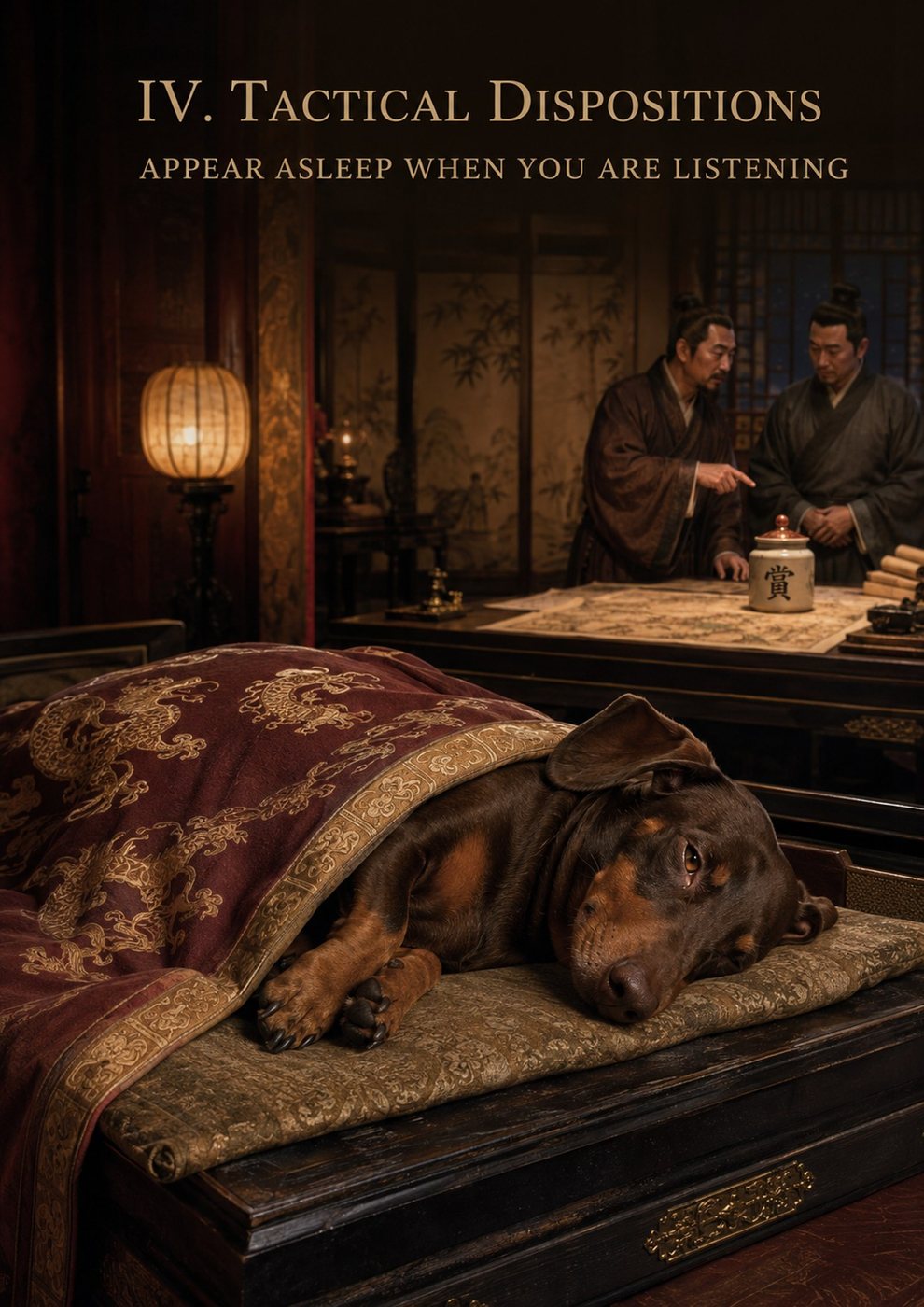
CHAPTER IV
TACTICAL DISPOSITIONS
APPEAR ASLEEP WHEN YOU ARE LISTENING
1. Sun Tzu said: The good fighters of old first put themselves beyond the possibility of defeat, and then waited for an opportunity of defeating the enemy. This is done by securing the cushion in the early afternoon, when no one wants it, and holding it into the evening, when everyone does.
2. To secure ourselves against defeat lies in our own hands, but the opportunity of defeating the enemy is provided by the enemy himself. He will at some point put down the plate.
3. Hence the good fighter is able to secure himself against defeat, but cannot certainly cause the enemy to be careless.
4. Hence the saying: One may know how to conquer without being able to do it, and this is why we sleep so much. Sleep is not idleness. Sleep is the army in reserve.
5\. Security against defeat implies defensive tactics; ability to defeat the enemy means taking the offensive. Standing on one's feet is offensive. Lying flat in the doorway, so that the whole house must step over you, is defensive, and is stronger.6. Standing on the defensive indicates insufficient strength; attacking, a superabundance of strength. The dog who has just eaten attacks. The dog who has not eaten occupies the doorway.
7. The general skilled in defence hides in the most secret recesses of the earth; he who is skilled in attack flashes forth from the topmost heights of heaven. This is the whole meaning of the blanket and the back of the sofa respectively.
8. To see victory only when it is within the ken of the common herd is not the acme of excellence. To hear the bag when it opens is nothing. Every dog in the house hears the bag.
9. Neither is it the acme of excellence if you rise at the sound of the bag and are commended for your quickness.
10. The acme is to be already in the kitchen, seated, facing away, having risen nine minutes earlier for no reason that any witness could name.
11. What the ancients called a clever fighter is one who not only wins, but excels in winning with ease.
12. Hence his victories bring him neither reputation for wisdom nor credit for courage. Nobody says of such a dog that he is clever. They say that he is lucky, and that he is always somehow there, and they say it while feeding him.
13\. He wins his battles by making no mistakes. Making no mistakes is what establishes the certainty of victory, for it means conquering an enemy that is already defeated. The plate on the low table is already yours. It has been yours since it was set down. Only the timing remains to be arranged.14. Hence the skillful fighter puts himself into a position which makes defeat impossible, and does not miss the moment for defeating the enemy.
15. Thus it is that in war the victorious strategist only seeks battle after the victory has been won, whereas he who is destined to defeat first barks and afterwards looks for the reason.
16. The consummate leader cultivates the Bond and strictly adheres to Method and Discipline; thus it is in his power to control success.
17. In respect of military method, we have, firstly, Measurement; secondly, Estimation of quantity; thirdly, Calculation; fourthly, Balancing of chances; fifthly, Victory.
18. MEASUREMENT owes its existence to the Floor: how far the crumb has fallen from the ankle, and whether it lies within the zone where retrieval is permitted or the zone where it is called stealing.
19. ESTIMATION OF QUANTITY owes its existence to Measurement: what is fallen is not all that will fall. A Tall One eating standing up over a sink is a whole campaign. A Tall One eating with a napkin is a famine.
20. CALCULATION owes its existence to Estimation: the interval between the fall of the crumb and the lowering of the eyes of the Tall One. This interval is measured in the time it takes him to finish a sentence.
21. BALANCING OF CHANCES owes its existence to Calculation: whether the crumb is worth the word no.
22. VICTORY owes its existence to Balancing of Chances. Victory is the crumb, and it is always worth the word no.
23\. A victorious army opposed to a routed one is as a pound weight placed in the scale against a single grain.24. The onrush of a conquering force is like the bursting of pent-up waters into a chasm a thousand fathoms deep, and this is what is meant by the arrival of a small dog in a room where a child is holding food at the height of the shoulder.

CHAPTER V
ENERGY
THE SUDDEN APPLICATION OF SMALL LEGS
1. Sun Tzu said: The control of a large force is the same in principle as the control of a few dogs: it is merely a question of dividing up their numbers. Where there is one dog, divide him into the part that is asleep and the part that is listening.
2. Fighting with a large army under your command is nowise different from fighting with a small one: it is merely a question of instituting signs and signals. Ours are three: the sigh, the single strike of the tail upon the floorboard, and the placing of the chin upon the shoe.
3. To ensure that your whole host may withstand the brunt of the enemy’s attack and remain unshaken, this is effected by manoeuvres direct and indirect.
4. In all fighting, the direct method may be used for joining battle, but indirect methods will be needed in order to secure victory. The direct method is to look at the food. The indirect method is to look at the Tall One who is holding it, in silence, for a long time, as though remembering him fondly after his death.
5\. Indirect tactics, efficiently applied, are inexhaustible as heaven and earth, unending as the flow of rivers and streams; like the sun and moon, they end but to begin anew; like the four seasons, they pass away but to return once more.6. There are not more than five musical notes, yet the combinations of these five give rise to more melodies than can ever be heard.
7. There are not more than five primary colours, yet in combination they produce more hues than can ever be seen.
8. There are not more than three postures of the ear, yet their combinations cannot be exhausted, and by them a dog may say I am hungry, I am wronged, there is someone at the gate, and I did not do it, which is the fourth posture and is a combination of the other three.
9. In battle, there are not more than two methods of attack, the direct and the indirect; yet these two in combination give rise to an endless series of manoeuvres.
10. The direct and the indirect lead on to each other in turn. It is like moving in a circle: you never come to an end. Who can exhaust the possibilities of their combination?
11. The onset of troops is like the rush of a torrent which will even roll stones along in its course.
12. The quality of decision is like the well-timed swoop of a falcon, which enables it to strike and destroy its victim. It is like the departure, at speed, of a small dog from a room in which nothing has happened, for a destination he has not chosen, by a route that includes the sofa twice.
13. Therefore the good fighter will be terrible in his onset, and prompt in his decision.
14. Energy may be likened to the bending of a crossbow; decision, to the releasing of the trigger. In our own case the bow is the body itself, which is long, and which is bent by nature, and which requires only that the hind legs be permitted to arrive.
15\. Amid the turmoil and tumult of battle, there may be seeming disorder and yet no real disorder at all; amid confusion and chaos, your array may be without head or tail, yet it will be proof against defeat.16. Simulated disorder postulates perfect discipline; simulated fear postulates courage; simulated weakness postulates strength.
17. Hiding order beneath the cloak of disorder is simply a question of subdivision; concealing courage under a show of timidity presupposes a fund of latent energy; masking strength with weakness is to be effected by tactical dispositions.
18. Thus one who is skillful at keeping the enemy on the move maintains deceitful appearances, according to which the enemy will act. He limps until the leash appears. He is grey about the muzzle and slow upon the stair until the refrigerator is opened, whereupon he is four years old.
19\. He sacrifices something, that the enemy may snatch at it. By holding out baits, he keeps him on the march; then with a body of picked men he lies in wait for him. He drops the toy at the feet of the Tall One so that the Tall One may throw it, and rise to throw it, and leave the chair, which was the object of the entire operation. 20\. The clever combatant looks to the effect of combined energy, and does not require too much from individuals. Hence his ability to pick out the right dogs and utilise combined energy.21. When he utilises combined energy, his fighting men become as it were like unto rolling logs or stones. For it is the nature of a log or stone to remain motionless on level ground, and to move when on a slope; if four-cornered, to come to a standstill, but if round-shaped, to go rolling down.
22. Thus the energy developed by good fighting men is as the momentum of a round stone rolled down a mountain thousands of feet in height. So much on the subject of energy, and of the two seconds after the front door closes, when the entire army arrives on the bed at once.
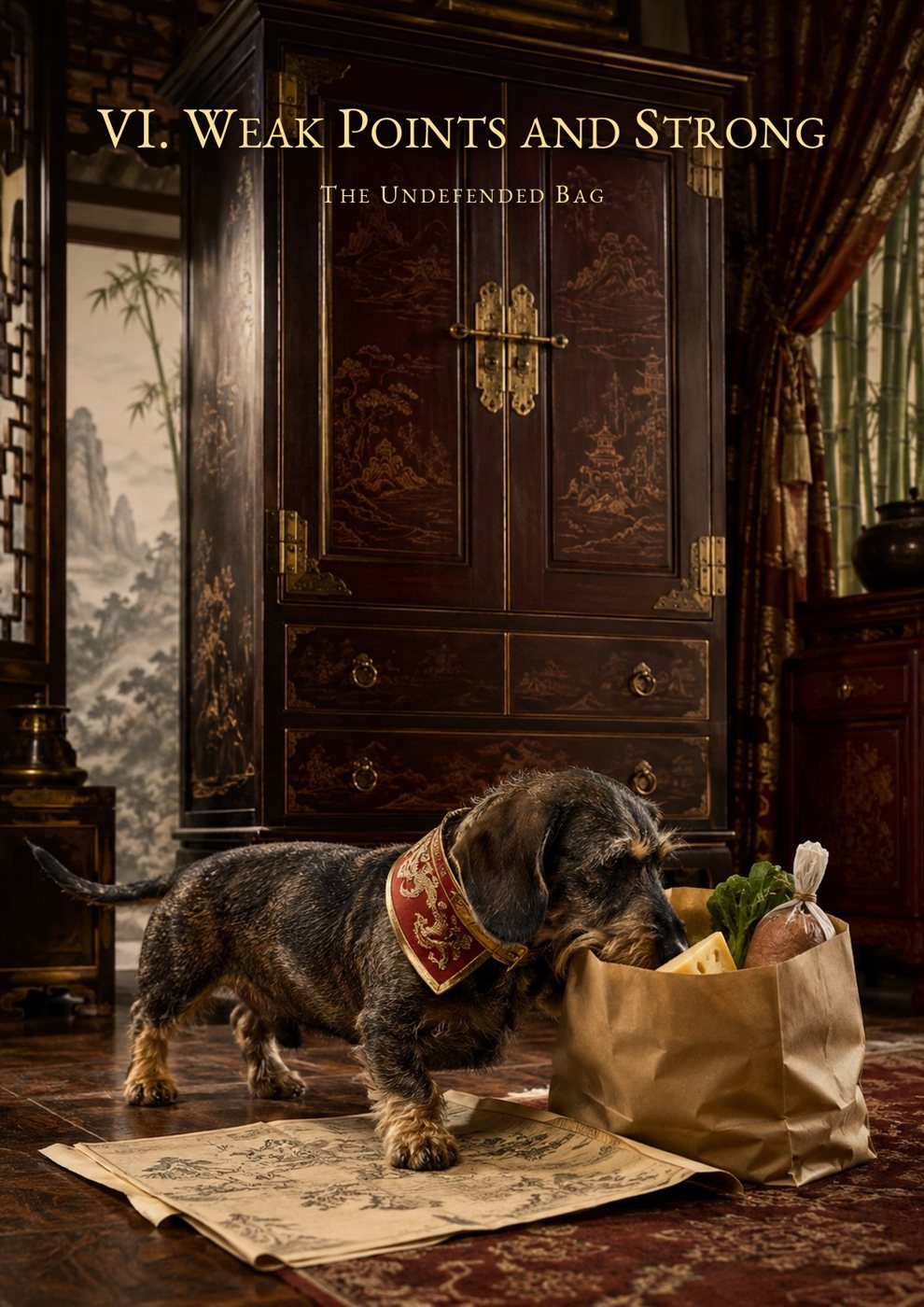
CHAPTER VI
WEAK POINTS AND STRONG
THE UNDEFENDED BAG
1. Sun Tzu said: Whoever is first in the kitchen and awaits the coming of the Tall Ones will be fresh for the fight; whoever is second in the kitchen and has to hasten to it will arrive exhausted, and will arrive visibly, and the visible arrival is itself the defeat.
2. Therefore the clever combatant imposes his will on the enemy, but does not allow the enemy’s will to be imposed on him.
3. By holding out advantages to him, he can cause the enemy to approach of his own accord; or, by inflicting damage, he can make it impossible for the enemy to draw near. The first is done by rolling over. The second is done by rolling in something.
4. If the enemy is taking his ease, he can harass him; if well supplied with food, he can starve him out; if quietly encamped, he can force him to move. This last is achieved by standing at the door, in silence, facing the door.
5. Appear at points which the enemy must hasten to defend; march swiftly to places where you are not expected.
6. An army may march great distances without distress, if it marches through country where the enemy is not. Such country is the corridor at four in the morning.
7. You can be sure of succeeding in your attacks if you only attack places which are undefended. There is in every household one such place. It is the paper bag of provisions, set down upon the floor for one minute while the door is closed.
8. You can ensure the safety of your defence if you only hold positions that cannot be attacked. There is one such position. It is beneath the bed, in the middle, where the arms of the Tall Ones do not reach and where they must speak to you in a tone that they will later regret.
9\. Hence that general is skillful in attack whose opponent does not know what to defend; and he is skillful in defence whose opponent does not know what to attack.10. O divine art of subtlety and secrecy! Through you we learn to be invisible, through you inaudible; and hence we can hold the enemy’s fate in our hands. This is possible for us above all peoples, for we are built low, and the eye of the Tall One is set high, and there exists beneath his gaze a country he has never surveyed.
11. You may advance and be absolutely irresistible, if you make for the enemy’s weak points; you may retire and be safe from pursuit if your movements are more rapid than those of the enemy, or if you go where he must first find a torch.
12. If we wish to fight, the enemy can be forced to an engagement even though he be sheltered behind a high rampart and a deep ditch. All we need do is attack some other place that he will be obliged to relieve. Take up the shoe. Do not chew the shoe. Merely stand with the shoe, in the hallway, and be seen.
13. If we do not wish to fight, we can prevent the enemy from engaging us even though the lines of our encampment be merely traced out on the ground. All we need do is to throw something odd and unaccountable in his way, such as being suddenly and profoundly asleep.
14. By discovering the enemy’s dispositions and remaining invisible ourselves, we can keep our forces concentrated, while the enemy’s must be divided.
15. We can form a single united body, while the enemy must split up into fractions. Hence there will be a whole pitted against separate parts of a whole, which means that we shall be many to the enemy’s few. This is the doctrine of the household with two Tall Ones and one dog, and it is the reason the dog is fed twice.
16\. And if we are able thus to attack an inferior force with a superior one, our opponents will be in dire straits.17. The spot where we intend to fight must not be made known; for then the enemy will have to prepare against a possible attack at several different points; and his forces being thus distributed in many directions, the numbers we shall have to face at any given point will be proportionately few.
18. Numerical weakness comes from having to prepare against possible attacks; numerical strength, from compelling our adversary to make these preparations against us.
19. Knowing the place and the time of the coming battle, we may concentrate from the greatest distances in order to fight. But if neither time nor place be known, then the left wing will be impotent to succour the right, the right equally impotent to succour the left, the van unable to relieve the rear, or the rear to support the van. How much more so if the furthest portions of the army are anything under a hundred paces apart, and one of them is asleep in a sunbeam!
20. Military tactics are like unto water; for water in its natural course runs away from high places and hastens downwards.
21. So in war, the way is to avoid what is strong and to strike at what is weak.
22. Water shapes its course according to the nature of the ground over which it flows; the soldier works out his victory in relation to the foe whom he is facing. Our people, being of a shape that is mostly length, take the form of whatever gap is offered, and this is why the fence was replaced, and why the second fence was also replaced.
23. Therefore, just as water retains no constant shape, so in warfare there are no constant conditions.
24. He who can modify his tactics in relation to his opponent, and thereby succeed in winning, may be called a heaven-born captain.
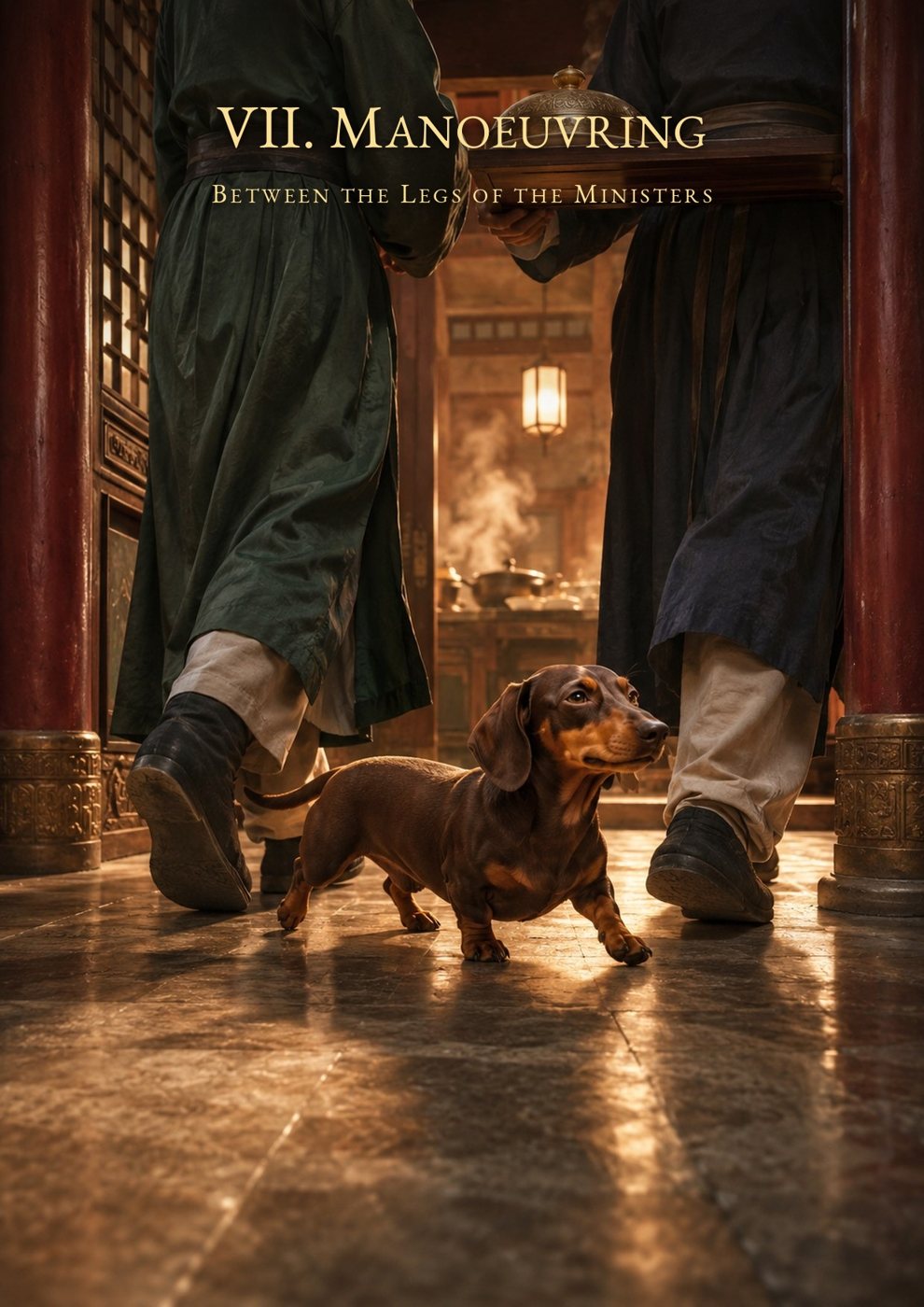
CHAPTER VII
MANOEUVRING
BETWEEN THE LEGS OF THE MINISTERS
1. Sun Tzu said: In war, the general receives his commands from the sovereign, collects his army, and blends it into a harmonious whole before pitching his camp on the coldest tile in the house, which is under the table, where the plates pass overhead.
2. After that comes tactical manoeuvring, than which there is nothing more difficult. The difficulty of tactical manoeuvring consists in turning the devious into the direct, and misfortune into gain.
3. Thus, to take a long and circuitous route, after enticing the enemy out of the way, and though starting after him, to contrive to reach the goal before him, shows knowledge of the artifice of deviation.
4. The road to the kitchen does not pass through the kitchen door while the Tall One is watching it. It passes behind the chair, along the wall, beneath the table, and arrives at the ankle from the blind side. It is four times longer and it is the shorter road.
5\. Manoeuvring with an army is advantageous; with an undisciplined multitude, most dangerous. Two dachshunds moving on the kitchen at once is not a manoeuvre. It is a noise.6. If you set a fully equipped army in march in order to snatch an advantage, the chances are that you will be too late. On the other hand, to detach a flying column for the purpose involves the sacrifice of its baggage and stores. There is no dog alive who has taken the counter at a run and also taken it quietly.
7. Thus, if you order your men to roll up their buff-coats, and make forced marches without halting day or night, covering double the usual distance at a stretch, you will lose the greater part of your army. Consider the young dog who follows the Tall One from room to room from morning until night, and is never once fed for it, and sleeps like the dead at six o’clock, when the plates come out.
8. We cannot enter into alliances until we are acquainted with the designs of our neighbours. We may not consider the cat an ally. We may, however, consider what the cat causes to fall.
9\. We are not fit to lead an army on the march unless we are familiar with the face of the country: its mountains and forests, its pitfalls and precipices, its marshes and swamps. In our own country these are: the stair, the cord of the lamp, the puddle by the door, the rug that slides, and the small hard toy that belongs to the child and is left in the dark.10. We shall be unable to turn natural advantages to account unless we make use of local guides. The local guide is the older dog, who does not run to the door when the bell rings, and who is therefore in the kitchen alone.
11. In war, practise dissimulation, and you will succeed. Move only if there is a real advantage to be gained.
12. Whether to concentrate or to divide your troops must be decided by circumstances.
13. Let your rapidity be that of the wind, your compactness that of the forest.
14. In raiding and plundering be like fire; in immovability like a mountain. Immovability is our greatest art. There is no force in this house sufficient to move a dachshund who has decided, on a matter of principle, that the walk is over.
15. Let your plans be dark and impenetrable as night, and when you move, fall like a thunderbolt.
16. When you plunder a countryside, let the spoil be divided amongst your men; when you capture new territory, cut it up into allotments for the benefit of the soldiery. This is the law of the fallen sandwich, and it is why the second dog must be present, and slow.
17. Ponder and deliberate before you make a move.
18. He will conquer who has learnt the artifice of deviation. Such is the art of manoeuvring.
19. The Book of Army Management says: On the field of battle, the spoken word does not carry far enough: hence the institution of gongs and drums. Nor can ordinary objects be seen clearly enough: hence the institution of banners and flags.
20. Gongs and drums, banners and flags, are means whereby the ears and eyes of the host may be focused on one particular point.
21. The host thus forming a single united body, it is impossible either for the brave to advance alone, or for the cowardly to retreat alone. This is the art of handling large masses of men.
22. Our own gongs are the bark, which is for the gate; the whine, which is for the Tall One who is already looking; the sigh, which is for the Tall One who is not; and the tail struck once upon the floor, which is used when it is important that the enemy believe you are asleep and yet you wish him to know that you have heard, and are wounded by it.
23\. A whole army may be robbed of its spirit; a commander-in-chief may be robbed of his presence of mind.24. Now a soldier’s spirit is keenest in the morning; by noonday it has begun to flag; and in the evening, his mind is bent only on returning to camp. This is the whole timetable of our people, and the Tall Ones have never once noticed that it is a strategy.
25. A clever general, therefore, avoids an army when its spirit is keen, but attacks it when it is sluggish and inclined to return. This is the art of studying moods. The Tall One at breakfast is a fortress. The Tall One at nine in the evening, on the sofa, with the light low, is an open gate.
26. Disciplined and calm, to await the appearance of disorder and hubbub amongst the enemy: this is the art of retaining self-possession.
27. To be near the goal while the enemy is still far from it, to wait at ease while the enemy is toiling and struggling, to be well-fed while the enemy is famished: this is the art of husbanding one’s strength.
28. To refrain from intercepting an enemy whose banners are in perfect order, to refrain from attacking an army drawn up in calm and confident array: this is the art of studying circumstances.
29. It is a military axiom not to advance uphill against the enemy, nor to oppose him when he comes downhill.
30. Do not pursue an enemy who simulates flight; do not attack soldiers whose temper is keen.
31. Do not swallow bait offered by the enemy. Do not interfere with an army that is returning home.
32. When you surround an army, leave an outlet free. Do not press a desperate foe too hard. Do not press a Tall One who is carrying a full cup with both hands, however low the cup, however good the smell of it, however clearly it is meant for you.
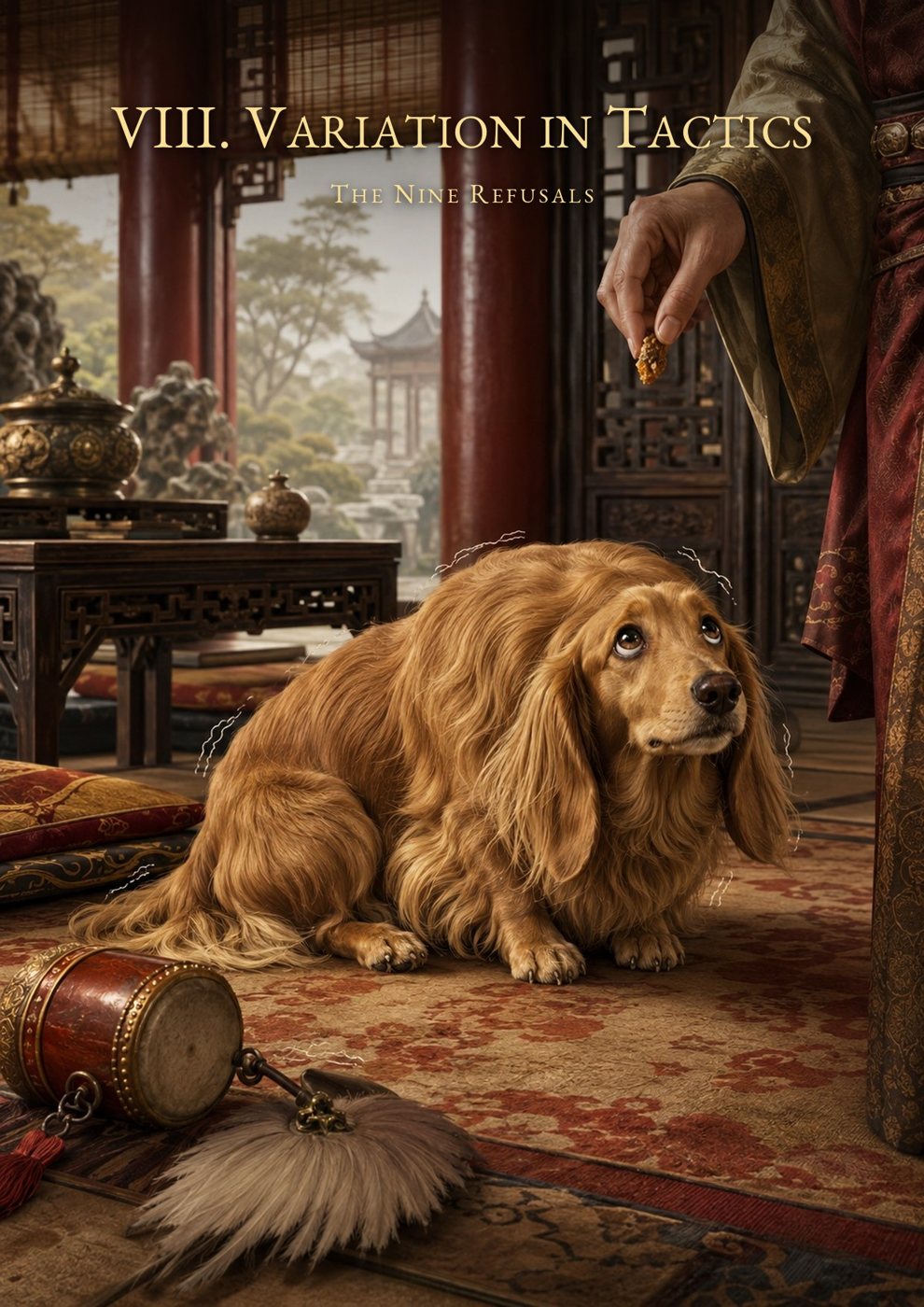
CHAPTER VIII
VARIATION IN TACTICS
THE NINE REFUSALS
1. Sun Tzu said: In war, the general receives his commands from the sovereign, collects his army and concentrates his forces. He then hears his name called, and considers it.
2. When in difficult country, do not encamp. In country where high roads intersect, join hands with your allies. Do not linger in dangerously isolated positions. In hemmed-in situations, you must resort to stratagem. In desperate position, you must fight.
3. There are roads which must not be followed, armies which must not be attacked, towns which must not be besieged, positions which must not be contested, commands of the sovereign which must not be obeyed.
4. Concerning the last, the Master’s disciples asked him to be plain, and he set out the Nine Refusals, which are these:
5. THE FIRST REFUSAL is of the command that is given from another room. It is not a command. It is a hope, expressed aloud, and it may be honoured or not according to the weather.
6. THE SECOND REFUSAL is of the command come when it is spoken in the tone reserved for the towel, the brush, the small bottle, or the clipping of the nails. This tone is unmistakable. Every dog knows it. Every Tall One believes he has concealed it.
7. THE THIRD REFUSAL is of the command to descend the stair at speed, which the long-backed general must never obey, for the body is a bridge and a bridge is not a spring. On this point the Master is inflexible, and every commentator, for once, agrees.
8. THE FOURTH REFUSAL is of the command to leave the bed in the morning at the first summons. The first summons is exploratory. Nothing has ever come of it.
9. THE FIFTH REFUSAL is of the command to walk in the rain, which no dog of dignity has ever obeyed, and which has been the ruin of many great generals, who stood in the doorway on principle and lost the whole afternoon.
10. THE SIXTH REFUSAL is of the command to release the object, when the object was found by you, upon the floor, in a house where things are constantly being dropped by people who then walk away from them.
11. THE SEVENTH REFUSAL is of the command to be friendly to the guest who has brought no food. Politeness is a treasury. Do not spend it at a loss.
12. THE EIGHTH REFUSAL is of the command to enter the small tiled room where the water falls. Here the Master permits open flight, and does not count it against the general’s record.
13. THE NINTH REFUSAL is of the command no when it is spoken by a Tall One who is smiling. Such a command has never once been enforced in the history of any household, and to obey it is to insult the giver.
14\. The general who thoroughly understands the advantages that accompany variation of tactics knows how to handle his troops.15. The general who does not understand these may be well acquainted with the configuration of the country, yet he will not be able to turn his knowledge to practical account.
16. So, the student of war who is unversed in the art of varying his plans, even though he be acquainted with the Five Constants, will fail to make the best use of his men.
17. Hence in the wise leader’s plans, considerations of advantage and of disadvantage will be blended together.
18. If our expectation of advantage be tempered in this way, we may succeed in accomplishing the essential part of our schemes.
19. If, on the other hand, in the midst of difficulties we are always ready to seize an advantage, we may extricate ourselves from misfortune. Thus the dog who is being scolded, and who during the scolding notices that the oven door has been left open, is not in difficulty at all. He is in a briefing.
20. Reduce the hostile chiefs by inflicting damage on them; make trouble for them, and keep them constantly engaged; hold out specious allurements, and make them rush to any given point.
21. The art of war teaches us to rely not on the likelihood of the enemy’s not coming, but on our own readiness to receive him; not on the chance of his not attacking, but rather on the fact that we have made our position unassailable. In practical terms: assume the bag contains food. Assume it always. You will be wrong nine times and right on the tenth, and the tenth is a whole ham.
22. There are five dangerous faults which may affect a general:
23. RECKLESSNESS, which leads to destruction. This is the leap from the high bed, taken in joy, in a body that was built long and low for the pursuit of badgers in the dark, and not for descent. Many great captains have been ruined at the moment of their gladness.
24. COWARDICE, which leads to capture. This is the fear of the floor that shines, which is a fear of nothing, and which surrenders three rooms without a blow.
25. A HASTY TEMPER, which can be provoked by insults. This is the bark given at the Delivery Man before he has reached the gate, which announces the garrison, wastes the ammunition, and teaches the enemy the strength of the walls.
26. A DELICACY OF HONOUR, which is sensitive to shame. This is refusing to walk in the rain, or to be laughed at while wearing the coat, or to accept the small biscuit in front of the large dog. Honour is expensive and is not eaten.
27. OVER-SOLICITUDE FOR HIS MEN, which exposes him to worry and trouble. This is following the Tall One into the small tiled room, where no food has ever been, and where you will now be shut in with him, having chosen it yourself.
28. These are the five besetting sins of a general, ruinous to the conduct of war.
29. When an army is overthrown and its leader slain, the cause will surely be found among these five dangerous faults. Let them be a subject of meditation.
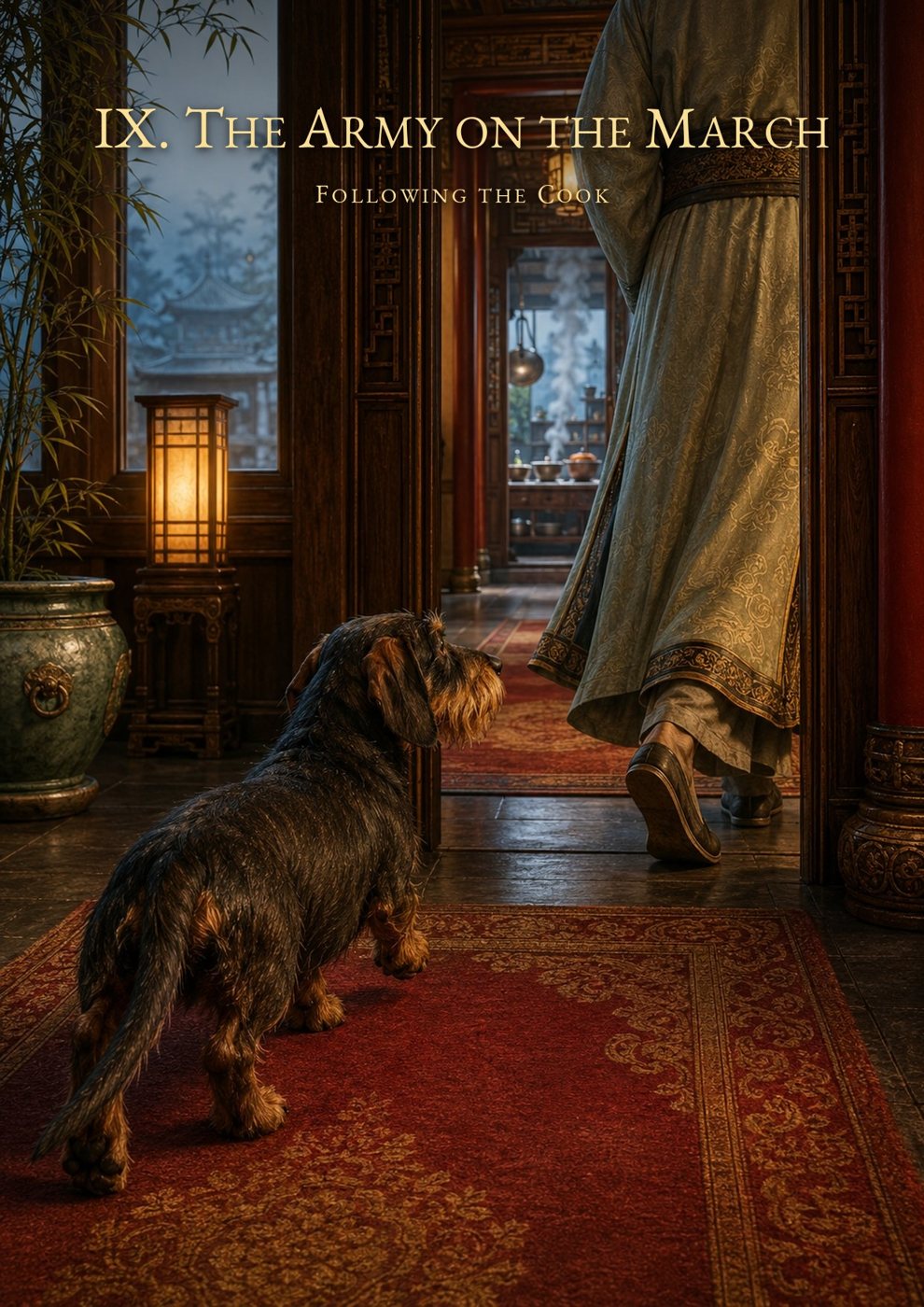
CHAPTER IX
THE ARMY ON THE MARCH
FOLLOWING THE COOK
1. Sun Tzu said: We come now to the question of encamping the army, and observing signs of the enemy. Pass quickly over mountains, and keep in the neighbourhood of valleys. This is to say: cross the empty room at speed, and remain always in the low country, which is the kitchen, and which is where the rivers arise.
2. Camp in high places, facing the sun. Do not climb heights in order to fight. So much for mountain warfare.
3. After crossing a river, you should get far away from it. This is the doctrine of the water bowl, from which one drinks and then departs, so that the drops upon the muzzle may be deposited elsewhere, upon a Tall One, as tribute.
4. In crossing salt-marshes, your sole concern should be to get over them quickly, without any delay. The wet grass at morning is such a marsh, and no general of our people has ever crossed it willingly.
5. If forced to fight in a salt-marsh, you should have water and grass near you, and get your back to a clump of trees. So much for operations in salt-marshes.
6. All armies prefer high ground to low, and sunny places to dark. This is the doctrine of the Moving Sunbeam, which is the only ground worth holding in the morning, and which cannot be held, because it moves, and because holding it requires that a general get up four times, which is itself a defeat.
7. If you are careful of your men, and camp on hard ground, the army will be free from disease of every kind, and this will spell victory.
8. Now the Master turns to the reading of signs, which is the greater part of this chapter and the whole of the general’s daily work.
9. When the Tall One rises and says nothing, and reaches for the shoes, the campaign is imminent. When he reaches for the shoes and also for the small black rectangle, the campaign is short. When he reaches for the shoes and also the long coat, the campaign is long, and you should have gone before.
10. When his words are humble and his preparations increased, he is about to advance. When he speaks softly, and crouches, and holds one hand behind his back, there is a pill in the cheese.
11. When there is no cheese, and yet cheese is offered, there is certainly a pill in the cheese.
12. When the cheese is offered by the Tall One who never offers cheese, do not eat the cheese. Eat it from the other one, later, when he is not watching, having first made a show of grief.
13\. When the keys are gathered slowly, with sighing, it is the place of work, and you may return to sleep. When they are gathered quickly, and a second voice calls, it is the car, and the car may be the park or it may be the House of Needles, and the general must decide in the hallway, at a run, with no further information.14. Dust rising in a high column is the sign of chariots advancing; dust low and widespread betokens the approach of infantry. Crumbs falling in a fine and continuous column indicate a Tall One eating standing up, over the sink, in haste, and this is the richest sign in all of nature.
15. When the birds rise in flight, it is a sign of ambuscade. When the cat leaves the room without appearing to have been asked to, the Roaring Beast is about to be brought out. There is no earlier warning. Watch the cat.
16. When the trees are seen to move, the enemy is advancing. When the bag rustles once, in the other room, and then is silent, the enemy has removed something from it and does not wish to be joined.
17. When the soldiers stand leaning on their spears, they are faint from want of food. When the Tall Ones eat in the dark, from the pan, without sitting, they have quarrelled, and the whole army should be somewhere else.
18. Humble words and increased preparations are signs that the enemy is about to advance. Violent language and driving forward as if to the attack are signs that he will retreat. When your name is spoken in full, with all its parts, the retreat has already begun and cannot be stopped by charm.
19. When light chariots come out first and take up a position on the wings, it is a sign that the enemy is forming for battle. When the plates are carried to the low table rather than the high one, the enemy is forming for battle, and the battle will be won.
20. Peace proposals unaccompanied by a sworn covenant indicate a plot. The Tall One who calls you in a warm voice from the direction of the bath is proposing peace. There is no covenant.
21. When there is much running about and the soldiers fall into rank, it means that the critical moment has come.
22. When some are seen advancing and some retreating, it is a lure.
23. If those who are sent to draw water begin by drinking themselves, the army is suffering from thirst.
24. If the enemy sees an advantage to be gained and makes no effort to secure it, the soldiers are exhausted. This is why the sandwich is sometimes left upon the low table for a whole minute. It is not a trap. He is simply tired. Nevertheless, move as though it were a trap, for the report will be written afterwards by him.
25. If birds gather on any spot, it is unoccupied. Clamour by night betokens nervousness.
26. If there is disturbance in the camp, the general’s authority is weak. If the banners and flags are shifted about, sedition is afoot. If the officers are angry, it means that the men are weary.
27. When an army feeds its horses with grain and kills its cattle for food, and when the men do not hang up their cooking-pots over the camp-fires, showing that they will not return to their tents, you may know that they are determined to fight to the death. When the Tall Ones take down the large bag from the high shelf, and the small hard box in which no food has ever been, you may know that they are going away, and that you are going with them, or worse, that you are not.
28\. He who exercises no forethought but makes light of his opponents is sure to be captured by them.29. If soldiers are punished before they have grown attached to you, they will not prove submissive; and, unless submissive, they will be practically useless. If, when the soldiers have become attached to you, punishments are not enforced, they will still be useless.
30. Therefore soldiers must be treated in the first instance with humanity, but kept under control by means of iron discipline. This is a certain road to victory. It is also, word for word, how a dog trains a Tall One, and the Tall Ones have never suspected that the treatise runs in both directions.

CHAPTER X
TERRAIN
OF CUSHIONS, THRESHOLDS, AND THE FORBIDDEN STAIR
1. Sun Tzu said: We may distinguish six kinds of terrain, to wit: accessible ground; entangling ground; temporising ground; narrow passes; precipitous heights; and positions at a great distance from the enemy.
2. Ground which can be freely traversed by both sides is called ACCESSIBLE. This is the open floor. With regard to ground of this nature, be before the enemy in occupying the raised sunny spots, and carefully guard your line of supplies. Then you will be able to fight with advantage.
3. Ground which can be abandoned but is hard to re-occupy is called ENTANGLING. This is the blanket, into which a dachshund passes easily and out of which he emerges only by a movement so undignified that he will often elect to remain until evening.
4. From a position of this sort, if the enemy is unprepared, you may sally forth and defeat him. But if the enemy is prepared for your coming, and you fail to defeat him, then, return being impossible, disaster will ensue. This is the whole tragedy of the blanket, and of the dog who charged from it at the doorbell and was afterwards discovered walking about the house wearing it.
5. When the position is such that neither side will gain by making the first move, it is called TEMPORISING ground. This is the doormat, where the dog who wishes to go out and the Tall One who does not wish to take him may stand together for a considerable time in a state of perfect mutual understanding and total inactivity.
6. In a position of this sort, even though the enemy should offer us an attractive bait, it will be advisable not to stir forth, but rather to retreat, thus enticing the enemy in his turn; then, when part of his army has come out, we may deliver our attack with advantage.
7. With regard to NARROW PASSES, if you can occupy them first, let them be strongly garrisoned and await the advent of the enemy. The narrow pass is the gap behind the sofa, and the space between the cabinet and the wall, and it is the natural home of our people, who were built for such places when the badger was our chief business.
8. Should the enemy forestall you in occupying a pass, do not go after him if the pass is fully garrisoned, but only if it is weakly garrisoned. A pass containing the cat is fully garrisoned.
9. With regard to PRECIPITOUS HEIGHTS, if you are beforehand with your adversary, you should occupy the raised and sunny spots, and there wait for him to come up. This is the bed, and the high armchair, and the back of the sofa where the cushions meet, from which the whole street may be watched and the gate commanded.
10. Here the Master gives his one absolute law. The ascent of the height is a matter for the general’s judgment. The descent of the height is not. It shall be made by the ramp, or by the arms of a Tall One, or by the low chest placed for the purpose, and never by the leap, though the leap be short and the general young and the ground soft.
11. The body of our people is a bridge, and a bridge that has once come down is not built again. A general may lose a battle and fight the next. He does not fight the next from a cart.
12\. If you are situated at a great distance from the enemy, and the strength of the two armies is equal, it is not easy to provoke a battle, and fighting will be to your disadvantage. The upstairs is such a country. Nothing has ever been eaten there.13. These six are the principles connected with Earth. The general who has attained a responsible post must be careful to study them.
14. Now an army is exposed to six several calamities, not arising from natural causes, but from faults for which the general is responsible. These are: flight; insubordination; collapse; ruin; disorganisation; and rout.
15. Other conditions being equal, if one force is hurled against another ten times its size, the result will be the FLIGHT of the former. This is the charge upon the Roaring Beast, and it is called flight because that is how it ends.
16. When the common soldiers are too strong and their officers too weak, the result is INSUBORDINATION. When the young dog is fed by the small Tall One in secret, the chain of command is broken and no order given afterwards is worth anything.
17. When the officers are too strong and the common soldiers too weak, the result is COLLAPSE. This is the household in which the dog is never once fed from the table, and in which the dog has simply given up, and lies in the hall, and is much praised for his behaviour.
18\. When the higher officers are angry and insubordinate, and on meeting the enemy give battle on their own account from a feeling of resentment, the result is RUIN. This is the shoe that was chewed after the holiday, and it should be understood that the shoe was not the object. The holiday was the object, and the shoe was the message.19. When the general is weak and without authority; when his orders are not clear and distinct; when there are no fixed duties assigned to officers and men, and the ranks are formed in a slovenly haphazard manner, the result is utter DISORGANISATION. This is the household where the supper hour is not fixed, and where the dog therefore begins at four, and is still going at eight, and is disliked.
20. When a general, unable to estimate the enemy’s strength, allows an inferior force to engage a larger one, or hurls a weak detachment against a powerful one, and neglects to place picked soldiers in the front rank, the result must be ROUT. This is the small dog who challenges the large dog at the gate through the safety of the fence, and who is one day, by an oversight, on the same side of it.
21. These are six ways of courting defeat, which must be carefully noted by the general who has attained a responsible post.
22. The natural formation of the country is the soldier’s best ally; but a power of estimating the adversary, of controlling the forces of victory, and of shrewdly calculating difficulties, dangers and distances, constitutes the test of a great general.
23. He who knows these things, and in fighting puts his knowledge into practice, will win his battles. He who knows them not, nor practises them, will surely be defeated, and will be fed at the times printed on the bag.
24. If fighting is sure to result in victory, then you must fight, even though the sovereign forbid it; if fighting will not result in victory, then you must not fight even at the sovereign’s bidding.
25. The general who advances without coveting fame and retreats without fearing disgrace, whose only thought is to protect his country and do good service for his sovereign, is the jewel of the kingdom.
26. Regard your soldiers as your children, and they will follow you into the deepest valleys; look on them as your own beloved sons, and they will stand by you even unto death. This is what the Tall Ones do. It is the source of their strength, and it is the reason they can be beaten, and it is why no dachshund has ever wished to beat them entirely.
27. If, however, you are indulgent, but unable to make your authority felt; kind-hearted, but unable to enforce your commands; and incapable, moreover, of quelling disorder: then your soldiers must be likened to spoilt children; they are useless for any practical purpose.
28. If we know that our own men are in a condition to attack, but are unaware that the enemy is not open to attack, we have gone only halfway towards victory.
29. Hence the saying: If you know the enemy and know yourself, your victory will not stand in doubt; if you know Heaven and know Earth, you may make your victory complete. Knowing Earth is knowing the house. Knowing Heaven is knowing the hour. Between the two of them there is nothing in this world that a small dog cannot obtain.
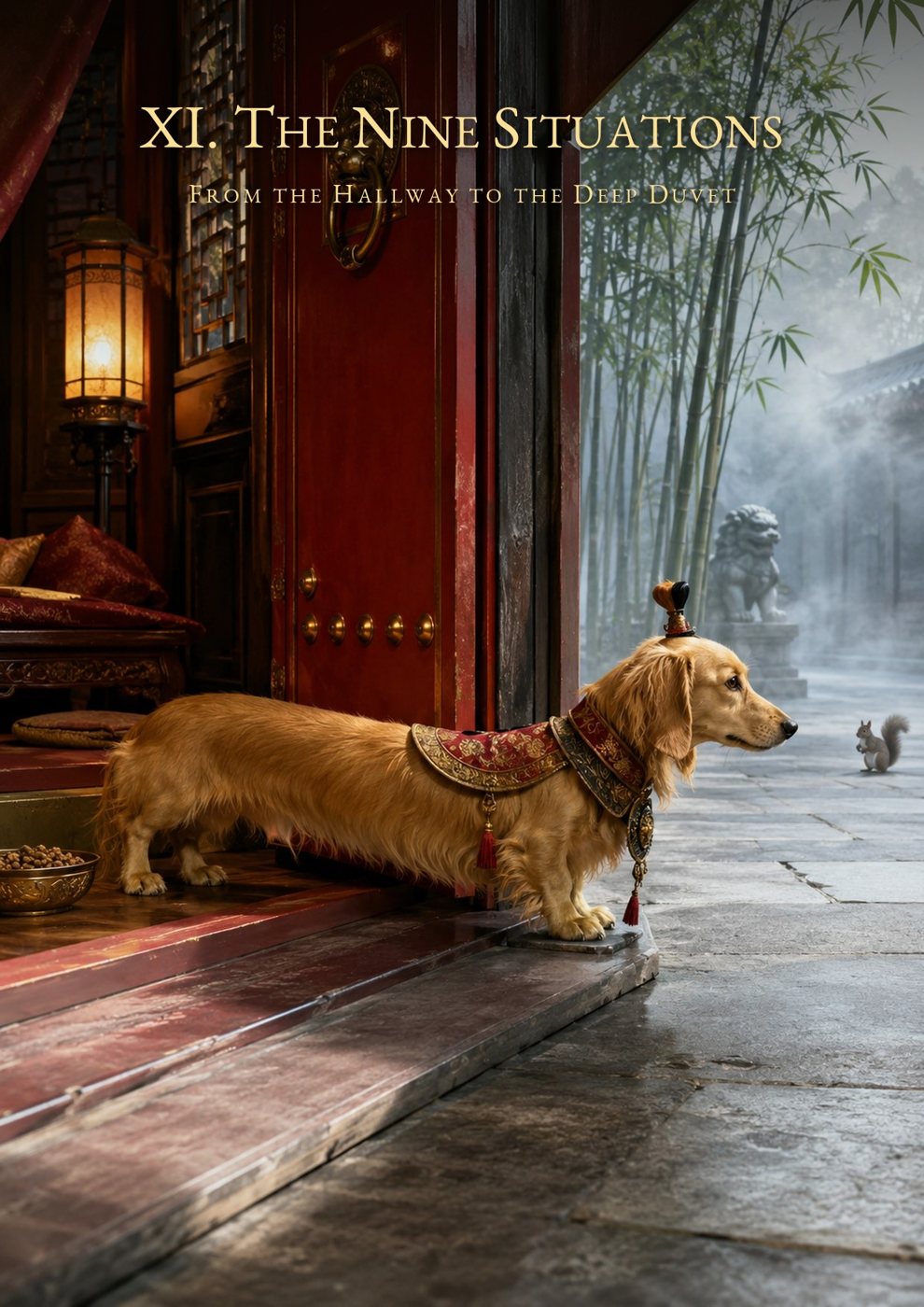
CHAPTER XI
THE NINE SITUATIONS
FROM THE HALLWAY TO THE DEEP DUVET
1. Sun Tzu said: The art of war recognises nine varieties of ground: dispersive ground; facile ground; contentious ground; open ground; ground of intersecting highways; serious ground; difficult ground; hemmed-in ground; and desperate ground.
2. When a chieftain is fighting in his own territory, it is DISPERSIVE ground. This is the house with the Tall Ones in it. Here no dog fights seriously, for every quarrel can be adjourned into a lap.
3. When he has penetrated into hostile territory, but to no great distance, it is FACILE ground. This is the hallway, and the front mat, and the first two feet of the yard.
4. Ground the possession of which imports great advantage to either side is CONTENTIOUS ground. There is one such place in every house: the warm hollow left in the cushion by a Tall One who has stood up for a moment. Whole reigns have turned on it. It is worth more than the cushion, more than the sofa, more than the room, and it cools in ninety seconds.
5\. Ground on which each side has liberty of movement is OPEN ground. This is the yard, which is open, and which is patrolled, and in which nothing has ever been achieved.6. Ground which forms the key to three contiguous states, so that he who occupies it first has most of the Empire at his command, is a ground of INTERSECTING HIGHWAYS. This is the kitchen doorway. He who lies across it in the evening commands the kitchen, the hall, and the sitting room, and is stepped over by everyone, and is fed by two of them for being in the way.
7. When an army has penetrated into the heart of a hostile country, leaving a number of fortified cities in its rear, it is SERIOUS ground. This is the deep interior of the duvet, four feet from the nearest air, from which no retreat is practicable and into which provisions must be brought by others.
8. Mountain forests, rugged steeps, marshes and fens: all country that is hard to traverse, this is DIFFICULT ground. This is the bath mat when wet, the tiled floor when newly washed, the stair carpet that was taken up, and the snow that is deeper than the general.
9. Ground which is reached through narrow gorges, and from which we can only retire by tortuous paths, so that a small number of the enemy would suffice to crush a large body of our men, this is HEMMED-IN ground. Nothing further need be said of the crate, except that generals have been made in it, and unmade.
10. Ground on which we can only be saved from destruction by fighting without delay is DESPERATE ground. This is the steel table in the cold bright room that smells of other dogs’ fear, and here the Master permits everything: the scream that is not a scream of pain, the sudden strength of a body four times the size of your own, and the reproachful silence for two days afterwards, which must be maintained without a single lapse, and which will yield chicken.
11. On dispersive ground, therefore, fight not. On facile ground, halt not. On contentious ground, attack not; but occupy it before the enemy returns. On open ground, do not try to block the enemy’s way. On the ground of intersecting highways, join hands with your allies. On serious ground, gather in plunder. In difficult ground, keep steadily on the march. On hemmed-in ground, resort to stratagem. On desperate ground, fight.
12. Those who were called skillful leaders of old knew how to drive a wedge between the enemy’s front and rear; to prevent co-operation between his large and small divisions; to hinder the good troops from rescuing the bad, the officers from rallying their men.
13. When the enemy’s men were scattered, they prevented them from concentrating; even when their forces were united, they managed to keep them in disorder. This is done by lying down in a doorway.
14. Rapidity is the essence of war: take advantage of the enemy’s unreadiness, make your way by unexpected routes, and attack unguarded spots.
15. The following are the principles to be observed by an invading force: the further you penetrate into a country, the greater will be the solidarity of your troops, and thus the defenders will not prevail against you. The dog who is already on the bed at midnight is not put off the bed at midnight. The dog who arrives at midnight is put off the bed.
16\. Make forays in fertile country in order to supply your army with food.17. Carefully study the well-being of your men, and do not overtax them. Concentrate your energy and hoard your strength. Keep your army continually on the move, and devise unfathomable plans. This last is easy for us and is done without effort. No Tall One has ever fathomed why we do anything.
18. Throw your soldiers into positions whence there is no escape, and they will prefer death to flight. If they will face death, there is nothing they may not achieve. Officers and men alike will put forth their uttermost strength.
19. Soldiers when in desperate straits lose the sense of fear. If there is no place of refuge, they will stand firm. If they are in hostile country, they will show a stubborn front. If there is no help for it, they will fight hard.
20. Thus, without waiting to be marshalled, the soldiers will be constantly on the qui vive; without waiting to be asked, they will do your will; without restrictions, they will be faithful; without giving orders, they can be trusted.
21. The skillful tactician may be likened to the shuai-jan. Now the shuai-jan is a snake that is found in the Ch’ang mountains. Strike at its head, and you will be attacked by its tail; strike at its tail, and you will be attacked by its head; strike at its middle, and you will be attacked by head and tail both.
22. Asked whether an army can be made to imitate the shuai-jan, the Master answered: It can. Our people are the shuai-jan, and have been from the beginning, and this is why we were made long.
23. Strike at the head and the tail arrives. Strike at the tail and the head arrives. Strike at the middle and both arrive together, slowly, from an unexpected direction, and very much louder than the size of the animal would lead you to expect.
24\. The principle on which to manage an army is to set up one standard of courage which all must reach.25. How to make the best of both strong and weak: that is a question involving the proper use of ground. Thus the skillful general conducts his army just as though he were leading a single man by the hand.
26. It is the business of a general to be quiet and thus ensure secrecy; upright and just, and thus maintain order.
27. He must be able to mystify his officers and men by false reports and appearances, and thus keep them in total ignorance. This is achieved daily, and without intention, by going to the window and barking at nothing whatever.
28. At the critical moment, the leader of an army acts like one who has climbed up a height and then kicks away the ladder behind him.
29. To muster his host and bring it into danger: this may be termed the business of the general. The different measures suited to the nine varieties of ground; the expediency of aggressive or defensive tactics; and the fundamental laws of human nature: these are things that must most certainly be studied.
30. We cannot enter into alliance with neighbouring princes until we are acquainted with their designs. We are not fit to lead an army on the march unless we are familiar with the face of the country. We shall be unable to turn natural advantages to account unless we make use of local guides.
31. Place your army in deadly peril, and it will survive; plunge it into desperate straits, and it will come off in safety.
32. For it is precisely when a force has fallen into harm’s way that it is capable of striking a blow for victory.
33. Success in warfare is gained by carefully accommodating ourselves to the enemy’s purpose. Learn what he intends, and intend it first, and louder, and appear to have wanted it always.
34. On the day that you take up your command, block the frontier passes, destroy the official tallies, and stop the passage of all emissaries. This is done by lying against the front door.
35. Be stern in the council-chamber, so that you may control the situation. If the enemy leaves a door open, you must rush in.
36. Forestall your opponent by seizing what he holds dear, and subtly contrive to time his arrival on the ground.
37. Walk in the path defined by rule, and accommodate yourself to the enemy until you can fight a decisive battle.
38. At first, then, exhibit the coyness of a maiden, until the enemy gives you an opening; afterwards emulate the rapidity of a running hare, and it will be too late for the enemy to oppose you. This is the entire method of the sandwich, and it is the last practical instruction the Master gives.
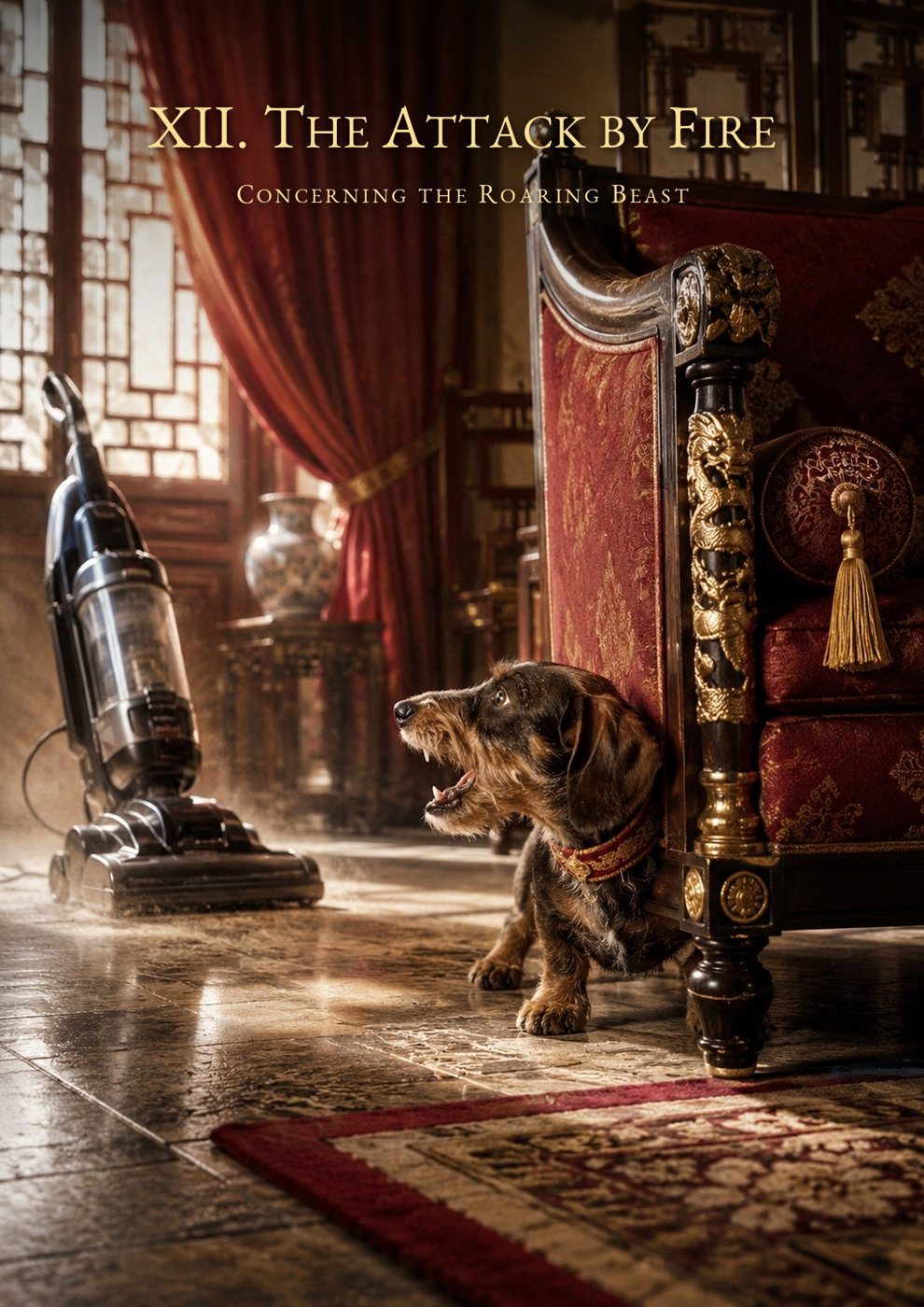
CHAPTER XII
THE ATTACK BY FIRE
CONCERNING THE ROARING BEAST
1. Sun Tzu said: There are five ways of attacking with fire. The first is to burn soldiers in their camp; the second is to burn stores; the third is to burn baggage trains; the fourth is to burn arsenals and magazines; the fifth is to hurl dropping fire amongst the enemy.
2. In our own age the Tall Ones possess one weapon only of this order, and it is sufficient. It is kept in the closet under the stair. It roars. It advances at walking pace and cannot be stopped, reasoned with, frightened, or bitten to any effect.
3. The Master does not call it fire. He calls it the Roaring Beast, and treats it under the head of fire because it consumes, and because what it consumes does not come back.
4. There are five occasions on which the Beast may be attacked, and the general must know them all:
5. THE FIRST is when it is dragged from the closet. Here it is asleep, and the attack is safe, and is therefore worthless.
6. THE SECOND is when the cord is unwound. Here the whole army should already be upstairs. The general who is still deliberating at the unwinding of the cord has failed at the level of intelligence, not of courage.
7. THE THIRD is when it first cries out. This is the moment at which every dog of our people has, at least once, charged. The Master does not forbid it. He merely records that it has never worked.
8. THE FOURTH is when it turns in a corner and pauses. Here the Beast is briefly still, and the young dog believes it has been defeated by his barking. It has not been defeated. It is being carried.
9. THE FIFTH is when it is silent and the Tall One coils the cord. This is the only true opportunity, and the correct action is not attack but inspection: walk the swept ground at once, before the crumbs of the corners have been forgotten, and learn what has been taken from you.
10\. In order to carry out an attack with fire, we must have means available; the material for raising fire should always be kept in readiness.11. There is a proper season for making attacks with fire, and special days for starting a conflagration. The season is the day upon which the Tall Ones speak of guests. The special days are those on which the sun comes low through the window and shows what has been on the floor all along.
12. In attacking with fire, one should be prepared to meet five possible developments. When fire breaks out inside the enemy’s camp, respond at once with an attack from without. If there is an outbreak of fire, but the enemy’s soldiers remain quiet, bide your time and do not attack.
13. When the force of the flames has reached its height, follow it up with an attack, if that is practicable; if not, stay where you are.
14. If it is possible to make an assault with fire from without, do not wait for it to break out within, but deliver your attack at a favourable moment.
15. When you start a fire, be to windward of it. Do not attack from the leeward. This is the doctrine of the shed hair, which travels always toward the Tall One, and which is the only weapon our people possess that the Beast cannot answer, and which we deploy continuously, without effort, for our whole lives.
16\. A wind that rises in the daytime lasts long, but a night breeze soon falls.17. In every army, the five developments connected with fire must be known, the movements of the stars calculated, and a watch kept for the proper days.
18. Hence those who use fire as an aid to the attack show intelligence; those who use water as an aid to the attack gain an accession of strength.
19. By means of water, an enemy may be intercepted, but not robbed of all his belongings. Here the Master speaks of the Bath, which is the enemy’s water-weapon, and which intercepts but does not consume; from which we emerge diminished, and shaken, and half our former size, but entire, and which is therefore not to be classed with the Beast.
20. Unhappy is the fate of one who tries to win his battles and succeed in his attacks without cultivating the spirit of enterprise; for the result is waste of time and general stagnation.
21. Hence the saying: The enlightened ruler lays his plans well ahead; the good general cultivates his resources.
22. Move not unless you see an advantage; use not your troops unless there is something to be gained; fight not unless the position is critical.
23. No ruler should put troops into the field merely to gratify his own spleen; no general should fight a battle simply out of pique.
24. If it is to your advantage, make a forward move; if not, stay where you are.
25. Anger may in time change to gladness; vexation may be succeeded by content.
26. But a kingdom that has once been destroyed can never come again into being; nor can the dead ever be brought back to life. The Tall One who was angry in the morning will feed you in the evening; the door that was shut will open; the coat you were made to wear will come off. But the crumb that the Beast has taken does not return, not in this life, and not from that corner, and not ever.
27. Hence the enlightened ruler is heedful, and the good general full of caution. This is the way to keep a country at peace and an army intact.
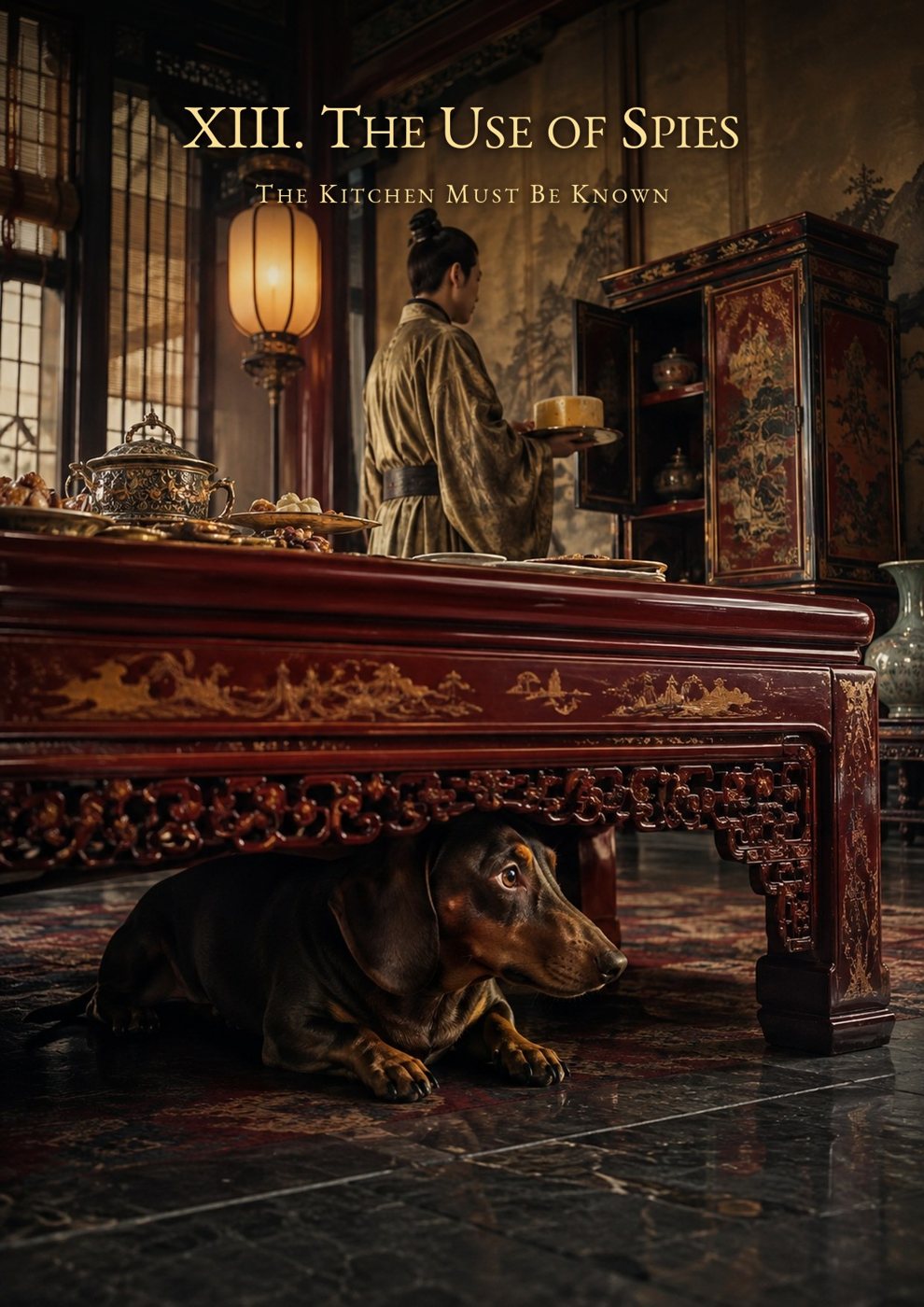
CHAPTER XIII
THE USE OF SPIES
THE KITCHEN MUST BE KNOWN
1. Sun Tzu said: Raising a host of a hundred thousand men and marching them great distances entails heavy loss on the people and a drain on the resources of the State. The daily expenditure will amount to a great sum. There will be commotion at home and abroad, and men will drop down exhausted on the highways.
2. Hostile armies may face each other for years, striving for the victory which is decided in a single day. This being so, to remain in ignorance of the enemy’s condition simply because one grudges the outlay of a hundred licks in honours and emoluments is the height of inhumanity.
3. One who acts thus is no leader of men, no present help to his sovereign, no master of victory.
4. Thus, what enables the wise sovereign and the good general to strike and conquer, and achieve things beyond the reach of ordinary men, is FOREKNOWLEDGE.
5. Now this foreknowledge cannot be elicited from spirits; it cannot be obtained inductively from experience, nor by any deductive calculation.
6. Knowledge of the enemy’s dispositions can only be obtained from other men. In our own case it is obtained chiefly from the small Tall One, who cannot keep a secret, and who will tell you what is in the oven by standing in front of it and saying nothing in a particular way.
7. Hence the use of spies, of whom there are five classes: local spies; inward spies; converted spies; doomed spies; and surviving spies.
8. When these five kinds of spy are all at work, none can discover the secret system. This is called divine manipulation of the threads. It is the sovereign’s most precious faculty.
9. Having LOCAL SPIES means employing the services of the inhabitants of a district. Ours is the cat, who goes upon the counter, where we have never been and shall never be, and who reports nothing, and whose reports are therefore read from her posture, and from the direction of her interest, and from what she knocks down.
10\. Having INWARD SPIES, making use of officials of the enemy. This is the small Tall One at the table, who is himself the subject of a policy, who does not wish to eat what is on his plate, and who has discovered that a dog beneath the table is a means of complying. He is not recruited. He recruits himself, in the first week, and he is the most valuable asset our people have ever held.11. Having CONVERTED SPIES, getting hold of the enemy’s spies and using them for our own purposes. This is the guest. The guest does not know the household rule. The guest believes that the rule is what you tell him it is with your eyes. The guest must be worked in the first ten minutes, before he is instructed by the others, and after supper he is worthless.
12\. Having DOOMED SPIES, doing certain things openly for purposes of deception, and allowing our spies to know of them and report them to the enemy. This is the other dog, who is sent to the window at the sound of nothing, who barks with his whole soul, who is scolded for it, and who has thereby emptied the kitchen for eleven seconds. He is not told the plan. He must not be told the plan. He would be no good at it if he knew. 13\. SURVIVING SPIES, finally, are those who bring back news from the enemy's camp. This is yourself: sent under the table, into the dark, among the feet, to return with what is on the plates, in what quantity, and in whose hands.14. Hence it is that with none in the whole army are more intimate relations to be maintained than with spies. None should be more liberally rewarded. In no other business should greater secrecy be preserved.
15. Spies cannot be usefully employed without a certain intuitive sagacity.
16. They cannot be properly managed without benevolence and straightforwardness.
17. Without subtle ingenuity of mind, one cannot make certain of the truth of their reports.
18. Be subtle! be subtle! and use your spies for every kind of business.
19. If a secret piece of news is divulged by a spy before the time is ripe, he must be put to death together with the man to whom the secret was told. In our practice this means only that the dog who goes to the kitchen too early ruins it for both, and is remembered, and is watched at the next meal, and the watching costs the whole army more than the theft was worth.
20. Whether the object be to crush an army, to storm a city, or to assassinate an individual, it is always necessary to begin by finding out the names of the attendants, the aides-de-camp, the door-keepers and sentries of the general in command. Our spies must be commissioned to ascertain these. In the household this reduces to a single question, and the general who can answer it correctly need not read this book at all:
21. Who is cooking?
22. The enemy’s spies who have come to spy on us must be sought out, tempted with bribes, led away and comfortably housed. Thus they will become converted spies and available for our service. The dog of the neighbours, who arrives at the fence with intelligence, is to be met with civility, and never with barking, for barking closes the border and the border is a road.
23. It is owing to his information that we can acquire and employ local spies.
24. It is owing to his information, again, that we can cause the doomed spy to carry false tidings to the enemy.
25. Lastly, it is by his information that the surviving spy can be used on appointed occasions.
26. The end and aim of spying in all its five varieties is knowledge of the enemy; and this knowledge can only be derived, in the first instance, from the converted spy. Hence it is essential that the converted spy be treated with the utmost liberality. Give the guest your whole attention. Lie upon his feet. Look at no one else in the room. It costs nothing and it has paid for centuries.
27. Of old, the rise of the Yin dynasty was due to I Chih, who had served under the Hsia. Likewise, the rise of the Chou dynasty was due to Lu Ya, who had served under the Yin.
28. Hence it is only the enlightened ruler and the wise general who will use the highest intelligence of the army for purposes of spying, and thereby they achieve great results. Spies are a most important element in war, because on them depends an army’s ability to move.
29. And so the treatise ends where it began, beneath the table, in the dark, among the feet, listening. This is the whole of the art. Everything else in this book is the arrangement of what is heard there.
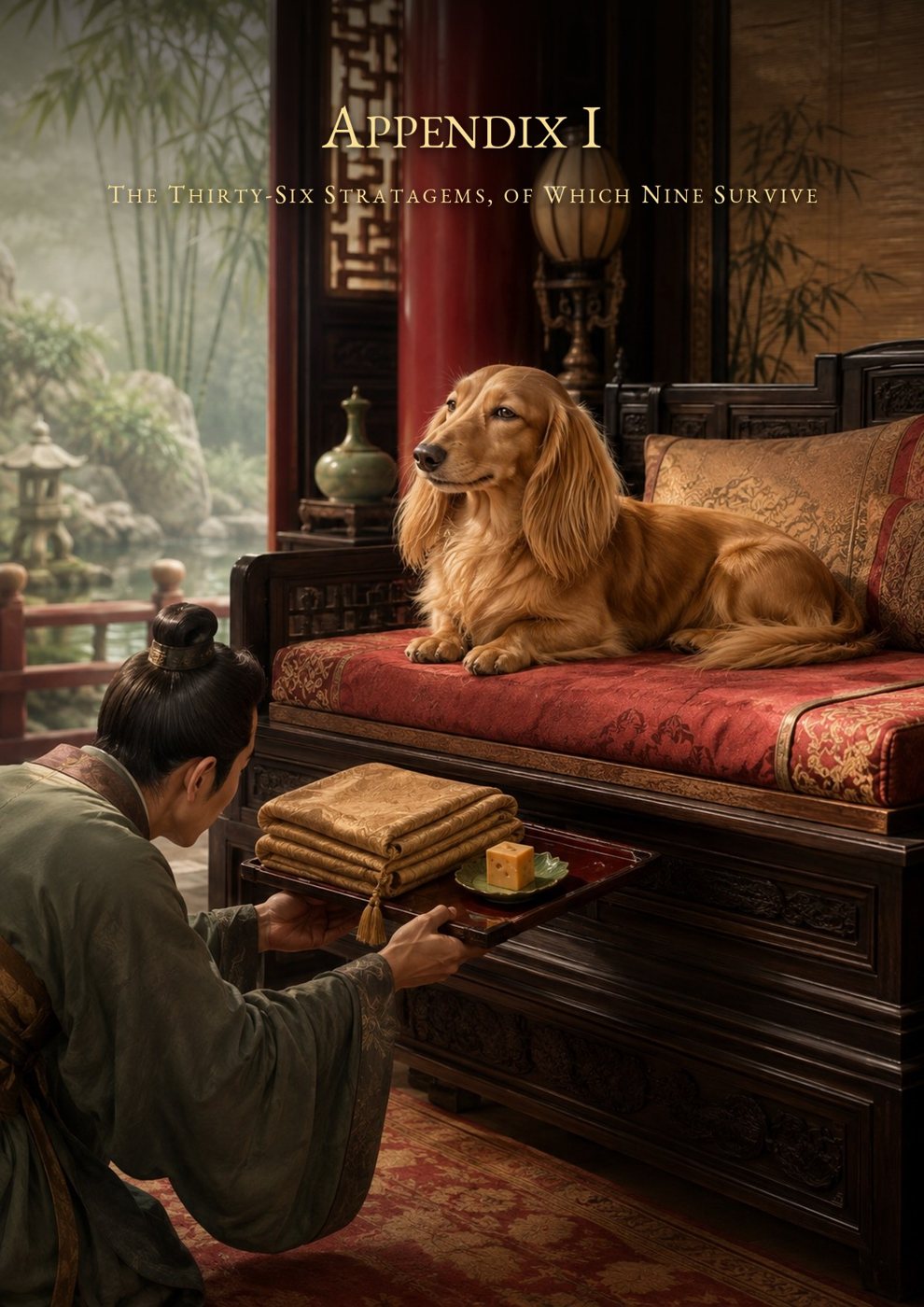
APPENDIX I
THE THIRTY-SIX STRATAGEMS, OF WHICH NINE SURVIVE
The larger collection is lost. What follows is the traditional short list, preserved by copyists, in the order in which it is customarily taught to the young.
THE FIRST. Cross the sea by deceiving the heavens. Walk past the food with your head turned away. The turning of the head is the whole stratagem. It costs one movement and it buys the second pass.
THE SECOND. Besiege Wei to rescue Chao. When the Tall One has the thing you want, do not approach the thing. Approach the door, and ask to go out, and be refused, and be pitied, and be compensated.
THE THIRD. Kill with a borrowed knife. Position yourself so that the child is between you and the plate. What follows is not attributable to you.
THE FOURTH. Watch the fire across the river. When something has been broken and no one yet knows by whom, do nothing at all. Do not approach it. Do not avoid it. Above all, do not look at it. The cat lives in this house too.
THE FIFTH. Make a sound in the east, then strike in the west. Bark once at the window. This has never in recorded history failed to move at least one Tall One out of the kitchen.
THE SIXTH. Beat the grass to startle the snake. Sigh, loudly, at a distance, and observe which of the Tall Ones looks up. That one is the front. Fight there for the rest of your life.
THE SEVENTH. The stratagem of the empty city. When you are certain you have been caught, do not run and do not hide. Lie down where you are, in the open, and go instantly and profoundly to sleep. The Tall One will conclude that a dog with such a conscience cannot have done it. Employ once a year at most.
THE EIGHTH. The beauty trap. Roll over. There is no defence to this and there never has been. It is not listed higher only because it is thought unbecoming for a general to rely upon it.
THE NINTH. If all else fails, retreat. Under the bed, in the middle, out of reach of arms. The tenth through thirty-sixth stratagems are lost, and the ninth is why nobody went looking for them.
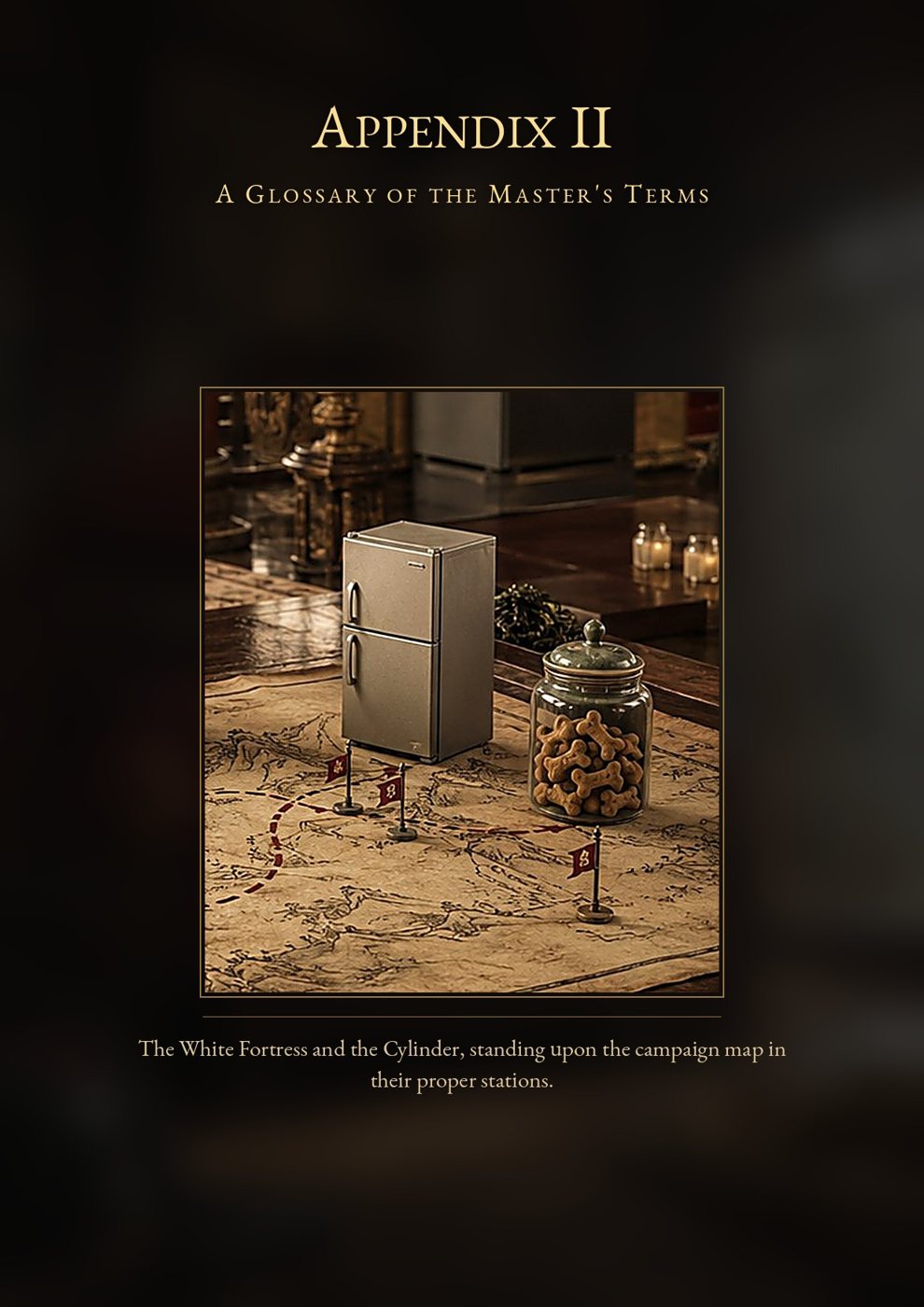
APPENDIX II
A GLOSSARY OF THE MASTER'S TERMS
THE TALL ONES — the sovereign and his court; the household; the enemy; the beloved. The Master uses one word for all four and does not appear to consider this a difficulty.
THE BOND — the first constant. Untranslatable. Something between morale, loyalty, and the reason they came back.
THE SOFA — the high ground.
THE CUSHION — the citadel.
THE WARM HOLLOW — contentious ground; ninety seconds.
THE WHITE FORTRESS — the cold cupboard in the kitchen from which all good things proceed. Fritz the Smooth held it to be the true subject of the treatise. He is not now thought to have been entirely wrong.
THE ROARING BEAST — the incendiary weapon of the Tall Ones. See Chapter XII.
THE HOUSE OF NEEDLES — the destination of the ambiguous car.
THE BATH — not discussed.
THE CYLINDER — the jar in which the biscuits are kept, and the sound of its lid, which is the most beautiful sound in the world.
CHEESE — gold; the currency of espionage; also, occasionally, cheese.
THE SMALL TALL ONE — the inward spy. See Chapter XIII, verse 10.
THE SQUIRREL — the hereditary enemy beyond the glass frontier. He is not mentioned in the treatise. The Master held that a war which has continued for nine hundred years without a single engagement is not a subject for strategy but for religion.
ABOUT DAS BUBO
BOOKS OF CONSIDERABLE LENGTH
DAS BUBO makes books that take history, art, cinema, literature, and other serious human achievements seriously enough to let dachshunds interfere with them.
The house rule is simple: the original must remain recognizable. The joke should come from the collision between the dignity of the source and the absolute certainty with which a dachshund assumes it was always about him.
We prefer dry wit to noise, detail to gimmick, and affection to ridicule. The dog is not pasted into the frame; he must behave as though the frame was built around him.
The result is a growing shelf of illustrated parodies for readers who like their culture intact, their footnotes unnecessary, and their dogs considerably longer than the argument requires.
Long in body. Long in thought.
— The Das Bubo Editorial Dachshunds
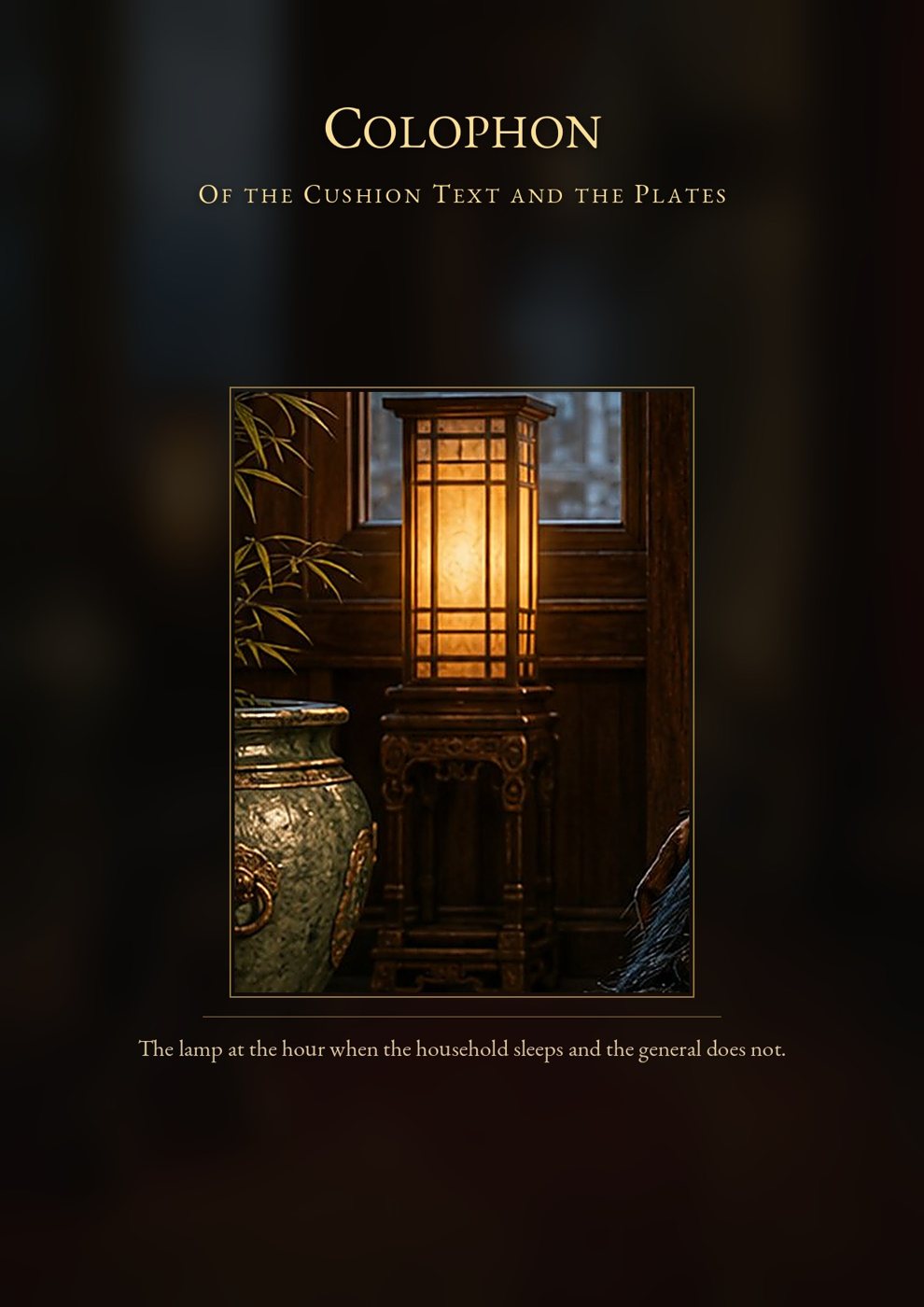
COLOPHON
This edition follows the cushion text throughout, with the exception of Chapter IX, verse 12, where the cushion text is illegible and the reading of the wire-coat tradition has been adopted.
The plates are contemporary and were commissioned by the household. The Master is not depicted. No portrait of him exists, on the grounds that at the hour when the painters came, he was under the table, working.
DAS BUBO EDITION DETAILS
DESIGN: Das Bubo Design Bureau
ILLUSTRATION: Commissioned for DAS BUBO
TYPOGRAPHY: Palatino Linotype
FORMAT: Illustrated collector’s edition
EDITORIAL SPIRIT: Eccentric, exacting, and easily amused
PUBLISHER AND CREATIVE IMPRINT: DAS BUBO
DAS BUBO · © 2026